

A hydrogen plant’s transformer architecture should separate electrolyzer conversion from process auxiliaries and functions required during startup, shutdown or abnormal operation. The main rectifier transformer is only one part of the electrical system. A plant-wide megawatt total can conceal different voltage, waveform, continuity and operating-sequence requirements that deserve distinct supply boundaries.
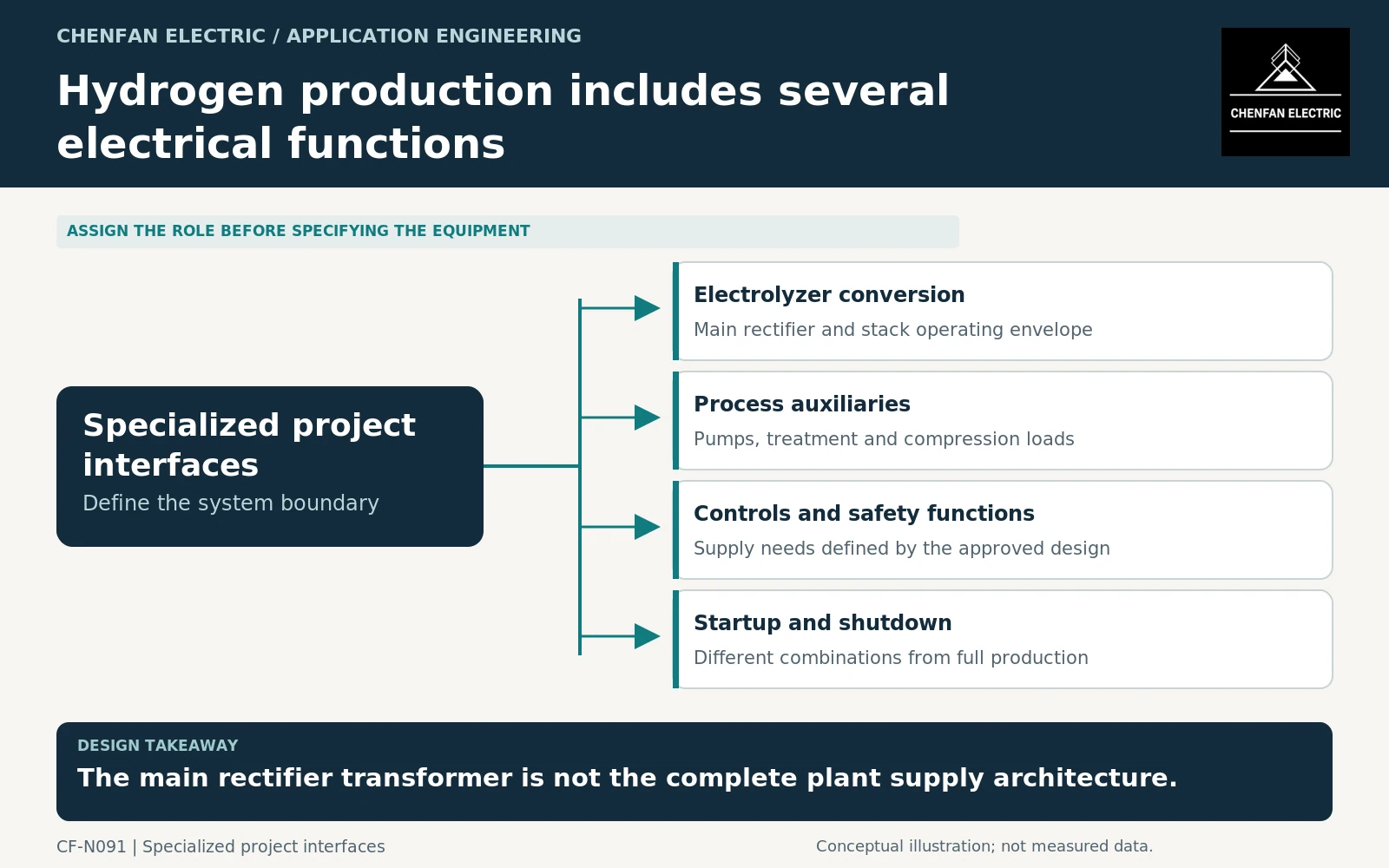
Divide the load list by electrical function
Identify the electrolyzer rectifier groups, water-treatment equipment, circulation systems, cooling, compression and other process services actually included in the project. Keep control and safety-related loads classified by the responsible process and safety design rather than assuming every auxiliary has the same continuity requirement.
Industrial converter-transformer requirements and application guidance address the main conversion interface within their scopes. They do not define the complete hydrogen plant’s auxiliary architecture. [1] [2]
The main transformer enquiry should receive converter winding data, while an auxiliary transformer enquiry should receive a conventional load schedule with starting and continuity cases. Copying the rectifier’s waveform requirements into every auxiliary supply is not automatically justified.
Follow startup and shutdown dependencies
Some process services may be needed before the electrolyzer reaches production, and some may remain required after its main power is removed. The actual process design must identify those dependencies. Do not assume that zero hydrogen production means all electrical demand can disappear.
A useful state map distinguishes cold startup, normal production, reduced production, controlled shutdown and loss of the normal source. For each state, identify the available supplies and the loads that must operate.
General transformer application guidance supports rating and connection review, but the process sequence supplies the actual combinations. [3]
Avoid circular supply assumptions. If a service is required to prepare the main conversion equipment for operation, its source must be available during that preparation state. An unexplained dependency on the not-yet-operating main system is an interface gap.
Compare shared and separate supply paths
| Load function | Architecture question |
|---|---|
| Electrolyzer rectifier | Which converter groups and operating envelopes are supported? |
| Large auxiliary drives | Is starting or converter input duty independently assessed? |
| Continuous process services | What remains available when production stops? |
| Safety-related functions | Which supply arrangement is required by the approved design? |
| Maintenance loads | Which equipment can be isolated without losing needed services? |
Shared transformers can simplify some equipment counts but create common outage and waveform boundaries. Separate supplies may improve functional separation while adding switchgear and maintenance interfaces. The choice should follow the required states, not a universal preference.
Motor-starting and sequence analysis may be needed for pumps or compressors. The actual starting devices and source conditions must be represented rather than treating auxiliaries as a fixed percentage of electrolyzer power. [4]
Purchase against the plant state map
The enquiry package should contain the complete single-line diagram, function-based load lists, converter data and startup/shutdown matrix. Each transformer schedule should state the boundary it serves and the duty used for assessment.
Acceptance should reconcile the implemented process controls with the electrical architecture. A late change in shutdown cooling or compression duty can alter auxiliary requirements without changing the main electrolyzer rating.
The useful result is not one large transformer labelled for hydrogen production. It is a coordinated set of supply paths that supports the actual process states, keeps specialized rectifier duties distinct and makes essential-service dependencies visible before procurement closes.
Core procurement checkpoint: Separate electrolyzer and auxiliary core procurement
A hydrogen plant’s rectifier transformers and auxiliary transformers should have distinct design references and core schedules. The approved geometry and steel specification must correspond to the actual equipment function rather than the plant’s headline hydrogen-production capacity. A core manufacturing quotation can address the defined drawings and inspection scope without implying delivery or qualification of the complete hydrogen electrical architecture.
For the core enquiry: Rectifier/auxiliary design schedule; approved core drawings; quantities; material specifications; delivery forms and inspection boundaries.