

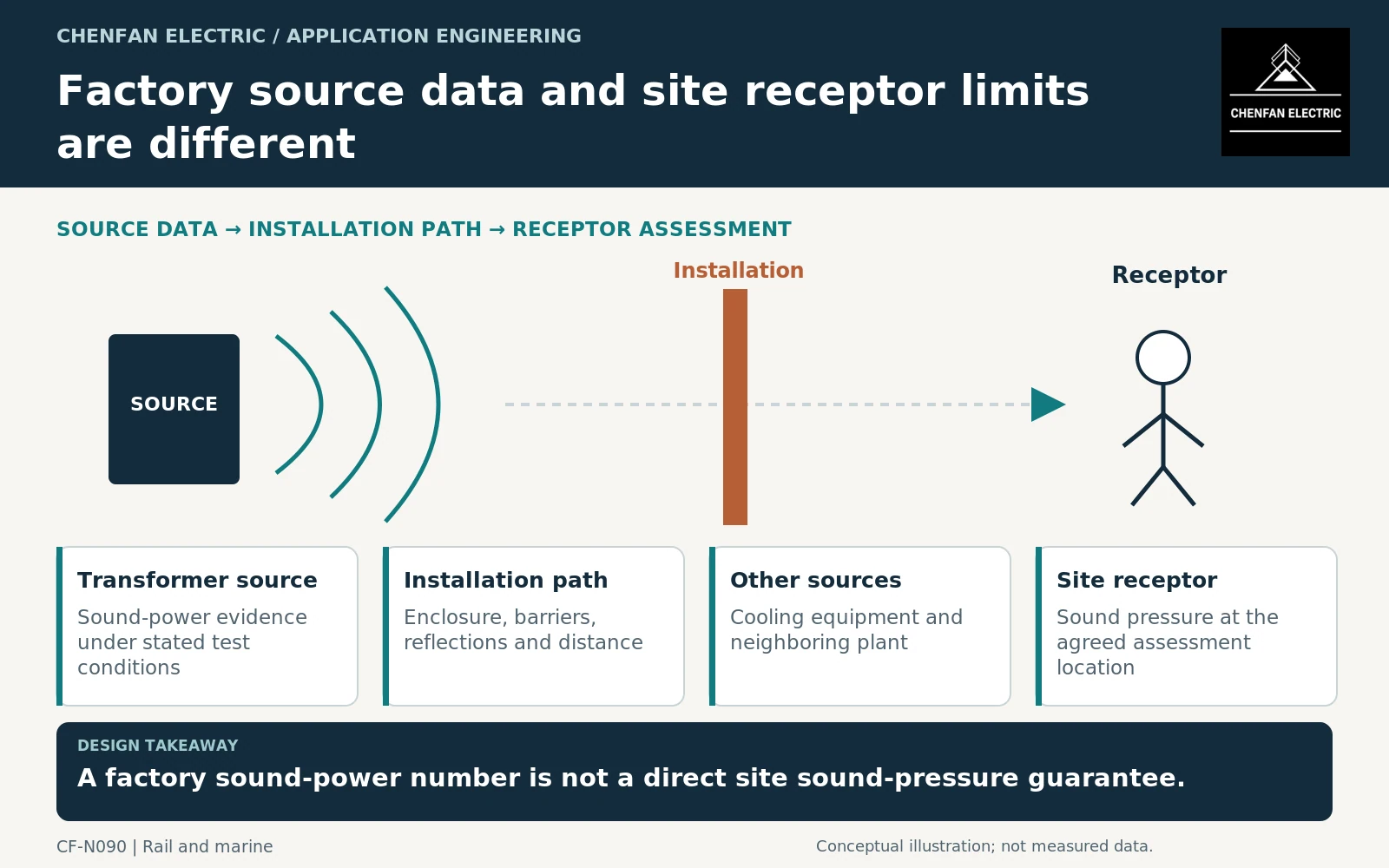
A railway transformer noise specification should distinguish equipment sound power from sound pressure at a site receptor. Factory source data are an input to the site assessment, not a direct prediction of the level at a nearby building or boundary. Installation geometry, barriers, reflections, cooling equipment and other sources influence the result.
Name the acoustic quantity and condition
IEC 60076-10 addresses transformer sound-level determination, including sound-power assessment from specified measurement methods, primarily in a factory-test context. It does not assign a universal receptor limit for every railway site. [1]
The enquiry should identify the required quantity, operating condition, cooling state and any relevant frequency information. A decibel value without those qualifiers is ambiguous. Sound power describes source emission, while sound pressure is measured at a location and depends on the acoustic environment.
Do not copy a site boundary sound-pressure requirement directly into a factory sound-power guarantee. The quantities require a defined relationship through the site model or measurement plan.
Model the installed source and propagation path
The acoustic assessment should include transformer placement, enclosures, barriers, nearby surfaces and the relevant receptor locations. Cooling equipment may contribute separately and can change with operating state.
A low equipment sound-power result does not automatically establish compliance at every receptor. Conversely, a particular site layout may attenuate sound differently from another installation of the same transformer.
As an illustrative acoustic-power calculation, doubling two equal independent source powers increases their combined sound-power level by approximately 3.01 dB. This is not a predicted site sound-pressure increase: source positions, spectra and propagation paths must still be considered.
Fixed-railway transformer requirements provide the application context, but the project’s acoustic and environmental requirements remain separate. [2]
Align factory evidence with the site study
| Evidence item | Information to retain |
|---|---|
| Factory acoustic result | Quantity, method, operating and cooling conditions |
| Frequency data | Resolution and source condition represented |
| Installation model | Geometry, barriers and relevant surface assumptions |
| Other plant sources | Included equipment and operating combinations |
| Receptor assessment | Locations, criteria and background treatment |
Where tonal or low-frequency characteristics are relevant to the project assessment, request suitable evidence rather than assuming one overall weighted number describes every concern. The applicable acceptance basis must come from the responsible acoustic design and site requirements.
Do not label an illustrative diagram or calculation as a measured noise map. Actual predictions and measurements should identify their methods, inputs and uncertainty.
Separate the two acceptance stages
The transformer supplier should demonstrate the specified equipment acoustic performance under agreed test conditions. The site team should verify the installed result at the agreed receptors using the applicable method and operating state.
If a site mitigation feature is needed, coordinate it with cooling and maintenance access. An enclosure or barrier that changes airflow can alter the transformer thermal boundary and must not be treated as an acoustics-only modification.
The useful specification links factory source evidence to an installation-specific receptor assessment. It avoids the common error of treating two different decibel quantities as interchangeable and gives both the equipment supplier and site designer a testable responsibility.
Core procurement checkpoint: Do not promise sound performance from a loss certificate
An electrical-steel loss value and an agreed bare-core test do not establish the completed transformer’s sound level at a site receptor. For a core enquiry, retain the designer’s joint pattern, assembly and clamp requirements and identify any specifically agreed acoustic-related test boundary. Sound-power acceptance of the complete equipment and environmental propagation assessment should remain separate deliverables.
For the core enquiry: Approved joint/assembly drawing; clamp boundary; material and loss-test basis; requested acoustic evidence; equipment/site assessment owner.