

Battery buffering can reduce a charging site’s short-duration grid demand, but it does not automatically justify a smaller transformer. The design must show that the buffer has enough usable energy and converter power, that it can recharge within the available schedule, and that a depleted or unavailable buffer does not create an uncontrolled transformer overload.
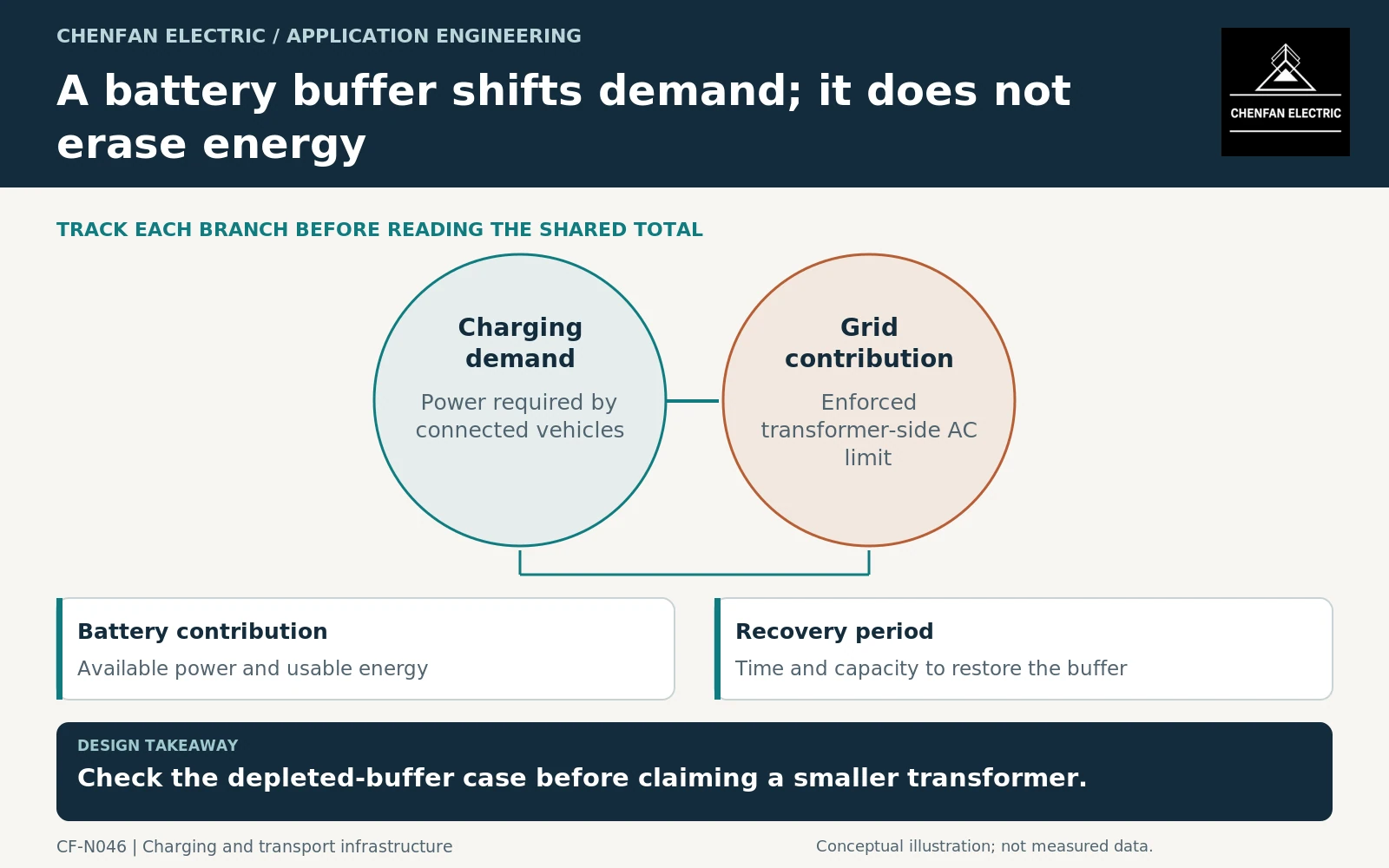
Separate the power deficit from the energy deficit
At any instant, the battery may supply the difference between charging demand and the permitted grid contribution, subject to its own converter and battery limits. Over time, that contribution consumes usable energy that must later be restored.
In an illustrative loss-free case, chargers demanding 2 MW for 30 minutes while the grid contributes 1 MW require 0.5 MWh from the buffer. Real design adds conversion losses, auxiliaries, usable-state-of-charge limits and the actual demand curve. The example is an energy-balance calculation, not a battery or transformer recommendation.
Converter-transformer application guidance helps frame the equipment interface, but it does not validate the site’s energy-management strategy. [1]
Examine the recovery window
A buffer that supports one peak must recharge before the next required peak unless enough usable energy remains. The recharge itself loads the transformer and may coincide with ongoing vehicle charging or site auxiliaries.
A daily average can conceal an impossible sequence. Several closely spaced demand peaks can exhaust the buffer even when total daily energy appears compatible with the grid connection. Use chronological arrivals, charging sessions and permitted recharge periods.
State whether the control objective is an active-power cap, apparent-power cap or current cap at a defined boundary. The transformer duty also depends on reactive power, terminal voltage and waveform.
Specify the unavailable-buffer behavior
| Buffer state | Required site response |
|---|---|
| Normal energy reserve | Permitted charging demand and grid contribution |
| Low usable energy | Reduced charger allocation or another defined restriction |
| Battery unavailable | Enforced demand within the nonbuffered supply capability |
| Power conversion system (PCS) unavailable | Defined fallback without assumed battery support |
| Controller or meter failure | Safe, documented aggregate-demand behavior |
| Recovery charging | Combined charger and buffer-recharge limit |
Do not count battery support as firm transformer relief if the site can continue unrestricted charging after the support disappears. The demand restriction must be implemented and compatible with the site’s service expectations.
Direct-current (DC) charger requirements remain equipment-specific. IEC 61851-23 does not establish the buffer’s availability or the charging site’s aggregate energy-management behavior. [2]
Compare the complete duty and service outcome
The transformer assessment should include peak support periods, recharge, standby and the unavailable-buffer case. Use an appropriate loading framework with the actual ambient and cooling assumptions. [3]
The commercial comparison should also state the charging service retained when the battery is depleted. A smaller transformer may be technically acceptable because chargers are curtailed, but that is a service limitation that should not be hidden inside a capacity-saving claim.
Require a chronological energy balance, converter capability data, control-state matrix and transformer current schedule. Verify that the installed controller enforces the same boundaries used in the design.
Battery buffering justifies a reduced transformer duty only when the reduction remains true across the agreed operating states. The battery shifts when energy crosses the grid boundary; it does not remove the need to supply that energy or define what happens when the buffer cannot contribute.
Core procurement checkpoint: Freeze the transformer design for storage-unavailable operation
A battery buffer can change the plant’s import profile, but the core supplier should receive the transformer design approved for the actual operating restrictions, including relevant unavailable-storage cases. Do not use a favorable energy balance as the sole basis for reducing core dimensions. Any revised geometry should be released by the transformer manufacturer together with its winding and thermal assessment.
For the core enquiry: Approved operating restrictions; released core drawing; variant and quantity; material specification; responsibility for control-limit enforcement.