

A bus depot’s transformer should be assessed against the full daily charging cycle, including the interval between overnight sessions. Charger count alone cannot show sustained current, thermal recovery or the consequences of late arrivals. The specification should connect fleet schedules, charging controls and site auxiliary demand to a chronological transformer duty.
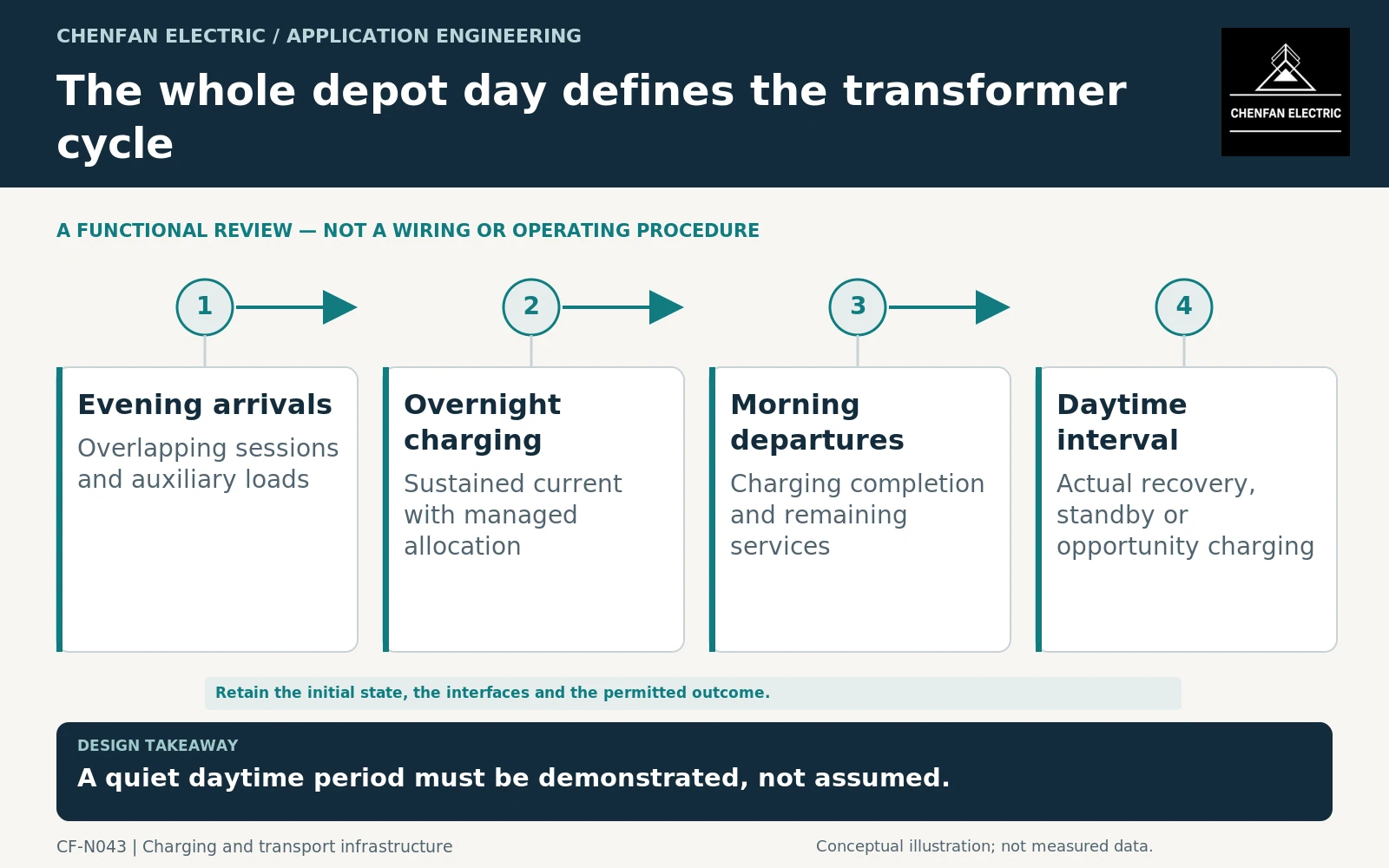
Map the depot’s real operating day
Record when buses return, the energy required for the next route and the latest acceptable departure time. Include vehicles returning late, maintenance movements and any daytime opportunity charging. A depot with an apparently quiet day may still operate workshops, heating, ventilation and air conditioning (HVAC) and other loads from the same transformer.
The charger’s direct current (DC) output capability is not the transformer input current. Obtain alternating current (AC)-side data and identify which station loads are included in the demand-control boundary. IEC 61851-23 addresses DC charging equipment, not the depot’s aggregate duty schedule. [1]
Keep measured fleet records separate from planning assumptions. A timetable is evidence of intended operation; it is not automatically a measured charging profile.
Preserve the current sequence for thermal assessment
Heating assessment needs the magnitude and duration of current together with initial temperature, ambient conditions and cooling availability. A night of sustained high current differs from short separated sessions, even if both deliver similar energy.
As a limited illustrative comparison, two hours at 1.0 per-unit current and eight hours at 0.5 per-unit current each produce 2 per-unit-squared hours when only I² × time is summed. That equality is not a complete thermal equivalence: temperatures, losses, cooling and chronology differ. The example shows why a simple energy or I² total cannot replace the appropriate model.
Mineral-oil and dry-type loading guides address their respective equipment classes. Use the relevant framework and retain the chronological duty. [2] [3]
Test the operational exceptions
| Depot condition | Required review |
|---|---|
| Late fleet return | Compressed charging window and higher overlap |
| Charger outage | Redistribution to remaining chargers |
| Demand controller restart | Permitted fallback and recovery behavior |
| Daytime opportunity charging | Reduced thermal recovery interval |
| Cold or hot weather | Changed auxiliary demand and cooling conditions |
A managed schedule can reduce peaks, but only if it still delivers the required vehicle energy before departure. Document both the electrical cap and the transport-service requirement.
Do not use the day’s lowest ambient temperature as the only cooling input. The local transformer enclosure and the temperature at the start of the charging period can differ from the overnight weather minimum.
Issue a repeatable duty specification
The enquiry should include the daily schedule, seasonal variants, charger AC input data, auxiliary loads and enforced controller limits. Ask the supplier to identify the governing thermal case and any restriction on repeated cycles.
General transformer application guidance supports the equipment review, while the fleet operator owns the schedule and the integrator owns the charging-control behavior. [4] Those responsibilities should remain separate and coordinated.
Acceptance should confirm that the implemented charging policy matches the duty used for transformer assessment. Adding daytime charging or changing route turnaround times should trigger review when it removes an assumed recovery interval.
The purchasing objective is not the smallest transformer that supports an average night. It is a defined electrical supply that supports the depot’s credible daily cycle, including the operational variations that the bus service cannot avoid.
Core procurement checkpoint: Keep overnight duty and core-loss comparisons consistent
A depot’s charging timetable informs the transformer’s thermal assessment, while its energized schedule helps define the basis for comparing excitation losses. Preserve that distinction in purchasing documents. For a core-only comparison, use the same test frequency, flux density and assembly state, and do not treat equal current-squared-hours as proof that alternative complete transformers have identical temperature or ageing behavior.
For the core enquiry: Energized-hour assumptions; designer-approved core; comparable core-loss test conditions; material specification; thermal assessment owner.