

A full-load charger harmonic figure does not describe every operating point in a charging hub. Vehicles often request changing power during a session, and several chargers may operate at different levels. The transformer enquiry should request absolute harmonic currents and the associated operating conditions, rather than using full-load total harmonic distortion as the sole design input.
Understand why the percentage can mislead
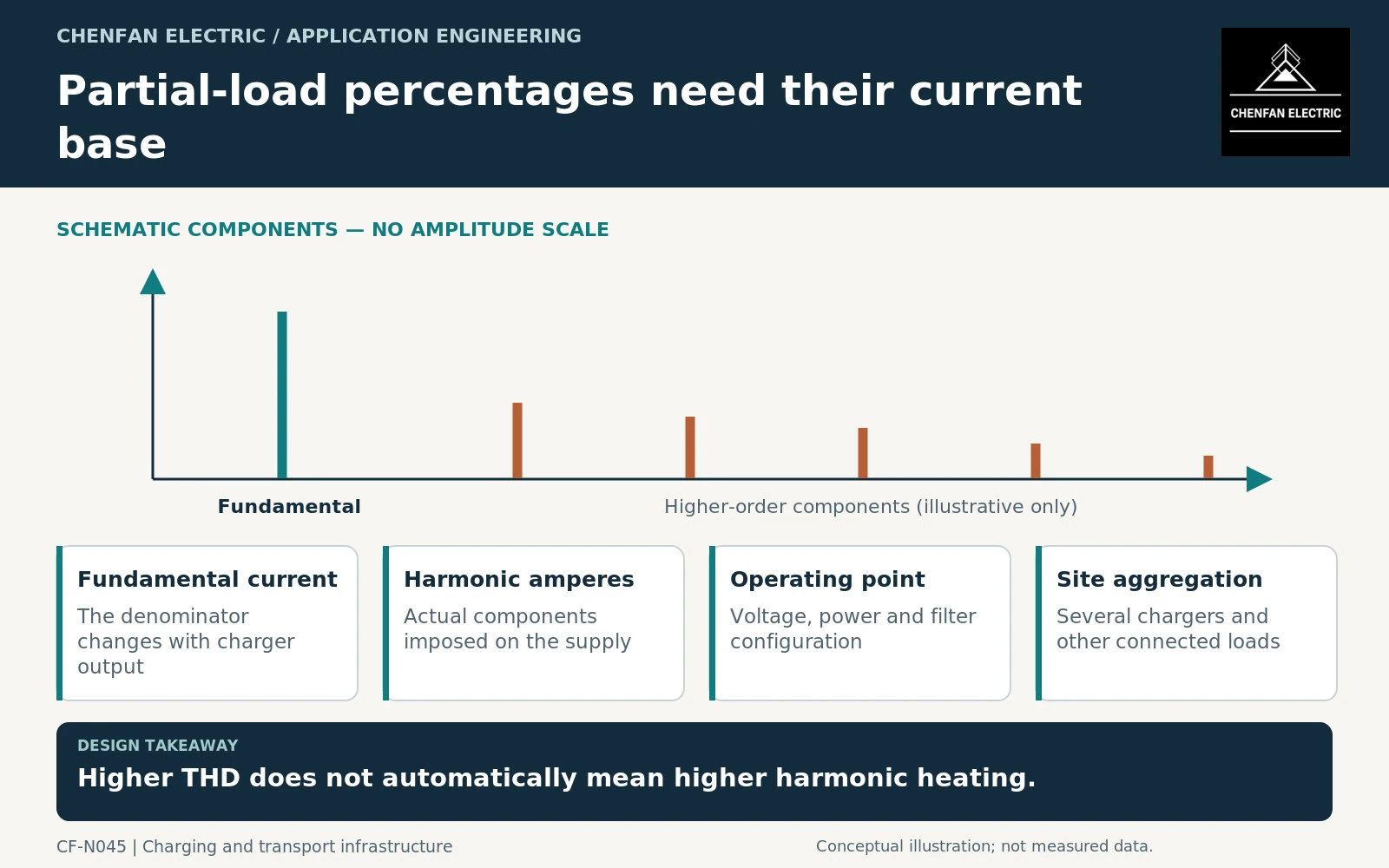
Current total harmonic distortion normally expresses harmonic root-sum-square current relative to fundamental current. When fundamental current falls, the percentage can rise even if the harmonic amperes remain unchanged or decrease. The transformer responds to imposed current components, not to a percentage detached from its denominator.
For an illustrative comparison, 10 A of root-sum-square harmonic current with a 100 A fundamental gives 10% current total harmonic distortion (THD). The same 10 A with a 50 A fundamental gives 20%. This arithmetic does not describe a particular charger; it demonstrates why the absolute current must accompany the percentage.
ABB’s harmonic guidance explains the broader effects of nonlinear loads. IEEE C57.110 provides a transformer-loading framework for defined nonsinusoidal-current applications, subject to its scope and exclusions. [1] [2]
Request spectra across the useful operating range
Ask for representative high, medium and low output conditions, plus relevant reactive or standby states. The exact points should follow the charger’s capability and the site’s operating profile rather than an arbitrary universal test list.
Record alternating current (AC) voltage, fundamental current, harmonic order coverage, filter configuration and evidence status. A spectrum measured under one supply condition or optional filter should not be treated as a guarantee for a different installed arrangement.
| Data field | Why it matters |
|---|---|
| Harmonic amperes by order | Supports the actual current-duty assessment |
| Fundamental current | Defines the percentage base |
| AC input voltage | Establishes the operating condition |
| Charger output and mode | Links the spectrum to a charging state |
| Duration or occurrence | Separates sustained duty from a rare state |
| Evidence type | Distinguishes measured, simulated and guaranteed data |
Aggregate the site without assuming perfect cancellation
Several chargers can have different phase relationships and operating points. Their currents interact with the site network and other nonlinear loads. Multiplying a single spectrum by charger count is an assumption; assuming favorable cancellation is another assumption.
The transformer designer needs an agreed winding-current duty. The power-quality analyst needs the network model and connection-point requirements. A result at the utility interface does not automatically describe each internal branch.
IEC 61851-23 addresses direct current (DC) supply equipment, but it does not determine the harmonic aggregation of a particular site’s chargers, cables and transformers. [3]
Convert missing data into a visible procurement condition
When detailed partial-load spectra are unavailable, identify the provisional assumption and the evidence required to close it. Do not manufacture a fixed transformer derating percentage from a full-load brochure value.
Require the charger supplier to state which operating points are covered by its guarantee and the transformer supplier to identify the current envelope used in its assessment. Keep later changes to charger models, filters and control settings under review when they alter that envelope.
The practical outcome is a mode-specific current schedule with traceable evidence. It avoids both overreacting to a large light-load THD percentage and overlooking substantial harmonic amperes at a heavily loaded operating point.
Core procurement checkpoint: Do not substitute current THD for a core test condition
Partial-load current distortion must be evaluated with its absolute spectrum and the transformer’s duty. For a core enquiry, separately specify the voltage waveform and excitation conditions selected by the designer. Comparing two steel grades at different frequencies or flux densities can obscure the purchasing decision. Retain material data as material data unless a defined assembled-core test has also been agreed.
For the core enquiry: Current-spectrum reference for the equipment designer; voltage-waveform basis; grade/thickness; common core-loss test conditions and boundary.