

Battery energy sufficient to run an island does not automatically prove that the battery system can energize its transformer. Black start includes a short-duration electromagnetic problem as well as a longer-duration energy problem. The review must establish how the power conversion system supplies magnetizing demand within its current and control limits, starting from the actual transformer and network conditions.
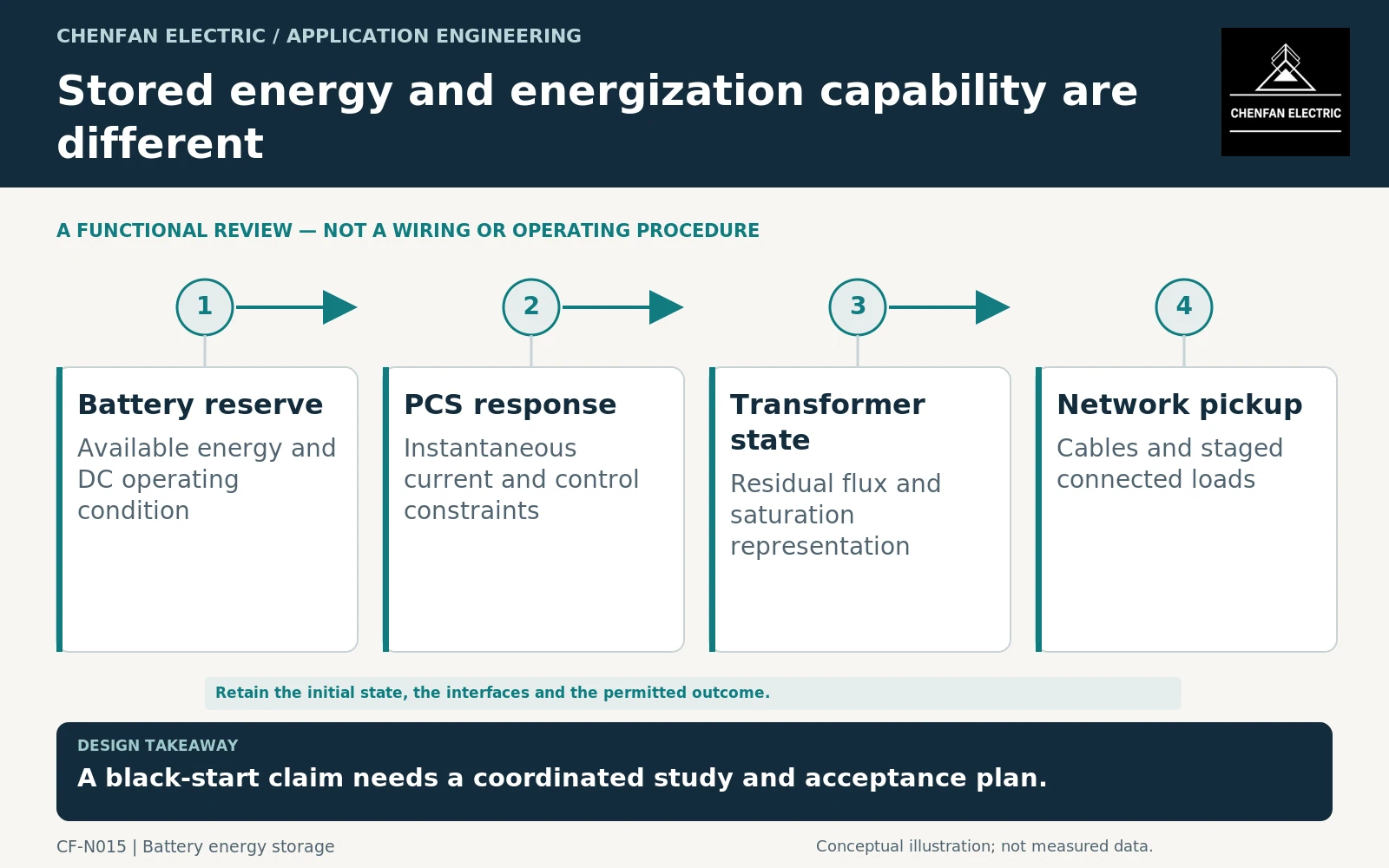
Separate energy reserve from instantaneous capability
Stored megawatt-hours describe an energy resource. Transformer energization can challenge instantaneous converter current, voltage control and the direct current (DC) supply condition before substantial energy has been delivered to useful loads. Both dimensions matter, but they are not interchangeable.
The available capability may depend on battery state of charge, temperature and the permitted converter mode. Record the guaranteed operating boundary rather than assuming the nameplate discharge power is available under every black-start condition.
Grid-forming research addresses the control and system-integration challenges associated with inverter-dominated networks. It should not be read as a blanket declaration that any grid-forming converter can black-start any transformer. [1]
Represent the transformer state before energization
Relevant inputs include winding configuration, nonlinear excitation behavior, residual-flux assumptions and the switching or voltage-establishment method proposed by the system designer. The surrounding cables and connected equipment can also influence the response.
CIGRE’s transformer-energization study-guide summary identifies voltage dips and temporary overvoltages as possible system consequences. The existence of these mechanisms supports a study requirement; it does not provide a universal acceptable inrush value or a ready-made operating sequence. [2]
A recent research preprint investigates active manipulation of transformer flux trajectories during inverter-based black-start procedures. Its relevance is the explicit treatment of flux offset and converter constraints. No numerical performance claim or operating recipe from that research should be transferred to a project without validating the applicable model and hardware. [3]
Do not assume zero residual flux merely because the transformer has been disconnected for a long period. The study should state its initial-state assumptions and test their significance, rather than using a favorable default without review.
Build a coordinated case register
| Case dimension | Questions for the study team |
|---|---|
| Converter condition | Which current limit and control mode are active? |
| Transformer state | Which excitation model and residual-flux cases apply? |
| Network configuration | Which cables and auxiliary circuits are connected? |
| Initial supply condition | What DC and auxiliary resources are available? |
| Load pickup | Which subsequent load steps are permitted? |
| Unsuccessful attempt | What restrictions govern recovery and another attempt? |
The last item matters because repeated attempts can have different initial temperatures and electrical states. A study of one idealized first attempt does not automatically cover a sequence of unsuccessful starts.
Electromagnetic-transient analysis may be appropriate where waveform-level excitation and converter controls dominate. The chosen model must represent those features adequately. Software documentation describing energization-case sweeps is a workflow reference, not evidence that such a study has been completed for this project. [4]
Define evidence before accepting the claim
Ask for a traceable model-input list, a case matrix, identified acceptance criteria and a staged verification plan agreed by the responsible system parties. Distinguish simulation results, component tests and integrated-system demonstrations. None should be relabeled as another form of evidence.
The transformer supplier should identify the supplied excitation and impedance information and its limitations. The converter supplier should identify the validated control representation and guaranteed current behavior. The integrator should own the combined operating claim.
A usable black-start specification states the supported network configuration, starting conditions and permitted load sequence. It also identifies restrictions and recovery requirements. “Enough battery energy” is necessary for the intended service, but it does not settle the magnetizing-duty question that occurs at the beginning of that service.
Core procurement checkpoint: Treat black-start evidence as a system deliverable
A black-start assessment may need excitation characteristics and assumptions about the transformer’s initial magnetic state. Identify who supplies and validates those inputs before ordering the core. A material certificate or an agreed core-loss test cannot alone predict the complete energization transient. Keep the core manufacturing acceptance separate from the converter, protection and network demonstration required for the black-start sequence.
For the core enquiry: Core design revision; requested excitation-data scope; test configuration; responsibility for residual-flux assumptions and system validation.