

Residual flux after de-energization is the magnetic state left by a particular history. It is not a fixed percentage that belongs to a steel grade under every circumstance. A material’s remanence characteristic helps describe possible behavior, but the state of an assembled transformer also depends on its circuit, switching event and coupled magnetic paths.
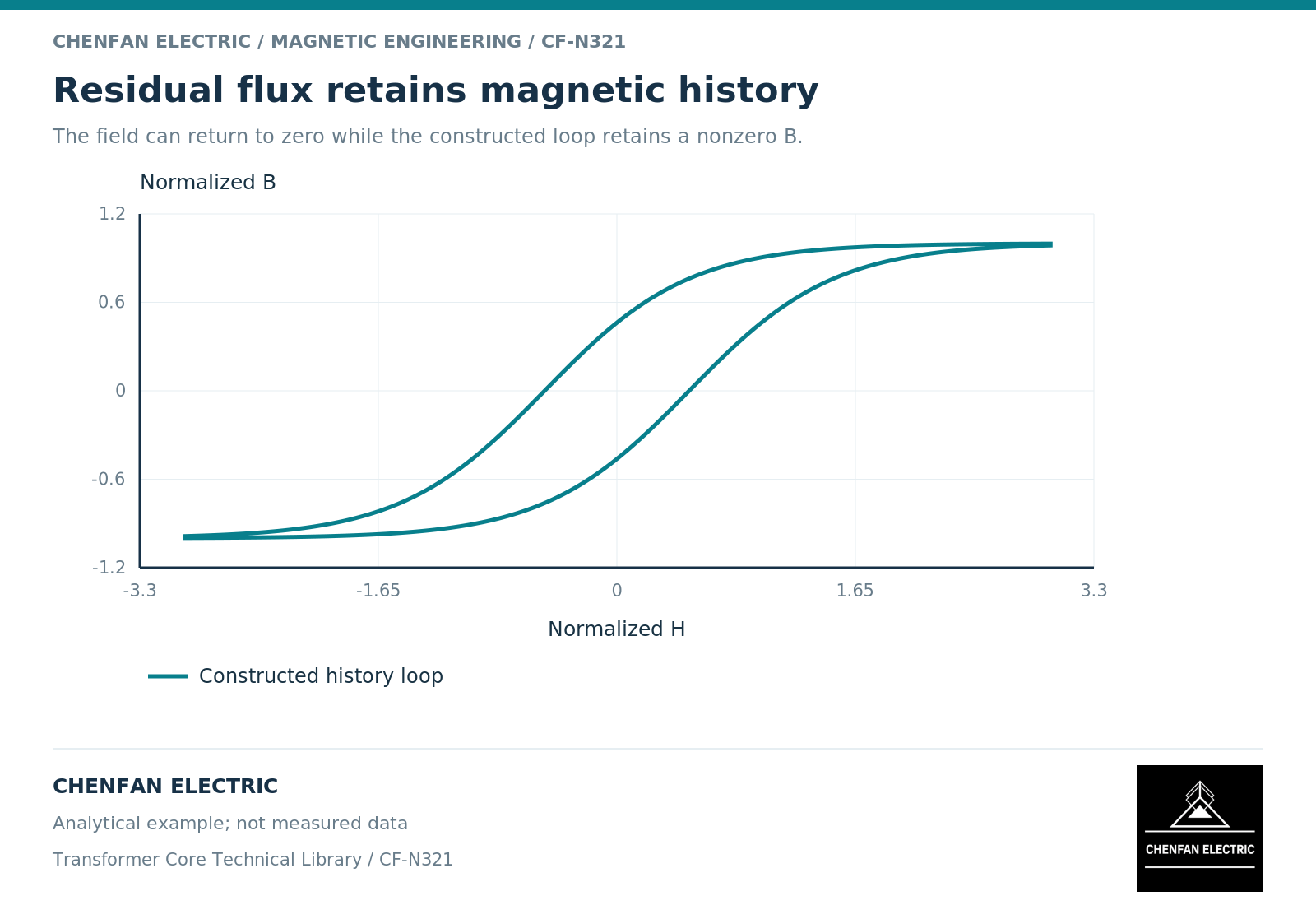
Separate a curve property from an initial condition
A hysteresis loop describes how magnetic flux density responds along a specified excitation history. Remanence on that loop refers to the remaining density at a defined zero-field condition. An actual transformer may finish an event on a different trajectory or minor loop. History-dependent and single-valued magnetic models therefore contain different information. [1]
For a transient calculation, residual flux is an initial condition. It needs a sign, a reference direction and a location in the magnetic model. A positive number without a polarity convention is insufficient when the next voltage integral may reinforce or oppose it.
The distinction is practical: replacing one steel grade with another does not justify copying a single residual-flux percentage into every switching case. Neither does using the same grade prove that two separate tests began from the same state.
Preserve the event that created the state
The final magnetic state can depend on the point at which excitation ceased and the circuit’s subsequent transient behavior. Winding capacitances, connected equipment and damping can affect the voltage history before the system settles. The flux change follows the induced-voltage integral, not simply the instant at which a control command was issued. [2]
A useful event record therefore separates command time, actual electrical interruption and the end of the observed decay. These may not be the same moment. The record should retain the relevant phase quantities rather than assigning all limbs an identical state by convenience.
Direct-current testing is another possible part of the history. It should appear in the chronology when later magnetic measurements are compared, even if no residual-flux value was measured directly.
Use an interval when the state is uncertain
When the residual state is not known, analyze a physically consistent range. An interval is more honest than an exact-looking assumed value. The range should respect the core topology and the model’s state constraints, not combine arbitrary limb values that violate its magnetic network.
For an illustrative single-phase study, compare positive, near-zero and negative starting flux against the same closing event. The purpose is to establish sensitivity to the initial state. It is not to claim that those three states are equally probable or measured on the equipment.
Report which result changes: peak magnetizing current, flux excursion, waveform duration or a protection-related observable. This makes the uncertainty useful to the decision rather than leaving it as a general disclaimer.
Make the residual-state record portable
A model handover should identify the reference winding, flux or flux-linkage units, polarity convention, state-assignment method and evidence origin. State whether the value was estimated from records, produced by a prior simulation or chosen for a sensitivity case.
Keep a separate field for magnetic conditioning. “Demagnetized,” “previously energized” and “history unknown” are different descriptions; none should be replaced by an unqualified claim of exactly zero flux.
The correct engineering statement is that a particular residual state was used or bounded for a particular calculation. That preserves the difference between material behavior and transformer history, and prevents an assumed initial condition from becoming an unsupported product guarantee.
References
[1] Cesare Tozzo / COMSOL. Modeling Ferromagnetic Materials in COMSOL Multiphysics.
[2] Lloyd Dixon / Texas Instruments. Magnetics Design 1 – Introduction and Basic Magnetics.