

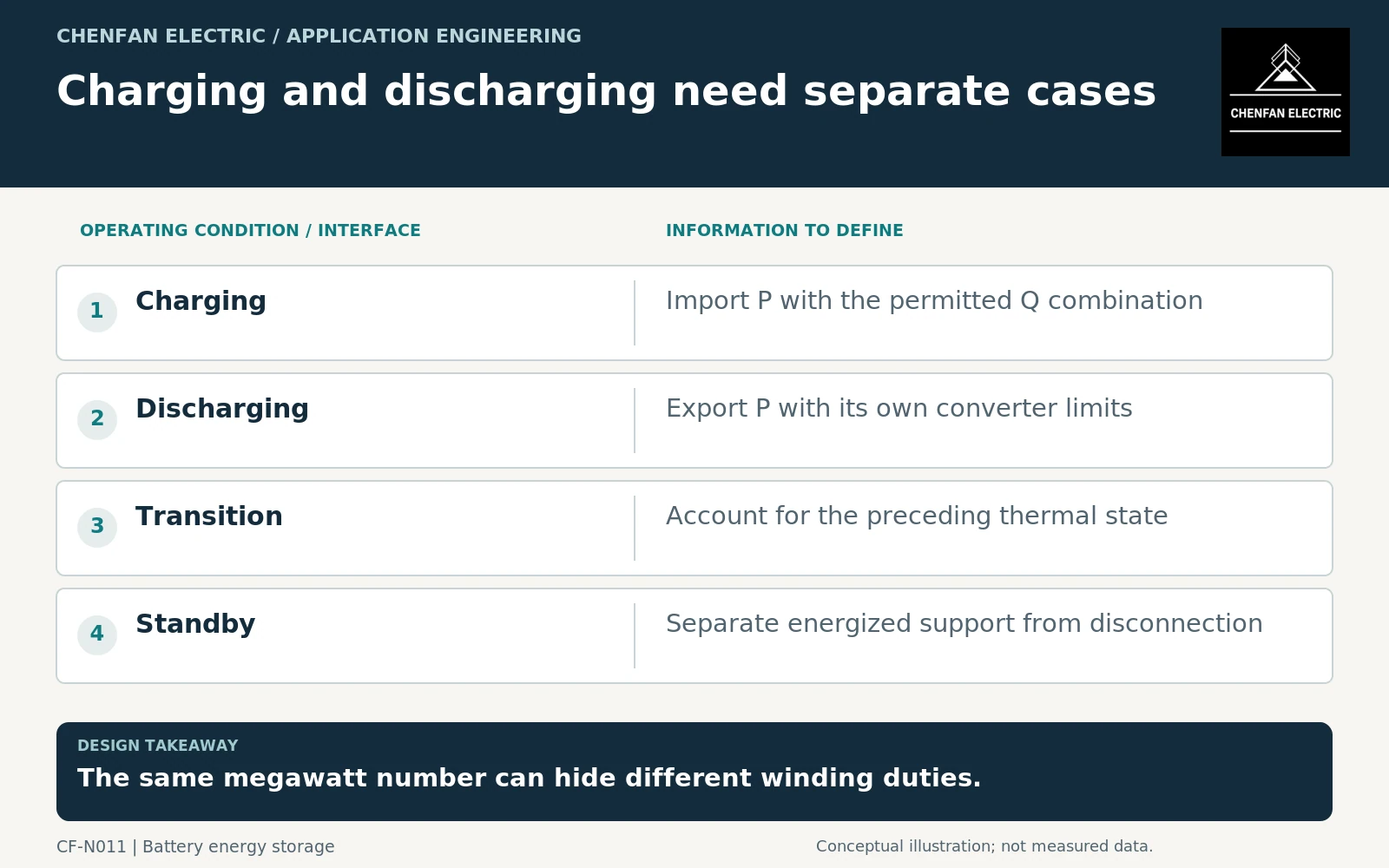
A battery energy storage system (BESS) transformer should be evaluated against separate charging and discharging cases, even when both directions have the same advertised megawatt rating. Converter limits, reactive-power requirements, voltage and duration can differ between those states. The correct starting point is a winding-level operating matrix, followed by an equipment-specific thermal assessment—not a single battery megawatt-hour value.
Translate converter ratings into terminal quantities
Request the power conversion system (PCS) capability envelope at its alternating current (AC) terminals. Identify continuous active power, reactive power, current limits and the voltage conditions associated with each. Battery-side power is a different boundary because conversion losses and auxiliary consumption intervene.
For balanced sinusoidal operation, apparent power follows S = √(P² + Q²). As an illustrative comparison, charging at 5 MW and 1 MVAr corresponds to approximately 5.10 MVA, while discharging at 5 MW and 3 MVAr corresponds to approximately 5.83 MVA. The equal active-power magnitudes do not produce equal apparent-power duties.
These examples assume the stated P and Q are simultaneous and measured at the same terminals. Actual converter capability may prevent one combination. Where waveform distortion is relevant, obtain root-mean-square current and spectral information rather than treating the fundamental P-Q calculation as the entire current assessment.
Keep power direction separate from permissible operation
A reversed active-power sign does not inherently remove transformer heating or establish an additional rating. It identifies a different operating case whose system interfaces must be reviewed. Tap assumptions, voltage regulation, metering and protection can be direction-sensitive even when winding current magnitudes are similar.
General transformer application guidance addresses operating conditions, connections and ratings. Converter-transformer application guidance provides additional context where the transformer forms part of a specialized converter system; applicability should follow the actual arrangement. [1] [2]
Define the sign convention at a named boundary. A PCS supplier using positive P for discharge and a network model using positive P for import can otherwise appear to contradict one another while describing the same physical state.
Evaluate the chronological loading cycle
Record charging duration, rest intervals, discharging duration, reactive support and auxiliary demand in time order. The initial temperature before discharge depends on what happened during charging and standby. A long daily rest interval cannot be assumed when the commercial dispatch strategy permits repeated cycles.
| Operating case | Minimum information |
|---|---|
| Sustained charging | P-Q envelope, voltage and duration |
| Sustained discharging | Independent P-Q envelope and duration |
| Rapid reversal | Transition frequency and preceding load |
| Reactive-only support | Current, energized hours and cooling state |
| Restricted cooling | Available equipment and permitted response |
Use the relevant thermal framework for the transformer type. IEC 60076-7 addresses mineral-oil-immersed transformers; it is not a universal loading model for every liquid or dry-type assembly. [3]
A dispatch model should also distinguish contractual restrictions from technical capability. If the proposed rating depends on a mandatory recovery interval, that interval must remain enforceable after the plant changes operating strategy.
Obtain an offer with explicit assumptions
The enquiry package should include the approved single-line diagram, converter data revision, winding-specific current cases, site conditions and operating schedule. Ask the supplier to identify the governing charging and discharging cases and any restrictions on continuous or temporary duty.
Compare offers using the same schedule. One supplier may evaluate continuous operation in both directions while another assumes a limited daily cycle. A price comparison that hides this difference is not comparing equivalent equipment.
Finally, retain a change-control trigger: a new PCS, revised reactive-power obligation or different dispatch schedule can require reassessment even when the battery megawatt-hours are unchanged. The transformer specification should follow the electrical duty actually imposed on it, not the energy label on the storage project.
Core procurement checkpoint: Use the governing magnetic case, not the sign of megawatts
Charging and discharging cases should reach the transformer designer before the core drawing is released. The core procurement record should retain the voltage, frequency and excitation basis selected from those cases, while the transformer manufacturer remains responsible for winding-current and thermal limits. Do not use the battery’s charge or discharge label as a substitute for a material specification and controlled geometry.
For the core enquiry: Approved design cases; core dimensions; steel grade and thickness; manufacturing revision; agreed loss-test excitation conditions.