

A two-hour or four-hour storage label does not directly determine transformer rating. Storage duration links battery energy to a stated discharge power, while transformer duty depends on alternating current (AC) current, voltage, reactive power and the time sequence of operation. Longer duration can matter thermally, but doubling battery energy does not automatically double transformer apparent power.
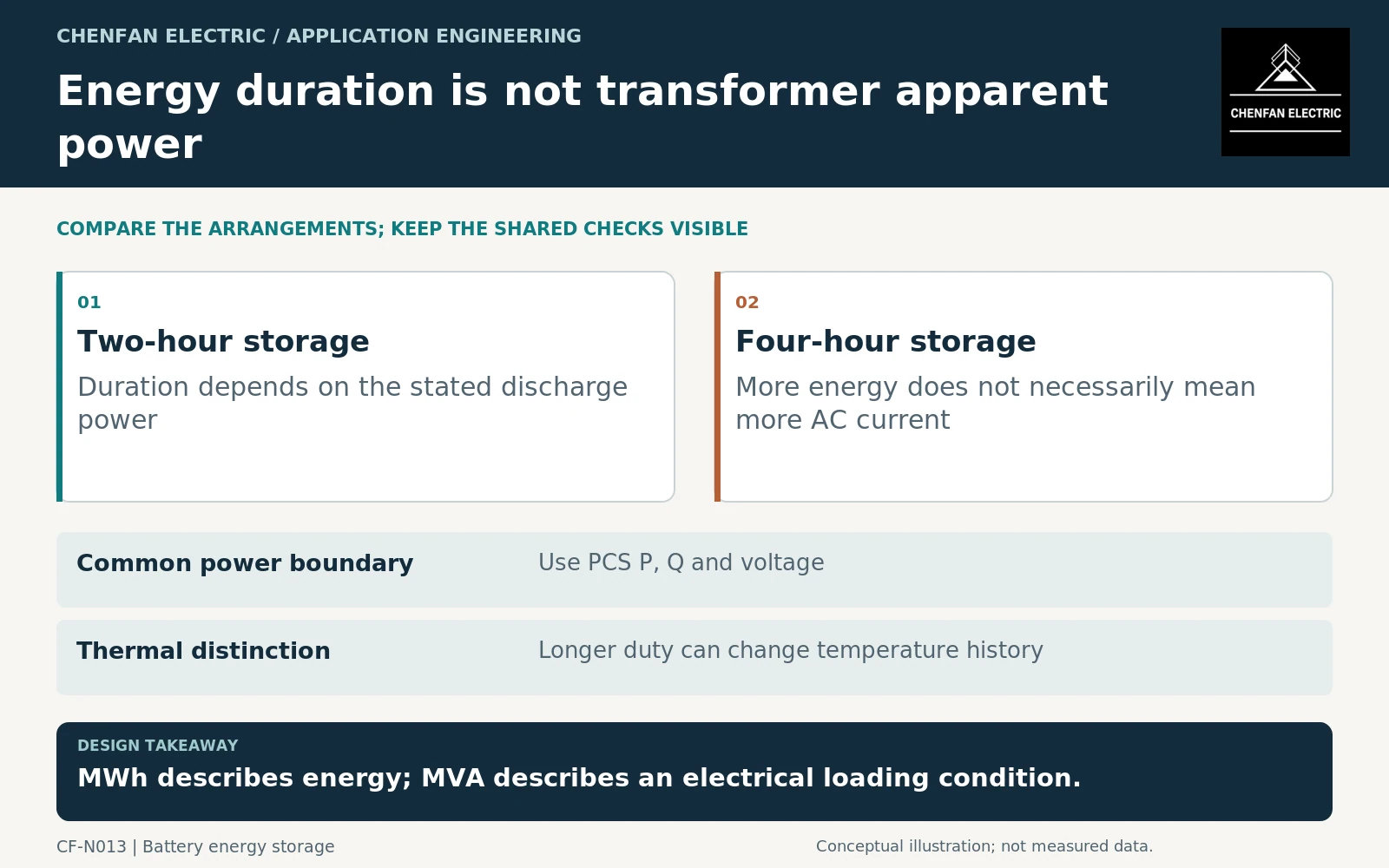
Separate energy, active power and apparent power
An illustrative system with 20 MWh of usable energy discharging at 10 MW has a nominal two-hour energy-to-power ratio before considering the precise project definitions. A 40 MWh system at the same 10 MW has a four-hour ratio. Their AC active-power boundary can therefore be the same despite different stored energy.
Neither example establishes transformer MVA. Reactive power, converter losses, auxiliary consumption and the actual terminal boundary remain relevant. Battery energy may also be quoted using a different usable range or reference condition, so the project should define the duration label rather than treating it as a universal electrical guarantee.
Transformer application guidance addresses ratings and operating conditions, not battery duration labels. The converter interface must supply the actual electrical quantities. [1] [2]
Examine whether the longer duty changes the thermal result
A four-hour operating period may approach a different thermal condition from a shorter pulse, depending on the equipment, prior loading, ambient temperature and cooling. The relationship is not a fixed percentage adjustment to transformer size.
Mineral-oil loading guidance evaluates loading and ambient effects within its scope. Dry-type transformers use a separate loading guide. Select the applicable framework and provide the complete duty rather than importing a result from a different construction. [3] [4]
The preceding charge also matters. Four hours of discharge after a long rest differs from four hours of discharge immediately after sustained charging. Repeated cycling can remove recovery intervals that an initial commercial model assumed.
Compare project schedules on equal terms
| Question | Why the duration label cannot answer it |
|---|---|
| What is the maximum AC current? | Energy capacity does not specify P-Q capability |
| How long is maximum current sustained? | Dispatch may differ from nominal energy duration |
| What happens between cycles? | Standby may remain energized and reactive |
| Which cooling equipment is available? | Availability is independent of battery MWh |
| Can the operating strategy change? | New services may alter the duty sequence |
Use a representative schedule and credible bounding cases. Include charging, discharge, reactive support, idle periods and temperature conditions. Do not hide a continuous support obligation inside an assumed no-load interval.
An annual energy-throughput figure is useful for commercial analysis but cannot preserve every thermal event. Two schedules with the same annual megawatt-hours can have different peaks, recovery intervals and initial temperatures.
Specify the future boundary explicitly
Projects sometimes install additional battery containers later while retaining the same power conversion system (PCS) power. That expansion may lengthen sustained operation without increasing instantaneous AC current. A different expansion may add PCS power as well. These are distinct transformer review cases.
State which future configuration the transformer must support and which requires a later assessment. Include the enforced current ceiling, permitted duration and any operational limitation that makes the proposed rating acceptable.
The enquiry should end with an AC operating matrix and chronological loading schedule, not a request for a “four-hour transformer.” The useful procurement distinction is whether the design supports the required electrical duty for the required duration under the agreed conditions. Battery duration is one input to that discussion, not the rating itself.
Core procurement checkpoint: Do not order a core by battery duration
Two-hour and four-hour storage descriptions belong to the energy schedule. A core order still needs the transformer’s selected geometry, electrical-steel specification and manufacturing quantities. Where the same transformer design is proposed for both systems, obtain confirmation from the equipment designer rather than assuming that equal power ratings make all duties equivalent. The core quotation should identify the exact approved variant.
For the core enquiry: Transformer design reference; core drawing; grade, thickness and quantity; approved commonality between storage-duration variants.