

A shared transformer can be appropriate for solar-plus-storage, but only after the simultaneous operating states are defined. Solar output, battery charging, battery discharge and reactive-power support cannot be reduced to a single net megawatt figure without identifying their connection points. Separate transformers may simplify some interfaces while increasing equipment count. The decision belongs to the complete architecture, not to an assumed diversity factor.
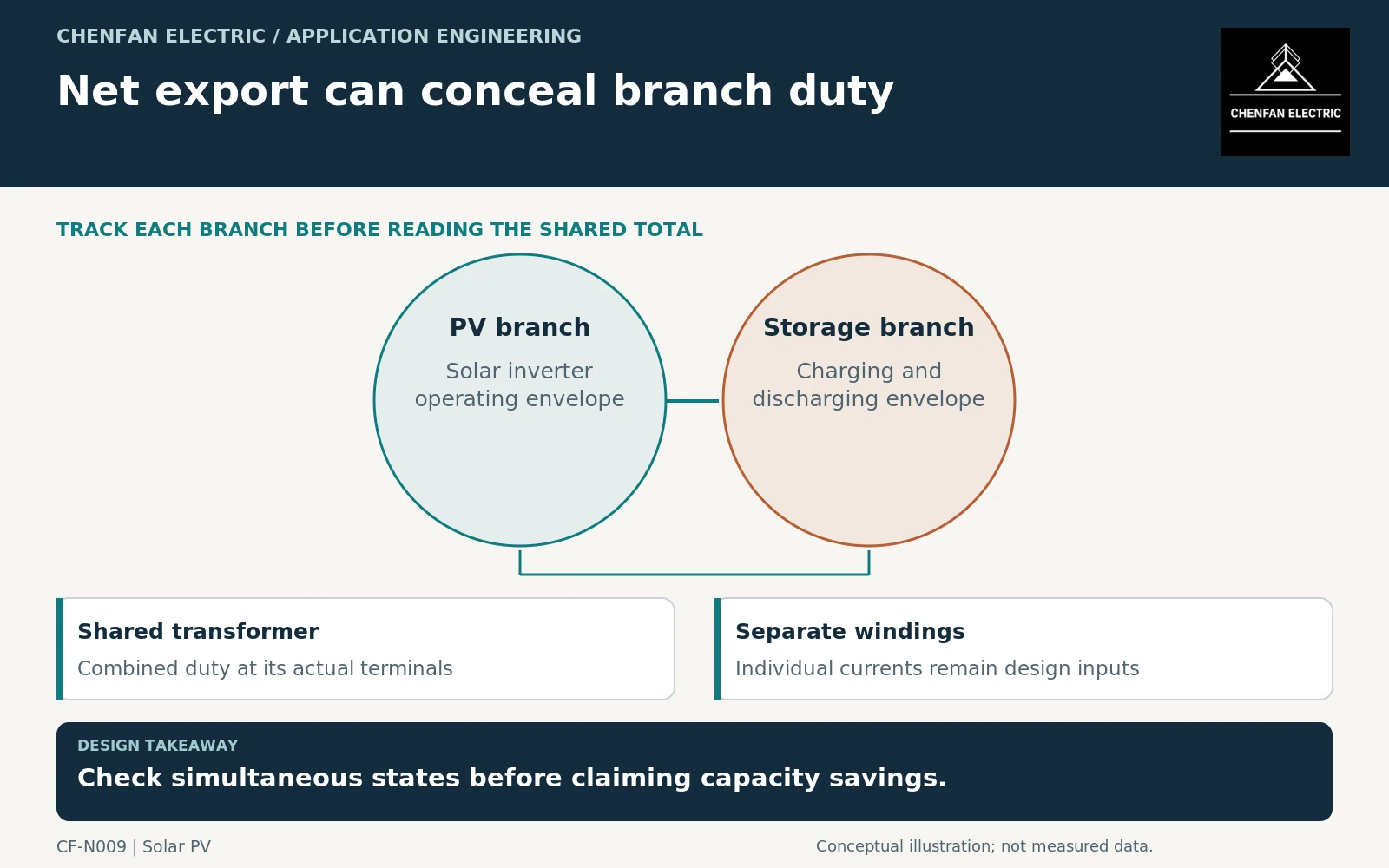
Establish where power is combined
In an alternating-current (AC)-coupled arrangement, photovoltaic (PV) and storage converters may join a common bus or connect to separate transformer windings. A direct-current-coupled arrangement has a different conversion boundary. These configurations do not impose identical duties on the transformer.
On a common AC bus, local solar generation can supply battery charging without that entire exchange passing through an upstream transformer. With separate transformer windings, however, the individual winding currents remain relevant even when the high-voltage net export is small. State the arrangement before calculating any capacity benefit.
Transformer application guidance provides the basis for reviewing connections and ratings. Specialized converter arrangements may need additional application considerations, rather than assuming that every combined PV-storage installation has the same transformer requirements. [1] [2]
Build the simultaneous operating matrix
List permitted combinations, not independent maxima copied from two equipment brochures. Include any controller-enforced import or export ceiling and identify what happens when that controller is unavailable.
| Scenario | Question to resolve |
|---|---|
| Maximum PV with battery charging | Which power exchanges remain local to the bus? |
| PV and battery exporting together | What limits total transformer current? |
| Night charging with reactive support | Which P-Q combination can persist? |
| One converter group unavailable | Does the remaining group have a different duty? |
An illustrative common-bus case with 5 MW of PV output and 2 MW of battery charging has 3 MW of net active export before losses and auxiliaries. That arithmetic does not establish transformer apparent power: net reactive power, voltage and distortion remain required. It also does not describe a multiwinding topology automatically.
Compare more than normal-operation losses
Shared equipment introduces a common outage boundary. Separate units may preserve part of the plant during a transformer outage, but only if the collector network, switchgear and controls support independent operation. Identify the actual isolation zones and maintenance configuration.
Compare annual energized states using a common schedule. Storage can add duty during hours when a PV-only transformer would be lightly loaded or disconnected. Thermal assessment must consider the chronological sequence, including the initial temperature before a charging or discharging period. Relevant loading guidance is equipment-specific. [3]
Metering and commercial boundaries can also affect the architecture. A shared electrical path may require additional measurement to distinguish imported charging energy, auxiliary consumption and exported generation. Define the project requirements without assuming that an electrical netting calculation satisfies every contractual measurement need.
Freeze a bounded sharing agreement
The purchasing package should include the single-line diagram, winding-specific duty matrix, converter P-Q envelopes, controller limits and agreed outage cases. Record which limits are inherent in equipment ratings and which depend on software or operating procedures.
Require offers to use the same sharing assumptions. A smaller rating based on enforced non-simultaneity is not directly comparable with a design permitting simultaneous maximum operation. The restriction is part of the product’s usable duty and should remain visible through commissioning and later plant expansion.
A shared transformer is justified when its capacity, protection, metering and availability consequences are understood. Separate transformers are justified when their additional equipment resolves a requirement that sharing cannot satisfy economically or operationally. Neither arrangement wins merely by having a shorter equipment list.
Core procurement checkpoint: A shared plant does not automatically mean a shared core design
The decision to share a transformer must reach the core supplier as an approved geometry and delivery scope. Different winding arrangements can require different window dimensions, limb configurations and assembly sequences even at the same plant export limit. Ask for separate quotations where the system study has not yet resolved the architecture, rather than blending alternative designs into one ambiguous core order.
For the core enquiry: Alternative-specific core drawings; winding-envelope interfaces; quantities; lamination or assembled-core boundary; release status of each option.