

A stack can be too thick for the winding and still contain the intended amount of steel.
Compressing it until the external dimension fits does not automatically resolve the problem.
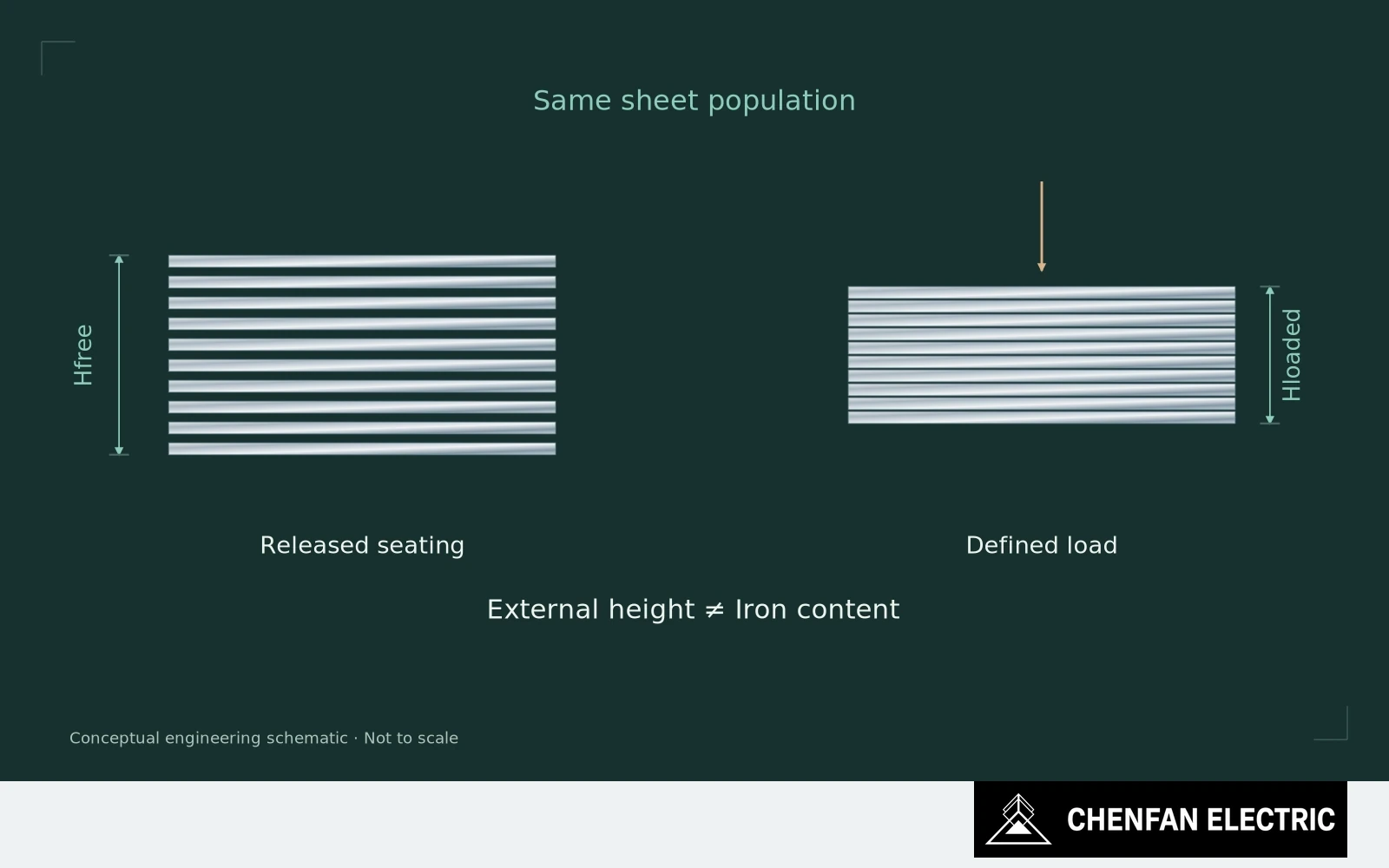
Separate stack envelope from iron content
Measured stack thickness reflects more than nominal sheet count multiplied by nominal gauge. Coating, local flatness, seating, inter-sheet spaces and the applied measurement or clamping condition influence the assembled dimension.
The first question is therefore: under what state was the thickness specified and measured?
A reading on an unconstrained packet is not necessarily comparable with a reading under a defined load. Nor should a material stacking-factor test be treated as a complete description of a finished core containing its own geometry and any designed spacers or ducts.
Investigate seating and count before compression
There are two separate engineering consequences. The external stack envelope affects interfaces such as winding clearance and clamping fit. The effective iron area affects the nominal flux density at a given voltage, frequency and turns. One dimension should not be used as an unexamined proxy for both.
If the measured stack is higher than expected, investigate the cause before increasing force. Incorrect counts, thickness variation, debris, edge damage or poor seating require different actions. Additional compression may conceal an assembly issue or change the stress state without correcting its origin.
If the stack is lower than expected, the same discipline applies. A compact external dimension is not evidence of missing sheets, and it is not evidence of an improved stacking factor until the relevant mass, area and measurement conditions support that conclusion.
The inspection record should connect packet counts, measured external dimensions and the calculation of effective section. Where different packet widths contribute to a stepped section, keep their individual contributions visible rather than relying on one overall height.
Verify both net area and winding clearance
For the transformer manufacturer, this is an interface review as much as a magnetic review. The winding may need both sufficient net iron area and a controlled insertion envelope. Meeting one does not waive the other.
A practical specification defines the measurement state and the functional limit before production begins. It also identifies who must approve a change in sheet count or clamping arrangement.
When a thickness discrepancy appears, solve the relationship between steel content, seating and usable envelope. Forcing the last measurement into tolerance is not the same as restoring the intended assembly.
Practical takeaway
The external stack envelope and effective iron content are related but not interchangeable.
Chenfan Electric manufactures custom transformer cores according to customer drawings. Where applicable to the specified material and core design, agreed process controls include burr height below 0.02 mm and stacking factor above 97%. Measurement methods and acceptance conditions are defined for each order.