

The scale is reporting a discrepancy.
It is not yet reporting missing iron.
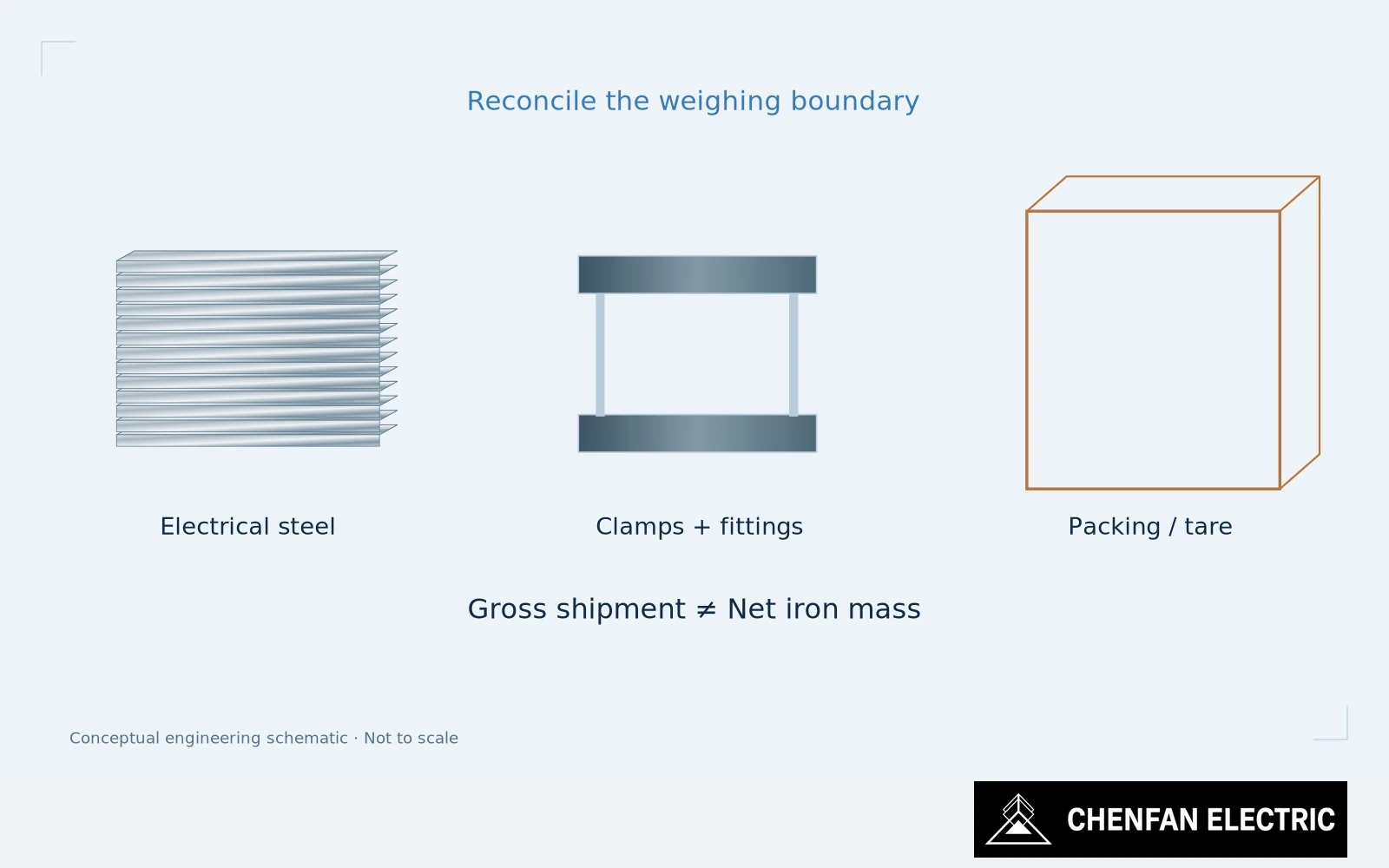
Match the drawing and weighing boundaries
Before investigating a core-weight deviation, establish whether the drawing and the weighing record describe the same object.
Does the theoretical figure include only electrical steel, or also clamps, insulation and other fitted parts? Does the measured figure exclude the pallet, lifting arrangement and temporary restraints? A gross-versus-net mismatch can look like a manufacturing problem until the boundaries are reconciled.
Once that is settled, examine the calculation. Sheet dimensions, counts, thickness assumptions, material density and any designed voids determine the steel mass. Nominal catalogue values and actual delivered dimensions need not be identical.
Cross-check counts, area and material assumptions
Stacking factor requires particular care. It belongs in a calculation that converts gross stack volume into effective iron volume. It should not be applied again if the mass has already been calculated from the actual steel-sheet volumes. Double application creates an artificial shortage.
A weight difference can have several explanations: a count discrepancy, a dimensional deviation, a changed packet definition, a different nominal-versus-actual thickness assumption, or an incomplete parts list. It does not distinguish among them.
Cross-check the mass with independent evidence. A lower-than-expected weight together with a reduced verified iron section deserves a different investigation from the same weight difference with correct sheet counts and geometry. Preserve which quantities were measured and which were inferred.
For magnetic interpretation, remember that voltage, turns, frequency and effective section determine the nominal operating induction. Core mass is related to geometry, but it is not a direct replacement for the effective-area calculation. Removing material from a non-critical allowance is not equivalent to reducing a limb’s working section.
Separate the technical decision from the invoice adjustment
The weighing method also needs suitable resolution and a documented tare. A number written to more decimal places than the measurement supports adds precision to the report, not knowledge about the core.
Procurement should request a reconciled mass record before treating the deviation as either a commercial adjustment or a technical rejection. The two decisions may use the same evidence, but they answer different questions.
A sound weight investigation ends with a mass balance tied to the actual drawing revision. It should explain where the difference came from, rather than merely replacing the theoretical number with the scale reading.
Practical takeaway
A weighing discrepancy does not identify missing magnetic section until mass boundaries are aligned.
Chenfan Electric manufactures custom transformer cores according to customer drawings. Where applicable to the specified material and core design, agreed process controls include burr height below 0.02 mm and stacking factor above 97%. Measurement methods and acceptance conditions are defined for each order.