

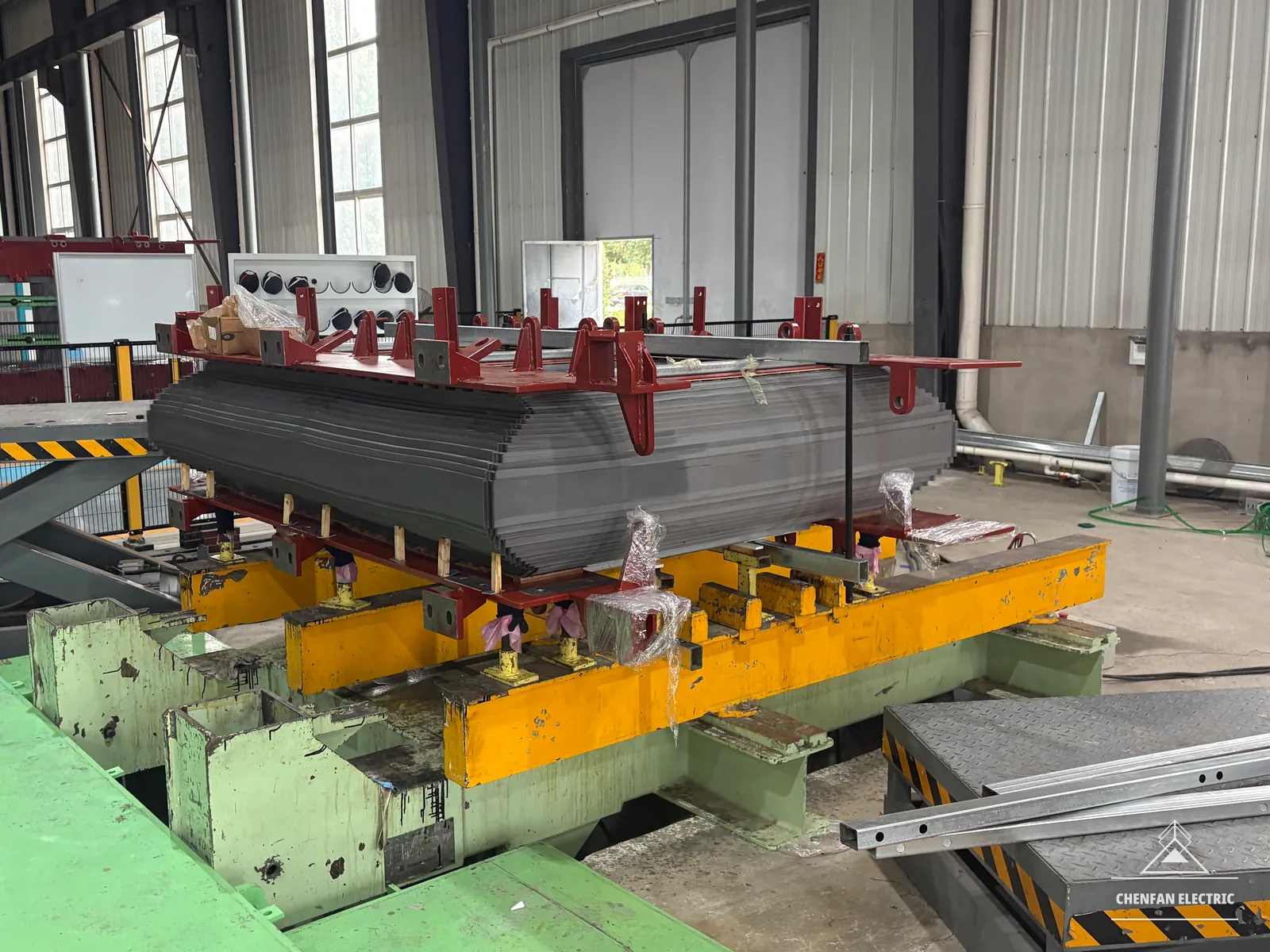
Core assembly
Engineering Question
How does stacking factor affect the magnetic section used in a core design?
Key Data
- Chenfan stacking-factor control: >97%.
- On a consistent section basis: effective steel area = gross stacked area × stacking factor.
Technical Explanation
Stacking factor expresses how much of a defined stack is occupied by steel. Insulation coating and spaces between laminations mean the gross physical section is not identical to the effective steel section. The design and inspection calculation must use compatible definitions.
If a supplier derives net area directly from the summed steel dimensions, applying stacking factor again can reduce the area twice. Agree whether the starting quantity is gross packed area or already net iron area.
At the same magnetic flux, a smaller effective steel area gives a higher flux density. This is why substituting a stack dimension or material thickness without checking the net steel build can change the magnetic operating point. The resulting loss and exciting current depend on the material and operating conditions.
The measured result also depends on the specimen or assembly being evaluated and its compression condition. A material sample value and a finished-assembly assessment should not be treated as identical without explaining the method.
IEC 60404-13:2018 provides methods for measuring stacking factor of electrical-steel strip and sheet.
Flatness, burrs, cleanliness, packet alignment and restraint all matter. Increasing clamp force alone is not a sound way to correct poor stacking: excessive or uneven stress can affect the magnetic material and the structure.
Engineering Implications
- Use the agreed effective steel area when checking flux density and lamination quantities.
- Check finished stack dimensions and joint alignment as well as the reported factor.
Procurement Implications
- Agree how the >97% requirement is evaluated for the ordered product.
- Keep stacking-factor acceptance distinct from finished-core loss acceptance.
What to Confirm Before Ordering
- Net steel area, gross section and material thickness basis.
- Measurement method, sample or assembly scope, and compression condition.
- Finished stack tolerance, inspection records and magnetic test requirements.
Apply the agreed measurement basis to the core manufacturing and supply specification; keep stacking-factor acceptance separate from the finished-core loss requirement.