

A wind-turbine transformer and a wind-farm main grid transformer serve different electrical boundaries. The former connects an individual turbine or associated converter to the collection system; the latter connects the collected plant output to another network voltage level. They should not inherit identical specifications merely because both belong to a wind project.
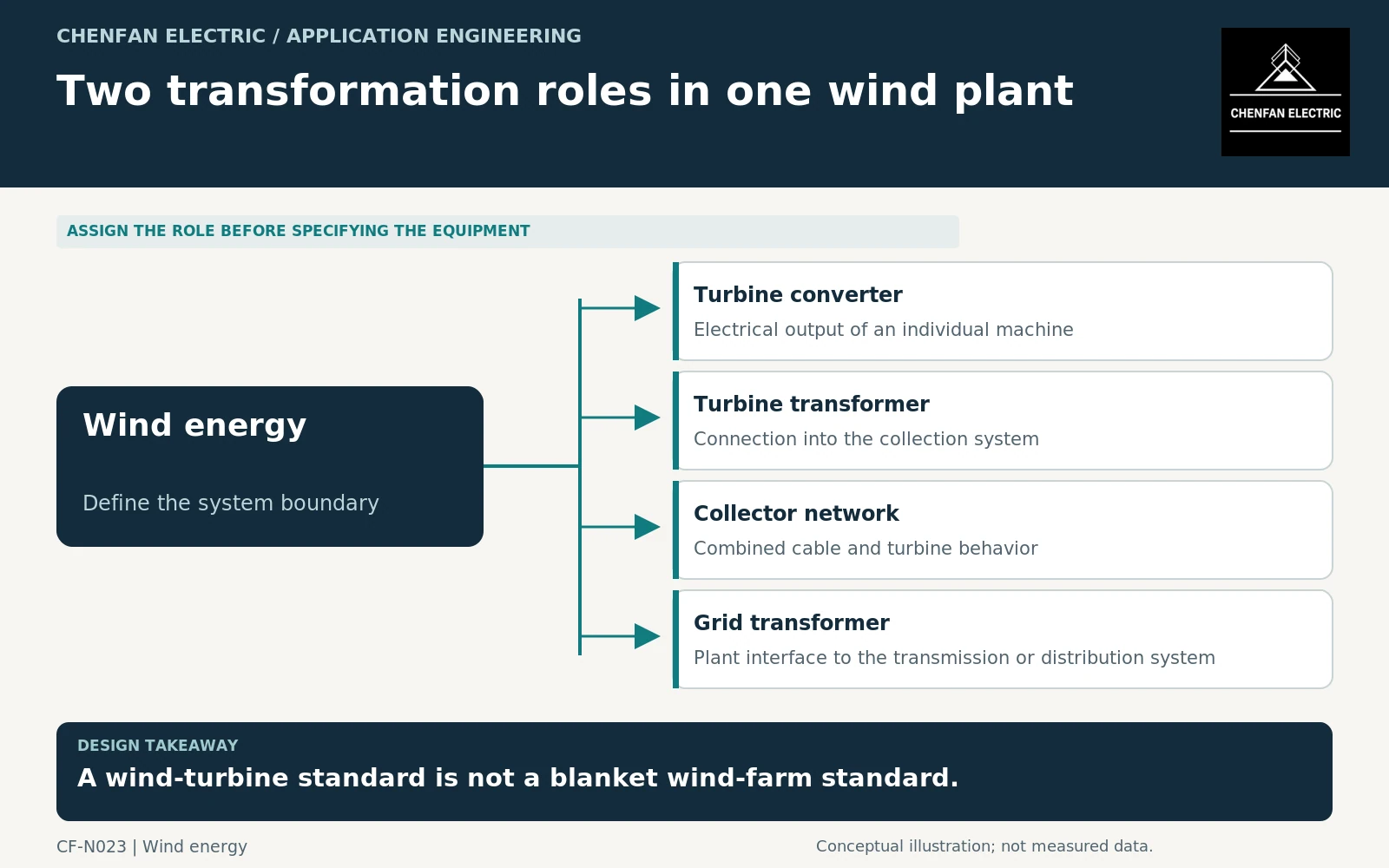
Identify the function on the single-line diagram
Mark converter terminals, turbine transformation, collector feeders, compensation equipment and the main grid connection. State the voltage and ownership boundary at each interface. This prevents a turbine supplier’s transformer requirement from being copied into a substation enquiry without checking its purpose.
IEC/IEEE 60076-16:2018 has a defined scope for wind-turbine step-up transformers, including a winding highest-voltage-for-equipment limit of 72.5 kV. It is not a general specification for all main wind-farm grid transformers. [1]
The scope statement matters independently of the plant’s marketing terminology. A purchase order calling equipment a “wind transformer” does not establish which technical requirements apply.
Separate the electrical studies
The turbine transformer review starts with the turbine converter’s operating envelope, winding connections and local installation conditions. It may need turbine-specific cooling, vibration or dimensional interfaces.
The main grid transformer review starts with aggregate plant power, collector-network behavior, grid voltage requirements and the substation arrangement. Tap regulation, reactive-power allocation and credible plant configurations can become central questions.
| Topic | Turbine-level emphasis | Main-grid emphasis |
|---|---|---|
| Loading input | Individual converter duty | Aggregate plant and network cases |
| Mechanical interface | Turbine location and replacement | Substation arrangement and handling |
| Voltage coordination | Converter-to-collector boundary | Collector-to-grid boundary |
| Reactive duty | Turbine capability and controls | Plant obligation and compensation allocation |
These are emphasis differences, not exclusive lists. Both units still need appropriate thermal, insulation, connection and protection assessments.
Do not transfer evidence across assemblies
A type test or design assessment for a turbine transformer does not automatically qualify a larger grid transformer with different windings, insulation levels or operating conditions. Similarly, a core material certificate is not complete-transformer evidence for either role.
General transformer standards and application guidance provide a broader framework, while equipment-specific and project-specific requirements must be selected according to their actual scope. [2] [3]
Where dielectric requirements are specified, use the relevant insulation-coordination and transformer test framework rather than inferring withstand levels from nominal system voltage alone. The IEC 60076-3 publication history includes amendments, so the contract should identify the applicable edition and amendments explicitly. [4]
Create two coordinated enquiry packages
The turbine package should reference converter data, local mechanical and cooling interfaces, winding duties and the turbine operating cases. The grid-transformer package should reference plant load-flow cases, collector studies, tap philosophy, substation conditions and grid-interface requirements.
Cross-reference shared assumptions: collector voltage range, grounding arrangements, reactive-power allocation and expansion plans. A conflict between the packages can survive procurement when each supplier only reviews its own equipment boundary.
The completed specification set should make it impossible to confuse the two roles. That clarity avoids both under-specification—omitting a main-grid requirement—and over-specification—imposing turbine-specific restrictions where they do not apply. The wind-farm label provides context; the actual electrical role determines the technical enquiry.
Core procurement checkpoint: Do not merge turbine and collector-transformer core schedules
A turbine transformer and a wind-farm transformer serve different interfaces even within the same project. Maintain separate core drawing numbers, dimensions and quantities, with clear delivery and inspection scopes. When seeking a drawing-based quotation, identify the associated equipment design rather than presenting the wind farm’s aggregate capacity as a standalone core rating or evidence of manufacturing feasibility.
For the core enquiry: Equipment function; approved core drawing per design; quantity; delivery form; material and inspection specification.