

The useful load time series for a wind-turbine transformer is the one that preserves its electrical and thermal duty. Average turbine power and annual energy yield cannot show every current peak, reactive-support interval or cooling constraint. Provide chronological data at a resolution appropriate to the assessment, with quantities referenced to the same terminals and time base.
Choose the electrical quantities deliberately
Active power alone does not define winding current. Include reactive power, terminal voltage and, where relevant, current distortion. If the converter provides a direct root-mean-square current record, retain it alongside the P-Q data and identify the measurement method.
Wind-turbine transformer requirements have a defined equipment scope under IEC/IEEE 60076-16. That scope does not supply the actual load history for a particular turbine or site; the project must provide it. [1]
Separate measured operating records from modeled production forecasts. Both can be useful, but they carry different uncertainty. Do not relabel a wind-resource-derived power trace as measured transformer current.
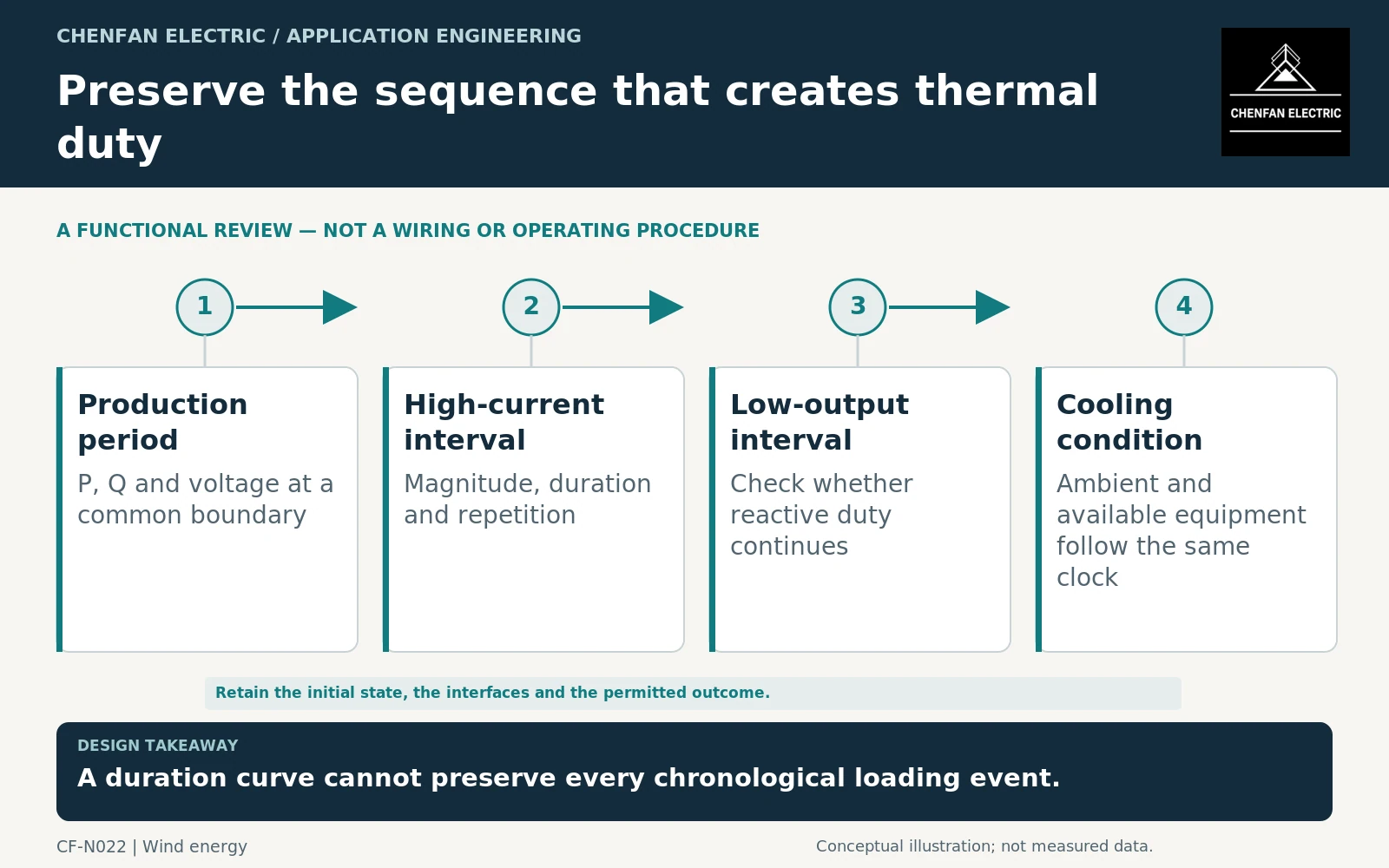
Preserve chronology where temperature matters
A load-duration curve orders values by magnitude and can support some comparisons, but it loses the sequence of events. A high-current interval after a long cool period differs from the same interval following sustained loading. The order matters when assessing initial temperatures and recovery.
Mineral-oil loading guidance considers loading and ambient conditions within its stated scope. Dry-type equipment has a separate loading guide. The selected model determines what time resolution and auxiliary information are needed. [2] [3]
Ask the study team to justify any resampling. Coarse averages can erase events relevant to electrical behavior; excessively fine data do not improve a thermal model if the input assumptions remain wrong. Keep transient switching questions separate from long-term thermal loading rather than forcing both into one simplified time step.
Align ambient and cooling data with the load
The relevant cooling condition is the one at the transformer interface. Nacelle air, tower-base air and cooling-liquid inlet temperature may differ from the weather-station reading. Record cooling availability and control state on the same clock as the electrical data.
An illustrative data record might contain timestamp, P, Q, line voltage, measured current, cooling-medium temperature and active cooling stage. These are field definitions, not a fabricated dataset. Add quality flags for missing or substituted values.
| Data-quality check | Reason |
|---|---|
| Common time zone and sampling interval | Prevents false alignment of load and temperature |
| Clear terminal reference | Avoids mixing converter and collector quantities |
| Missing-data flags | Keeps substitutions visible |
| Control-mode annotation | Explains reactive duty or curtailment |
| Cooling-state record | Identifies periods with different thermal capability |
Build a representative duty without hiding extremes
Use the chronological record to select normal operation, credible high-duty periods and relevant abnormal cooling cases. Explain why each case is representative or bounding. Avoid combining unrelated extremes into an impossible scenario, but retain rare credible events that can govern the design.
The procurement deliverable should include the data source, revision, preprocessing rules and selected duty cases. A supplier should be able to reproduce the inputs used for its assessment without reconstructing undocumented spreadsheet edits.
Finally, establish a review trigger for turbine repowering, converter changes or revised reactive obligations. A transformer evaluated against one time series is not automatically assessed against a later operating regime simply because annual energy production remains similar.
Core procurement checkpoint: Retain the design case behind the wind-duty profile
The turbine load time series helps the transformer manufacturer assess duty, but the core supplier still needs a released drawing and material specification. Identify the voltage and frequency assumptions associated with that design and keep them linked to the approved turbine configuration. A load histogram alone does not justify changing core dimensions or converting a material-loss figure into total annual transformer losses.
For the core enquiry: Turbine configuration reference; approved core design; excitation basis; grade and thickness; loss-data boundary and inspection requirements.