

Gripper frame sag, suction-contact deformation and sheet flexure respond differently to robot posture. Measure those contributions with the working yoke lamination to build compensation over the placement path. [1]
Measure the loaded geometry
Observe reference points on the tool frame and on the lamination under the intended load. Compare them with the unloaded tool at the same robot posture. This separates tool deformation from the nominal robot motion. Additional observations on the sheet reveal whether it follows the tool frame rigidly or bends relative to it.
Repeat the measurement at the actual picking, transport and placement postures, including relevant overhang and contact patterns. Record load mass, centre of gravity and effective vacuum-contact condition. Equal mass does not imply equal deformation if the load distribution changes.
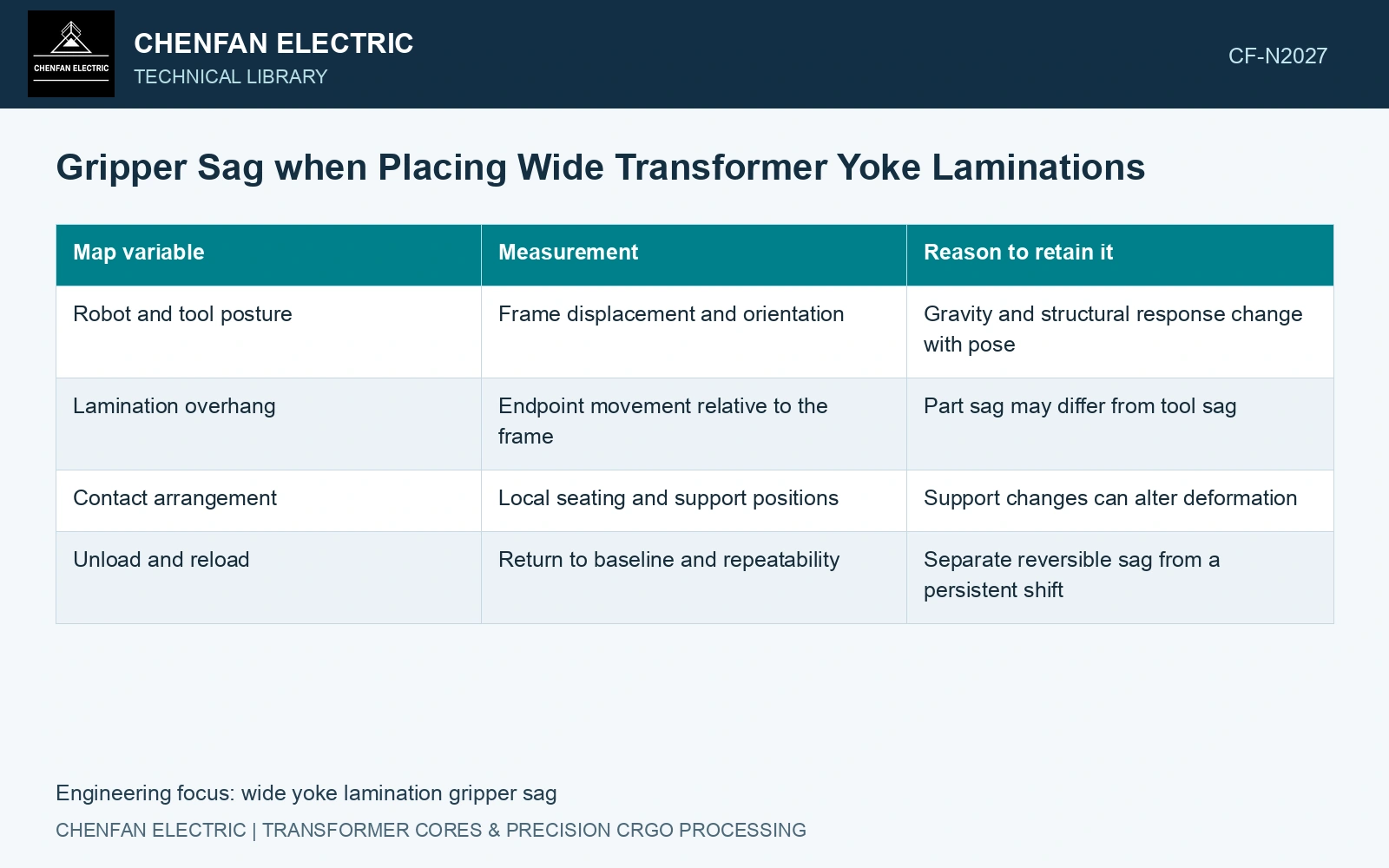
| Map variable | Measurement | Reason to retain it |
|---|---|---|
| Robot and tool posture | Frame displacement and orientation | Gravity and structural response change with pose |
| Lamination overhang | Endpoint movement relative to the frame | Part sag may differ from tool sag |
| Contact arrangement | Local seating and support positions | Support changes can alter deformation |
| Unload and reload | Return to baseline and repeatability | Separate reversible sag from a persistent shift |
Base compensation on the repeatable load map
A correction map requires a repeatable relationship between configuration and displacement. If the same load and posture produce inconsistent shapes because a seal slips or seating changes, a deterministic correction can make some placements worse. First resolve the variable support condition. [1]
Fit the correction using the measured states and test it at independent states not used to determine the map. Avoid extrapolating beyond the qualified load, overhang or posture range. NIST robot accuracy research treats loading and gravity effects as nongeometric, potentially position-dependent errors; it does not justify replacing them with a universal constant. [1]
Validate the moment of release
Measure placement while the tool carries the sheet and again after the sheet transfers its load to the stack. Tool sag can recover as load is released, while the sheet may settle into a different support condition. A correction that aligns the suspended sheet can leave the released sheet displaced if this transition is ignored.
Inspect contact areas and fragile ends as well as gross alignment. Increased vacuum or an extra support can change local deformation even when it reduces overall sag. Verify that the altered contact arrangement does not create a new surface or release problem.
Use catalogue gauge 0.23 mm and density 7,650 kg/m³ [2]. An assumed 1.5 × 0.40 m sheet weighs 1.0557 kg. For an independent static beam screen, assume simply supported free spans 0.15/0.10 m, E = 200 GPa and g = 9.81 m/s². With I = bt³/12 and w = ρbtg, δ = 5wL⁴/(384EI) gives 0.561/0.111 mm, with δ/L = 0.00374/0.00111. The shorter span has 0.1975 of the sag, an 80.25% reduction in this small-deflection model. Select it for loaded validation, not automatic compensation release. Real suction contacts, acceleration and support transfer still need a shape measurement; large-deflection spans cannot inherit this ratio without another model.
Gripper-pad locations, sheet flatness, support sequencing and acceleration govern the wide-sheet shape. Verify the far yoke tips after release because reduced midspan sag does not guarantee correct overlap registration.
The qualified map should state the load family, postures and release condition it covers. When a yoke width or tool contact pattern changes, compare that new state with the map before relying on the old compensation.
References
- G. Qiao and B. A. Weiss, Industrial Robot Accuracy Degradation Monitoring and Quick Health Assessment, Journal of Manufacturing Science and Engineering 141, 2019. DOI: 10.1115/1.4043649.
- Nippon Steel Corporation, Grain-Oriented Electrical Steel Sheets, catalogue D004je, April 2020, specification and typical-property tables.