

Recover an interrupted step-lap cycle from the last physically confirmed layer. Reconcile released, retained and unverified laminations before selecting the next part, keeping the sequence aligned with the core. [1]
Freeze the expected and observed states
Retain the active job revision, intended lamination identity, step-lap phase, last confirmed placement and any command issued after that confirmation. Inspect whether the tool still holds a part and whether a part lies in an uncertain position on the stack. Preserve this evidence before moving material during recovery.
The physical stack is the deciding object, but its visible top profile may not reveal every buried layer. Use the cell’s established layer record and observable geometry together. A remembered operator action or a nominal program counter cannot substitute for an unresolved placement observation.
Locate a confirmed recovery boundary
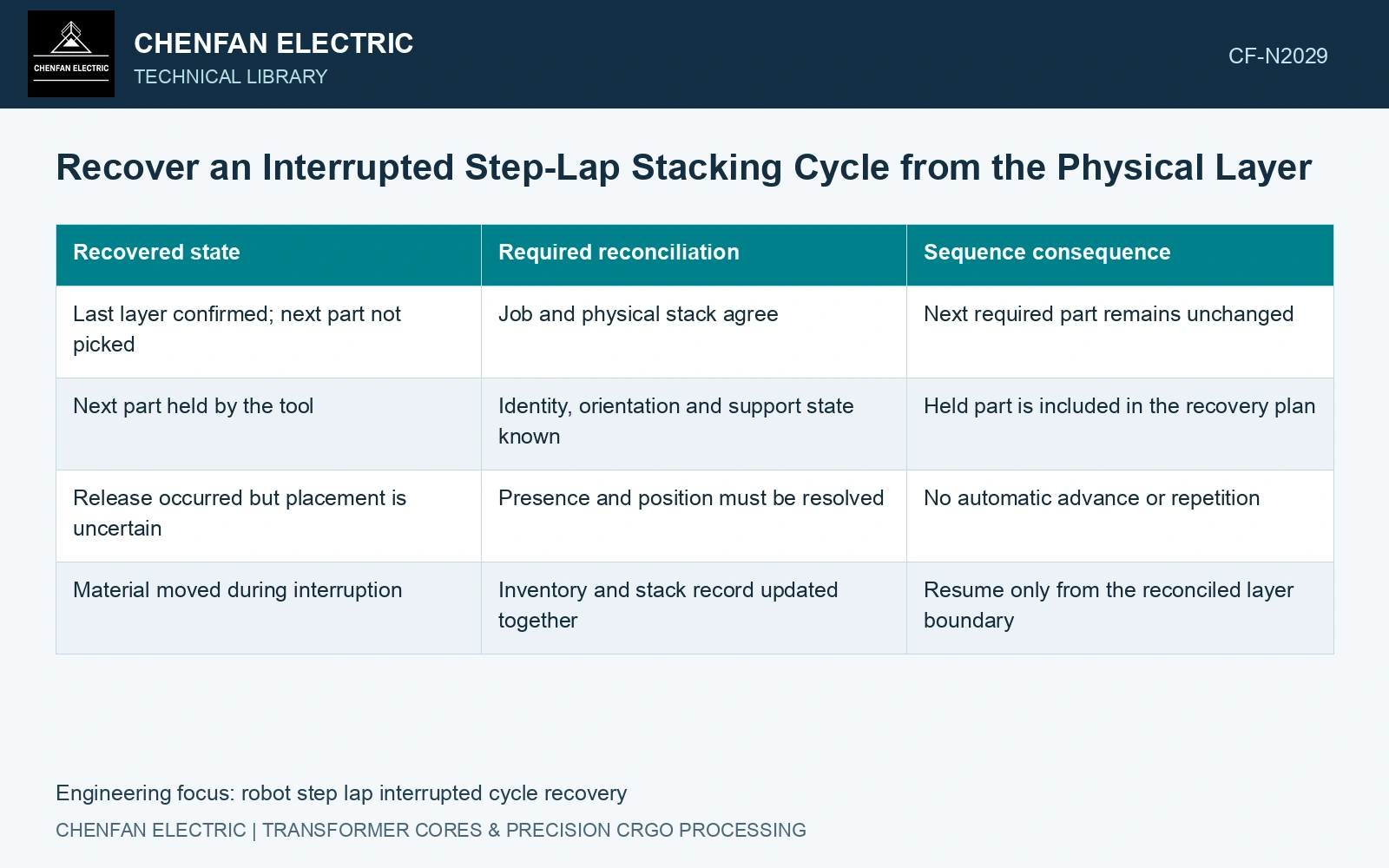
| Recovered state | Required reconciliation | Sequence consequence |
|---|---|---|
| Last layer confirmed; next part not picked | Job and physical stack agree | Next required part remains unchanged |
| Next part held by the tool | Identity, orientation and support state known | Held part is included in the recovery plan |
| Release occurred but placement is uncertain | Presence and position must be resolved | No automatic advance or repetition |
| Material moved during interruption | Inventory and stack record updated together | Resume only from the reconciled layer boundary |
Reconcile actions that cross the checkpoint
Check whether a counter advanced before or after placement confirmation, whether a feeder delivered another part and whether a rejected part created a replacement requirement. These events can occur on different devices with different timestamps. Reconstruct their order using synchronized records where available, and preserve uncertainty when the order cannot be established.
For a step-lap sequence, the correct next part includes its sequence position, not just its external shape. Two similar laminations can belong to different steps. If the top stack was partly disturbed, inspect the affected region before treating the retained layer record as physically valid.
Validate recovery scenarios during commissioning
Use controlled interruption scenarios at picking, transport, release and confirmation boundaries. Demonstrate that each approved recovery path preserves the intended layer sequence and part inventory. Include power or communications loss only through the authorized machine procedure; do not improvise restart motion around an uncertain held part.
The controller’s recovery semantics must be demonstrated on the actual cell. Test interruptions that cross pick, release and placement-confirmation boundaries, including relevant interactions with job revision or buffer occupancy [1]. Generic equipment descriptions cannot establish those transaction rules.
For a stack of catalogue 0.23 mm sheets, assume interruption occurs after physical placement of layer 537 but before the controller commits it. [2] Restarting from the last committed count of 536 would duplicate one sheet and add 0.23 mm nominal steel thickness. Skipping to 538 without checking could instead omit its assigned variant. The recovery decision must be based on the observed layer and lap state, with an explicit reconciliation of the pending transaction. Confirm the next physical part and sequence position before enabling motion; height alone does not identify the uncommitted variant.
Recovery records need physical layer identity, lap phase, gripper occupancy and any manual intervention. Keep the partial stack restrained while the pending transfer is reconciled.
A reliable recovery record names the last physically confirmed layer and the disposition of every part beyond it. The next action can then follow a known sequence state instead of an assumption about where the program stopped.
References
- NIST, Combinatorial Testing, programme and method overview.
- Nippon Steel Corporation, Grain-Oriented Electrical Steel Sheets, catalogue D004je, April 2020, specification and typical-property tables.