

Percent impedance gives magnitude; X/R describes its composition. Two transformers with the same percent Z can produce different asymmetrical fault-current peaks and different DC-offset decay because their resistance-to-reactance split is different. Studies that check breaker making duty, CT performance, relay transient behavior or mechanical peak forces therefore need R and X, or an equivalent X/R ratio, in addition to percent impedance.
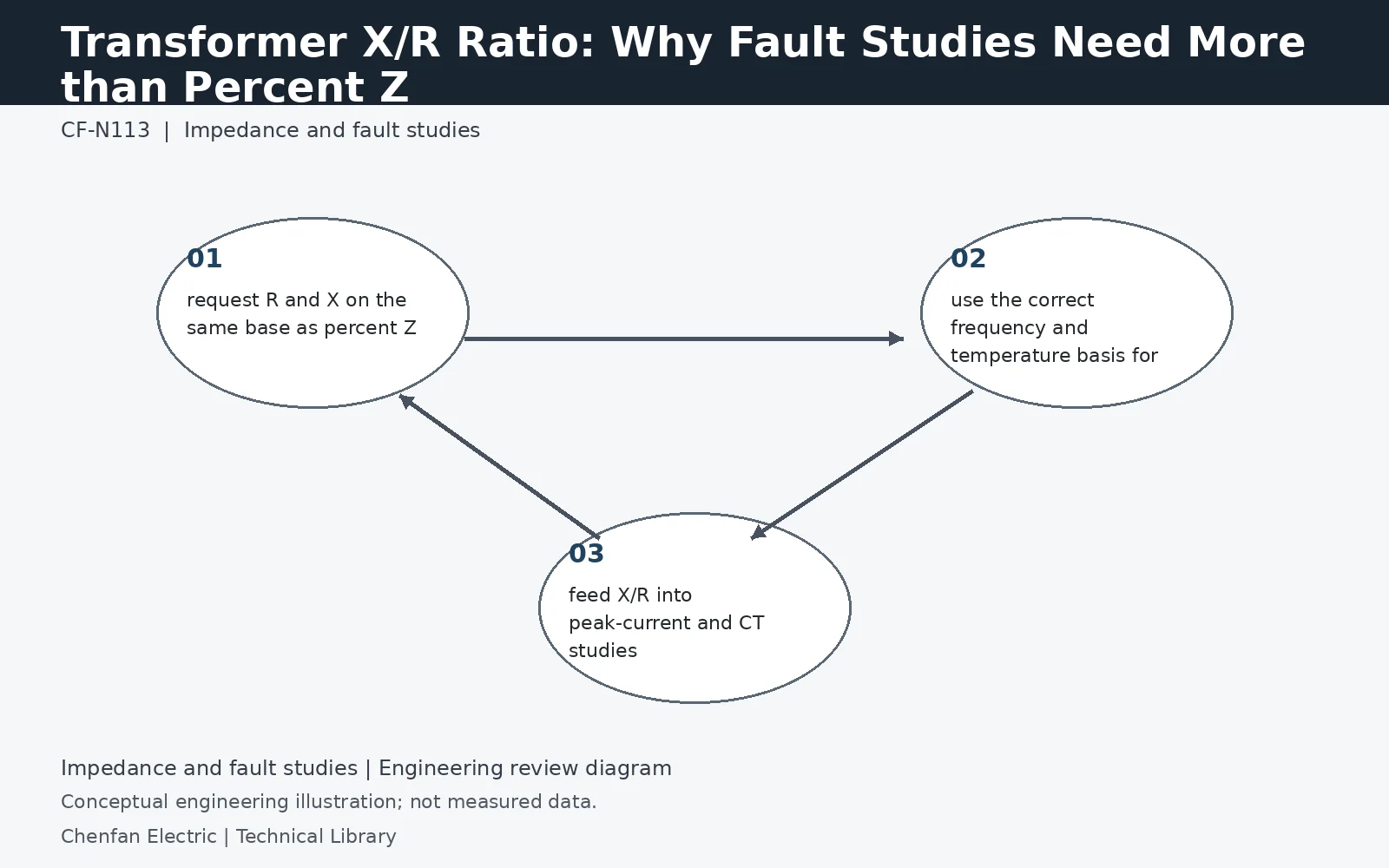
Resolve impedance into resistance and reactance
Given impedance magnitude |Z| and ratio q = X/R, calculate R = |Z|/sqrt(1 + q²) and X = qR. Apply the same reference temperature and base to both components. Do not confuse the transformer's own X/R with the equivalent system X/R at a fault: source, cables and other branches alter the combined value. If resistance is inferred from load-loss data, confirm the manufacturer's method because measured load loss can contain stray components and is not simply a room-temperature winding resistance measurement.
Compare decay time, not only symmetrical current
For a simple equivalent series R-L circuit, the DC time constant is τ = L/R = (X/R)/(2πf). At 50 Hz, X/R values of 10 and 20 correspond to about 31.8 ms and 63.7 ms respectively. This illustrates why equal impedance magnitudes can produce different decaying offsets. The first peak also depends on fault inception angle and the network representation. Use the calculation method required by the equipment rating standard rather than treating this simple time constant as a complete breaker-duty calculation.
Pass the transient basis to the protection team
CT saturation and relay performance depend on more than the steady symmetrical current. Provide the maximum fault case, equivalent X/R, CT excitation information, secondary burden and clearing sequence. Include a minimum-fault case for sensitivity rather than assuming the maximum-current model covers both purposes. When an impedance or source revision arrives, update the transient inputs as well as the fault-current magnitude. A report that changes only the kA column can leave making-duty and CT checks based on an obsolete decay assumption.
Technical reference framework
[1] IEC 60076-1:2011 — Power transformers, General.
[2] IEC 60076-5:2006 — Ability to withstand short circuit.
[3] IEC 60076-8:1997 — Application guide.