

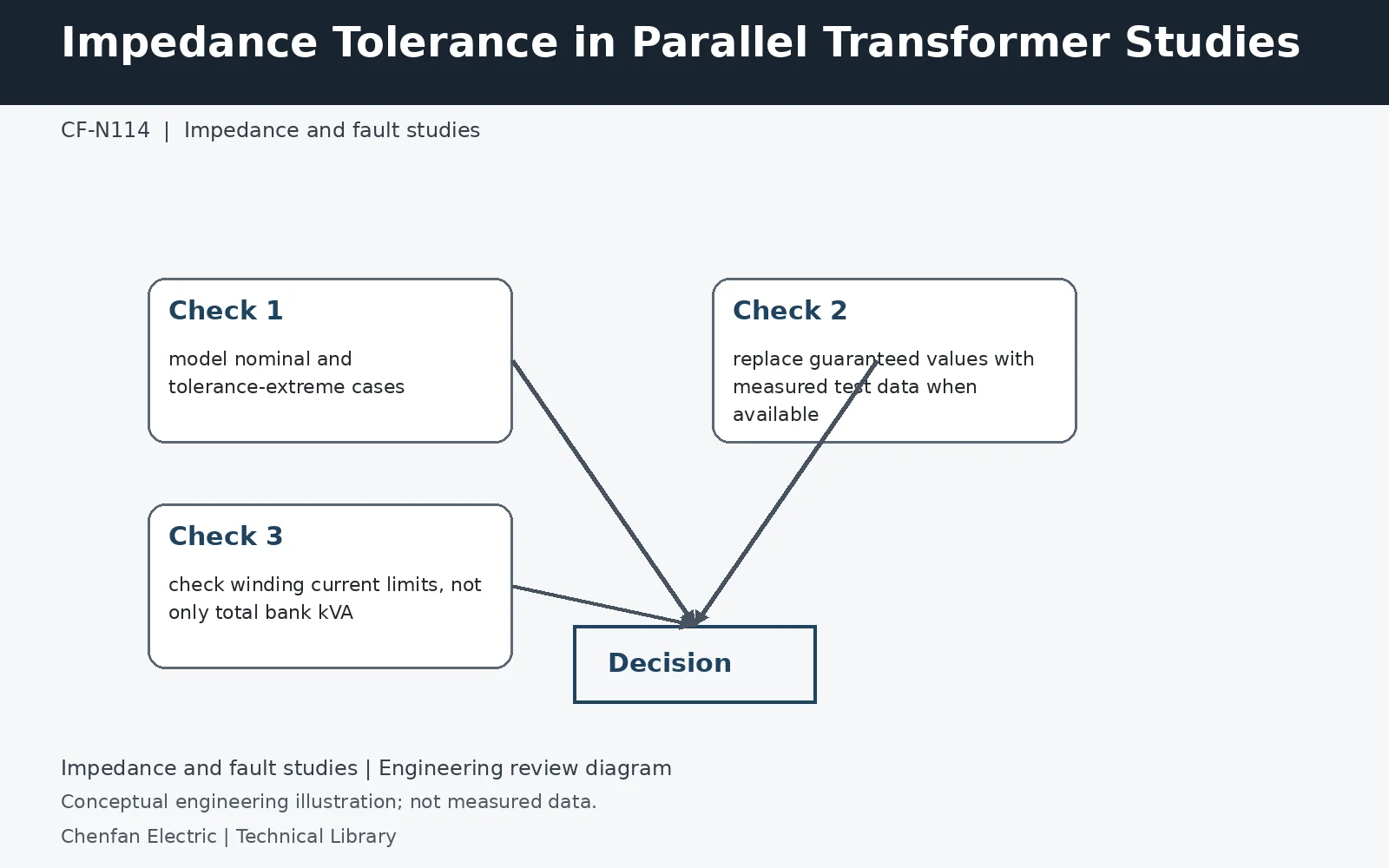
Parallel-load sharing is sensitive not only to nominal impedance but also to manufacturing and test tolerance. If two units sit near opposite ends of the permitted impedance band, the lower-impedance transformer can take more than its proportional kVA share even when ratios and vector groups match. A credible study should examine nominal, low/high tolerance combinations and available measured factory-test values.
Test the low-impedance and high-impedance pair
Assume equal-rated transformers with equal induced voltages and equal impedance angles. With negligible connection impedance, current divides inversely with impedance. For illustrative values of 5.5% and 6.5% on equal bases, the lower-impedance unit takes 6.5/(5.5 + 6.5) = 54.17% of total current. If both units are rated 1 MVA and the bank carries 2 MVA at the corresponding voltage, that unit carries about 1.083 MVA. The values are an example, not a statement of a standard tolerance.
Turn the sharing result into a bank limit
In that simplified example, limiting the more heavily loaded unit to 1 MVA restricts the bank to roughly 1/0.5417 = 1.846 MVA. Real installations also need voltage-ratio mismatch, X/R differences, cable impedance and cooling-stage limits included. This is why installed MVA and usable parallel-bank capacity can differ. Run both low/high combinations when either supplied unit could lie at either end of the agreed band; checking only the most convenient pairing misses a legitimate procurement outcome.
Use factory results without losing the guarantee
At the procurement stage, assess the full agreed guarantee band. After manufacture, re-run the case with test values on the same temperature, tap and MVA bases. A measured result can refine the predicted sharing but does not retroactively change the contract acceptance criterion. Record instrument and correction conventions where they affect interpretation. If a spare transformer may replace either unit later, check its guaranteed compatibility envelope as well; a bank optimized only for today's two measured values may not accept the planned spare.
Technical reference framework
[1] IEC 60076-1:2011 — Power transformers, General.
[2] IEC 60076-5:2006 — Ability to withstand short circuit.
[3] IEC 60076-8:1997 — Application guide.