

Lower transformer impedance reduces internal voltage drop but increases available fault current; higher impedance does the reverse. The optimum therefore depends on breaker ratings, bus bracing, feeder voltage performance, motor starting, parallel operation and the utility source strength. A procurement target should emerge from a coordinated system study, not from a universal preferred percentage.
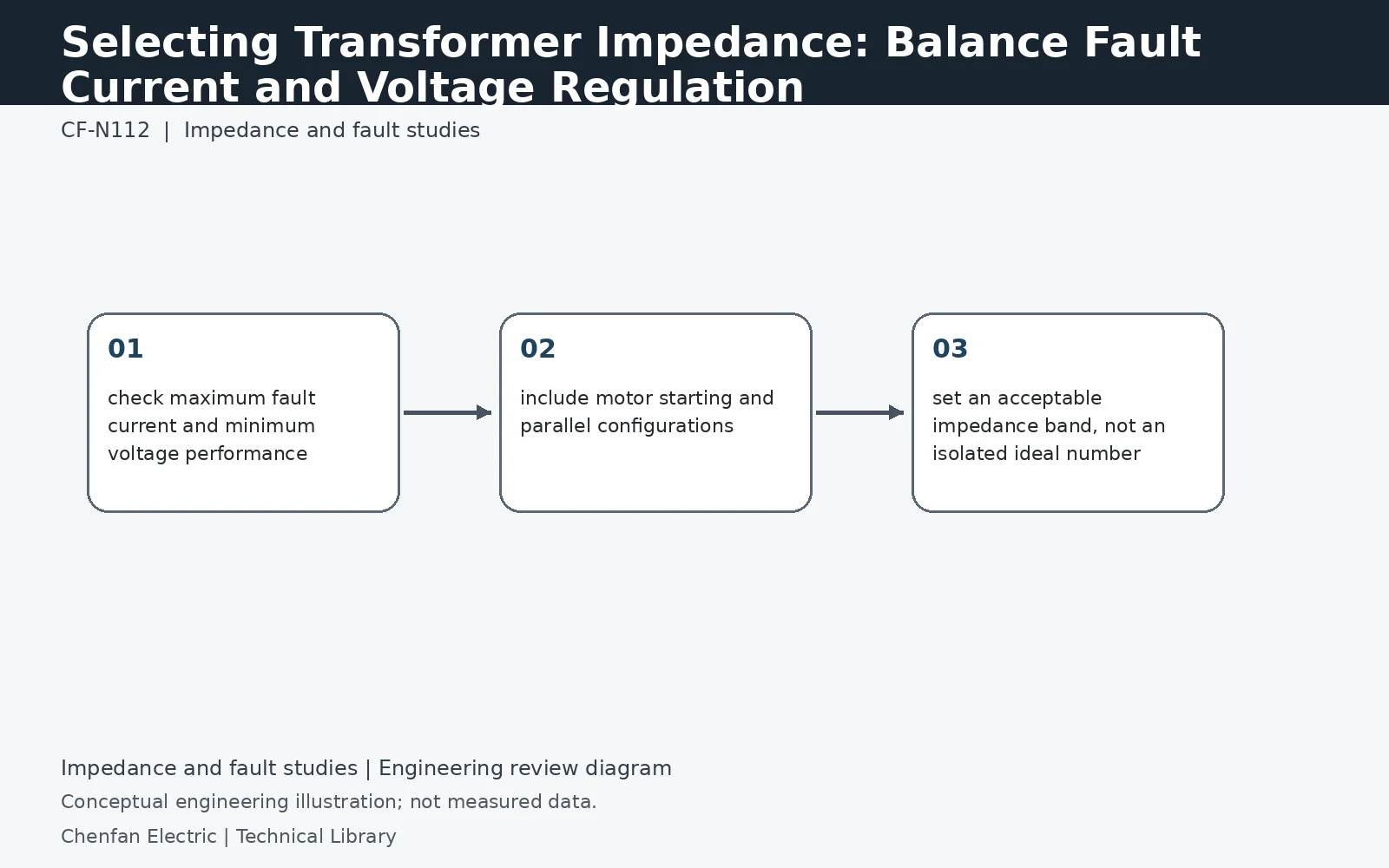
Quantify the fault-current trade-off first
Consider a 1 MVA, 400 V transformer with an ideal stiff source and no other infeed. Rated current is about 1,443 A. A simplified symmetrical terminal-fault estimate gives 1,443/0.06 = 24.1 kA at 6% impedance, compared with 18.0 kA at 8%. These illustrative values exclude source and connection impedance and are not final equipment duties. They show why a small change in the requested impedance can materially affect downstream switchgear selection even when voltage and capacity remain unchanged.
Then test the voltage-sensitive operating cases
Higher impedance can worsen voltage drop with lagging loads and during starting, but the actual change depends on its resistance/reactance split and load angle. Model the motor terminals, not only the transformer bus. Include weak-source operation, expected tap positions and any leading-power-factor condition. A tap change can compensate a steady voltage offset but does not remove the transformer impedance or necessarily solve an acceleration problem. Compare alternatives using the same load cases so an apparent improvement is not caused by different assumptions.
Specify an acceptable range, not an isolated target
The lowest allowed impedance often governs maximum fault current, while the highest allowed value may govern voltage performance. Parallel operation can impose an additional sharing constraint across two units' tolerance bands. Send those boundary cases to the manufacturer and agree a realizable guarantee and test basis. A nominal target that passes only at its midpoint is not a robust procurement requirement. The final selection should state which fault, voltage and sharing limits were checked and which upstream source conditions would require another review.
Technical reference framework
[1] IEC 60076-1:2011 — Power transformers, General.
[2] IEC 60076-5:2006 — Ability to withstand short circuit.
[3] IEC 60076-8:1997 — Application guide.