

Choose the extrapolation window to retain shutdown thermal information after the resistance measurement settles. The synthetic comparison below separates fit quality from intercept accuracy; selecting a valid heat-run method still requires the governing test procedure.
The first recorded points have a different difficulty. Test-current establishment, switching and the inductive response can interfere with a stable resistance reading. A defensible fitting window must deal with both effects: early measurement settling and later loss of information about fast thermal behavior.
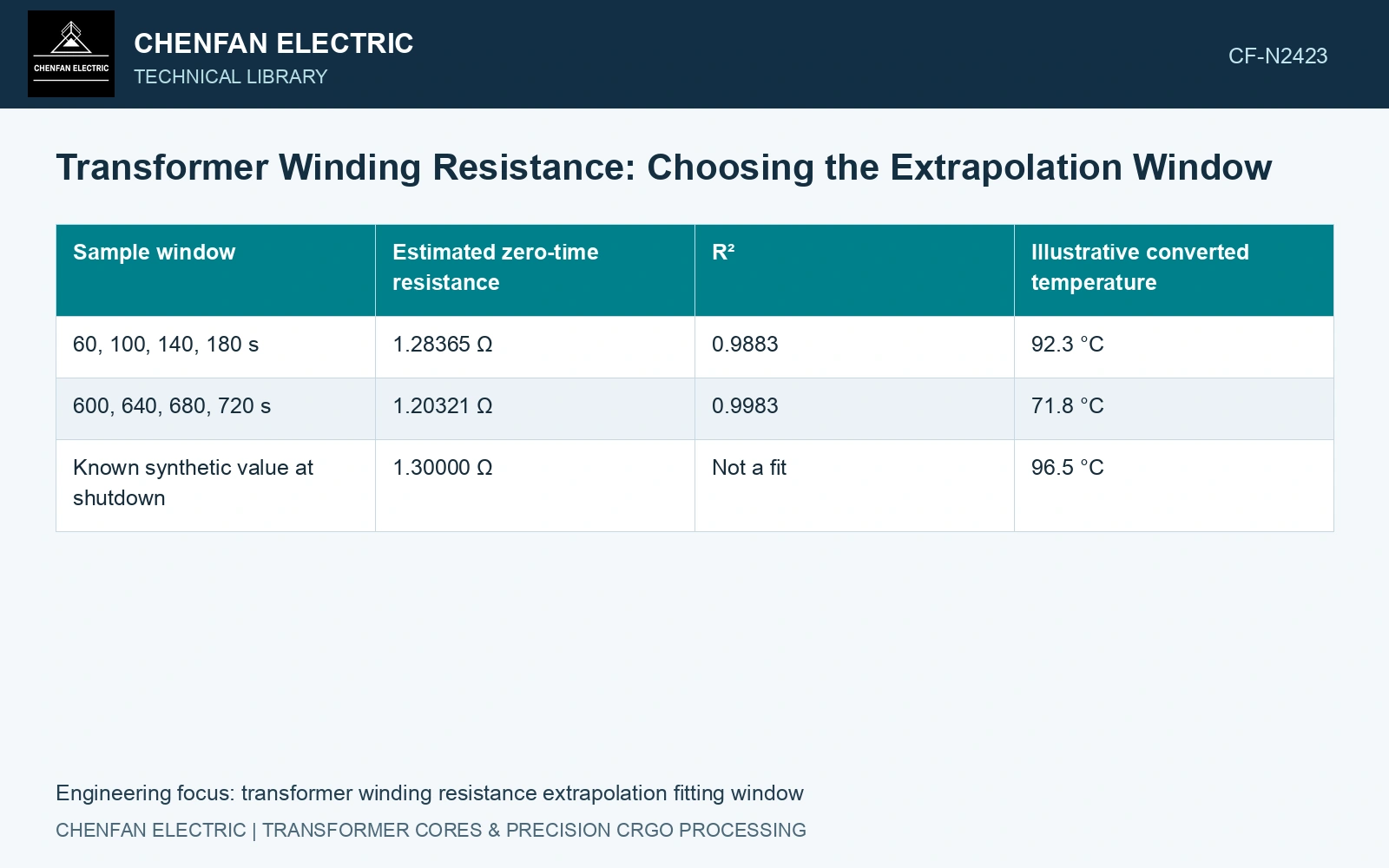
Separate acquisition settling from winding cooling
Keep the shutdown event, connection events, current trace and resistance trace on a common timeline. Exclude an initial point because its measurement is demonstrably unsettled, not because it makes the fitted curve inconvenient. Retain excluded data and the reason for exclusion.
Changing test current or connection configuration partway through the sequence can create a discontinuity unrelated to the thermal model. A fit should not absorb such a step as if it were continuous cooling. Conversely, a real early thermal change should not be deleted merely to increase the coefficient of determination.
Compare fit quality with shutdown-intercept accuracy
Consider an illustrative synthetic curve R(t) = 1.15 + 0.10e−t/150 + 0.05e−t/1500 Ω, with time in seconds. Its true zero-time resistance is 1.300 Ω. Ordinary linear fits to four equally spaced samples give the following results. This linear-fit comparison exposes window sensitivity; it is not a prescribed heat-run calculation method.
| Sample window | Estimated zero-time resistance | R² | Illustrative converted temperature |
|---|---|---|---|
| 60, 100, 140, 180 s | 1.28365 Ω | 0.9883 | 92.19 °C |
| 600, 640, 680, 720 s | 1.20321 Ω | 0.9983 | 71.72 °C |
| Known synthetic value at shutdown | 1.30000 Ω | Not a fit | 96.35 °C |
Assume cold resistance 1.000 Ω at 20 °C. Use the USBR copper constant k = 234.5 °C [1] in T = (R/Rcold)(k + Tcold) − k. The late fit has the higher R² and the lower, less accurate shutdown intercept.
Assume standard uncertainty of 0.002 Ω in a fitted intercept, with the cold reference and conversion inputs held exact solely for this sensitivity check. The temperature sensitivity is 254.5 K/Ω, so that contribution is 0.509 K. Add covariance and other input contributions in a complete uncertainty model [2]; this isolated term cannot cover a wrong cooling model.
Compare the synthetic intercepts on the copper conversion
The known synthetic shutdown temperature is 96.35 °C. The early and late linear fits under-read it by 4.16 K and 24.63 K. If the illustrative maximum permitted model bias is assumed to be 2 K, neither window passes, despite both high R² values. Do not select the late window or accept the early one from appearance alone. Recover earlier stable observations or validate a better cooling representation, then repeat the intercept and uncertainty comparison.
Report how much the answer depends on selection
Repeat the accepted fitting method over neighboring admissible windows and compare the shutdown estimates. Inspect residual shape as well as fit statistics. Consistent curvature can indicate that the model is missing a thermal component even when random scatter is small.
References
- U.S. Bureau of Reclamation, FIST Volume 3-31, Transformer Diagnostics, June 2003.
- B. N. Taylor and C. E. Kuyatt, NIST Technical Note 1297, Guidelines for Evaluating and Expressing the Uncertainty of NIST Measurement Results, 1994, sections 5 and 6.