

An ambient-reference bias changes reported rise directly. Assume an 85 °C winding and 20 °C reference air: the rise is 65 K. A probe reading 24 °C in warm return air instead reports 61 K. This 4 K arithmetic difference does not establish that either location is the reference required by the governing test method [1].
Calibration checks the probe and measurement chain under defined conditions. It does not establish that a particular location measures the ambient quantity required by the heat-run procedure. Placement deserves its own review, especially where fans, nearby equipment or sunlight change the air and radiation around the transformer.
Identify what heats the ambient probe
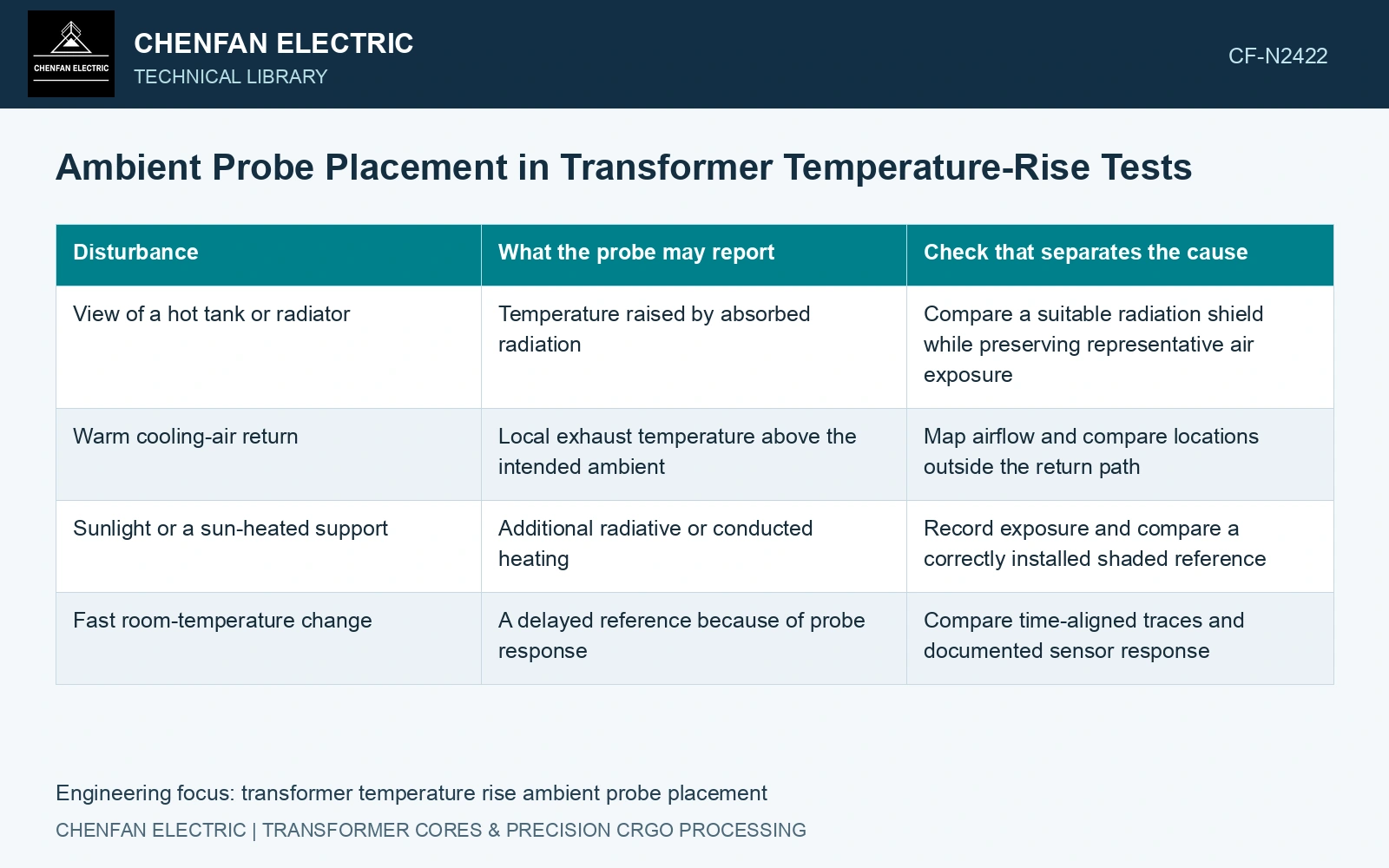
A probe exchanges heat with the air, surrounding surfaces and its mounting or leads. A hot radiator can affect an unshielded sensor by radiation even when the nearby air remains cooler. A fan may improve convection at the sensor while also carrying heated exhaust towards it. A protective cover can reduce radiation yet slow the response or trap a different air sample.
| Disturbance | What the probe may report | Check that separates the cause |
|---|---|---|
| View of a hot tank or radiator | Temperature raised by absorbed radiation | Compare a suitable radiation shield while preserving representative air exposure |
| Warm cooling-air return | Local exhaust temperature above the intended ambient | Map airflow and compare locations outside the return path |
| Sunlight or a sun-heated support | Additional radiative or conducted heating | Record exposure and compare a correctly installed shaded reference |
| Fast room-temperature change | A delayed reference because of probe response | Compare time-aligned traces and documented sensor response |
The sign of the final error follows the measurement definition. For rise ΔT = Tcomponent − Tambient, a positive ambient bias reduces the reported rise. A cold draught can produce the opposite effect. Averaging two biased probes does not restore the intended reference.
Investigate disagreements between ambient channels
Record probe identity, height, orientation, shielding, support and position relative to cooling equipment. Compare the channels through fan changes and environmental changes rather than checking only the final readings. A channel that follows fan exhaust immediately while another follows room air gradually may be measuring a different local environment.
A controlled position swap can help separate sensor offset from location effects, provided it is performed within an agreed investigation and does not invalidate the qualification run. Log the intervention. If the discrepancy follows the location, replacing a calibrated probe is unlikely to solve it.
Radiation, convection and mounting conduction can make probe temperature differ from its intended air measurand [2]. A calibrated sensor therefore still needs a representative installation; averaging several probes exposed to the same warm return does not remove that common location bias.
Carry the ambient-reference bias into the rise
For the stated assumed 85 °C winding, a 20 °C ambient gives 65 K rise and a 24 °C warm-return reading gives 61 K. The 4 K difference is a location-dependent reference bias. Verify the required ambient geometry and channel history before claiming extra winding margin from the lower reported rise.
References
- IEC, IEC 60076-2:2011, Power transformers — Part 2: Temperature rise for liquid-immersed transformers.
- U.S. Department of Energy, DOE-HDBK-1012/2-92, Thermodynamics, Heat Transfer, and Fluid Flow, Volume 2, 1992.