

Transformer uprating can change permissible loading, cooling assumptions and measurement requirements even when primary voltage is unchanged. Fault current changes only when the relevant physical network or operating conditions change, not simply because a larger MVA number is declared. Protection review must distinguish these effects before revising settings.
An MVA-base change does not create more fault current
If an uprating changes cooling capability but leaves the transformer's physical impedance in ohms unchanged, recalculating percent impedance on a larger MVA base does not by itself change the terminal fault current. For example, 8% on 20 MVA becomes 10% on 25 MVA at the same voltage. The ohmic impedance is identical. A replacement or winding redesign may genuinely change impedance, so distinguish a numerical base conversion from a physical network modification before revising the fault study.
Higher continuous current can exceed existing interfaces
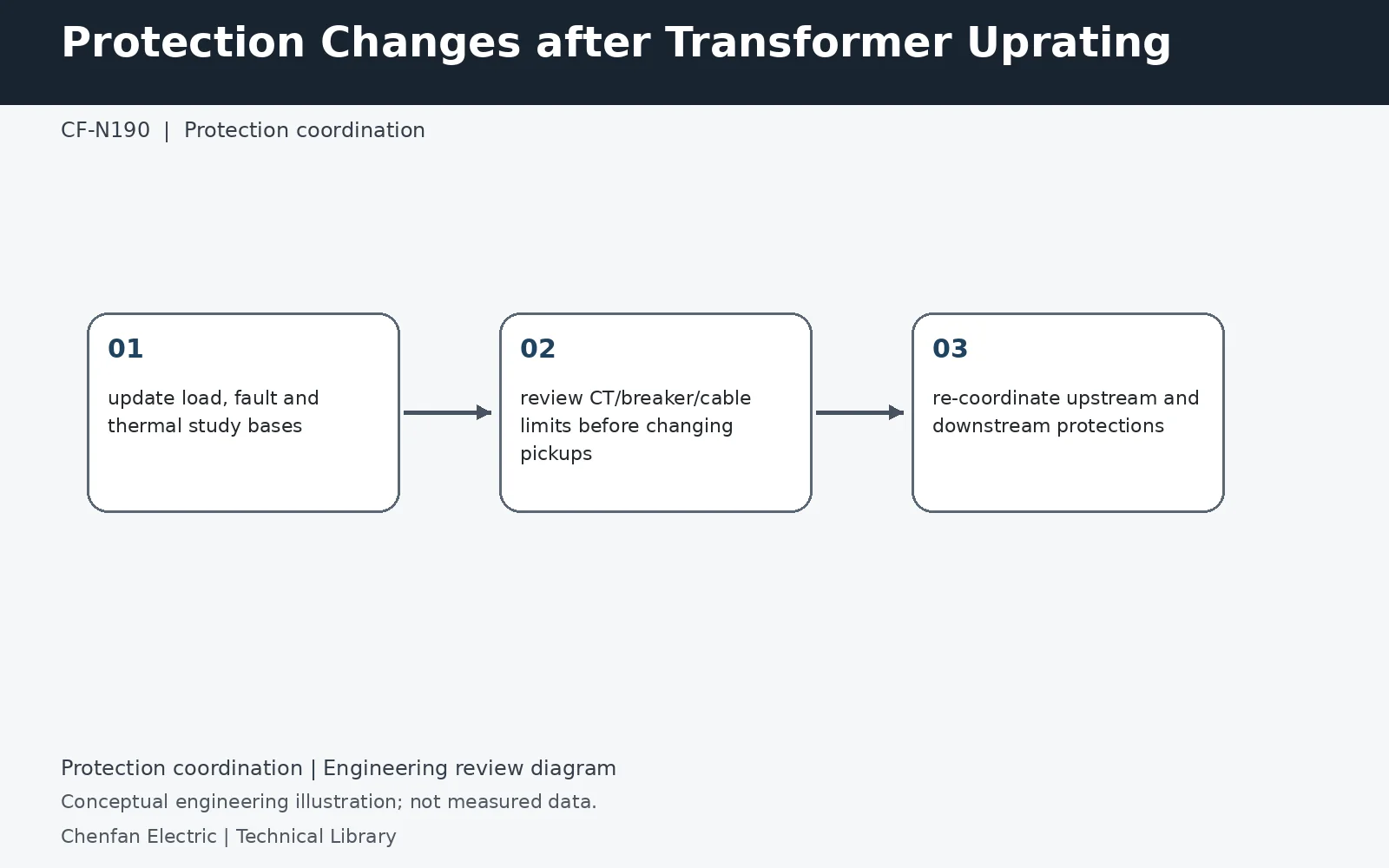
At unchanged voltage, higher permitted MVA means higher rated current. Check CT continuous capability and measurement range, bushings, buswork, cables and breaker continuous ratings. An equipment item can become the new limiting element even when the transformer thermal design supports the uprating. CT-ratio changes also affect relay scaling and metering, so they require a coordinated revision rather than an isolated change to a nameplate or database field.
Reissue the thermal and coordination basis together
Obtain the manufacturer's supported rating by cooling stage and any revised thermal parameters. Recheck maximum load, minimum fault sensitivity, through-fault coordination and loss of a cooling stage using the updated operating envelope. Preserve unchanged settings only where the revised study supports them. The closeout package should contain the new rating schedule, affected drawings, relay configuration and test records, with obsolete values clearly superseded to prevent later reuse.
Technical reference framework
[1] IEEE C37.91-2021 — Protecting power transformers.
[2] IEC 60076-1:2011 — Power transformers, General.
[3] IEEE C57.109-2018 — Liquid-immersed transformer through-fault-current duration.