

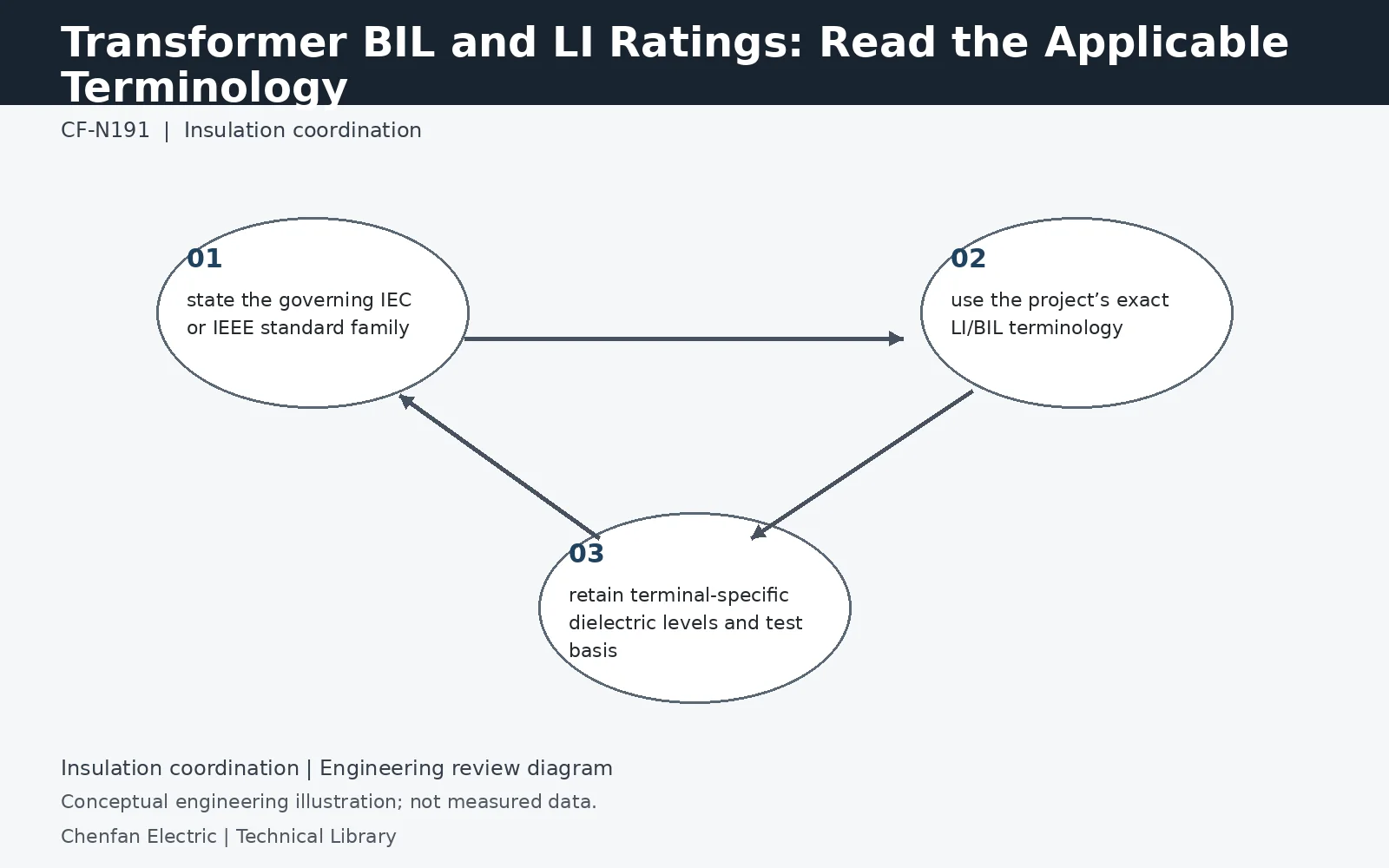
BIL is IEEE terminology for a lightning-impulse insulation level; IEC documentation more commonly states rated lightning impulse withstand voltage (LI). They express related insulation-coordination concepts but should not be mixed without checking the applicable standard and voltage class. Procurement should use the terminology and standard basis required by the project and avoid translating one label into another as if every test definition were identical.
Keep operating RMS voltage separate from impulse peak voltage
A lightning-impulse withstand value is a peak-voltage test quantity, whereas a system operating voltage is commonly expressed as power-frequency RMS. The numbers therefore cannot be compared as though they described the same waveform or continuous duty. BIL is commonly expanded as basic lightning impulse insulation level in IEEE practice; IEC schedules use rated lightning impulse withstand voltage. The related terminology does not remove the need to identify the standard edition and the exact terminal requirement.
Compare the complete dielectric test schedule
Two offers with the same quoted impulse kV can still differ in specified test configuration, terminal coverage or other dielectric duties. Review the applicable full-wave and any required chopped-wave or other tests, neutral-end requirements and the winding connection used during testing. Do not infer that a line-terminal impulse number also applies to a reduced-insulation neutral. The purchaser should reconcile these fields before describing unlike standard-based offers as technically equivalent.
Use system coordination to select the level
The selected withstand level must be coordinated with the expected overvoltages and protective devices at the installation. Choosing a larger impulse number alone does not resolve arrester location, temporary overvoltage or external-clearance issues. The purchase schedule should name the equipment highest voltage, terminal-specific withstand duties and governing insulation-coordination report. A cross-reference between terminology is useful; an automatic one-label substitution is not a substitute for this engineering review.
Technical reference framework
[1] IEC 60071-1:2019 — Insulation co-ordination, Definitions, principles and rules.
[2] IEC 60071-2:2023 — Insulation co-ordination, Application guidelines.
[3] IEC 60076-3:2013 + AMD1:2018 — Insulation levels, dielectric tests and external clearances.
[4] IEEE C57.98-2026 — Transformer impulse tests.