

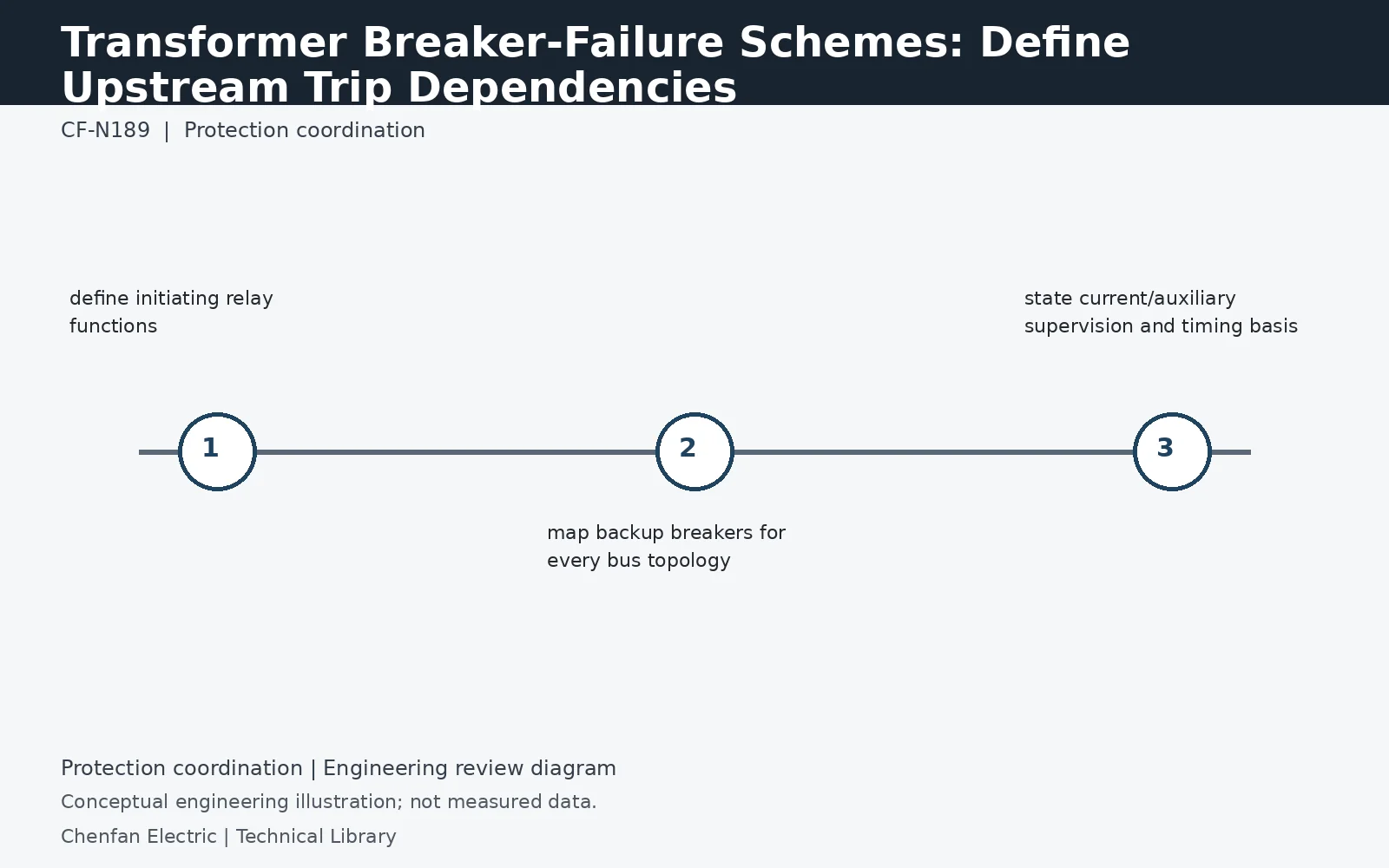
Breaker-failure protection is a dependency scheme, not just a local timer. For a transformer breaker failure, the backup trip may need to open upstream, bus-tie or remote breakers depending on current paths. The design file should define initiating protections, breaker auxiliary/current supervision, timer logic and the exact backup trip matrix for each bus configuration.
Backup tripping must remove every relevant source path
A failed breaker can leave a fault supplied from an upstream source, a bus tie, another transformer or an embedded generator. The required backup action depends on the actual topology and the location of the fault. Draw the remaining current paths after the intended breaker fails to clear, then identify the breakers needed to isolate them. A standard instruction to “trip upstream” can be incomplete where several directions of supply remain available.
Initiation, current supervision and reset form one function
Specify which protection trips initiate breaker-failure logic and how continuing current, breaker status and timers are used. Current supervision can be challenging for low-current faults or certain mechanical-protection trips, so the selected logic needs application-specific review. Define how the function resets after successful interruption and how a failed auxiliary contact is treated. A timer value without these conditions does not describe a complete breaker-failure scheme.
Use total backup-clearing time in equipment checks
Transformer and conductor short-time duty must consider the interval from fault inception through detection, attempted primary clearing, breaker-failure decision and final backup interruption. Communication delay can matter for remote trips. Compare that total with the applicable equipment capability and system stability requirements. Acceptance testing should verify the trip matrix for every permitted bus state, with test isolation and execution controlled by the authorized commissioning procedure.
Technical reference framework
[1] IEEE C37.91-2021 — Protecting power transformers.
[2] IEC 60076-1:2011 — Power transformers, General.
[3] IEEE C57.109-2018 — Liquid-immersed transformer through-fault-current duration.