

Mark a fan or pump transition as a new cooling state on the trace. Stored heat and changed heat removal drive component temperatures toward a new condition [1]. Different nodes can respond on different timelines.
The same issue arises when oil circulation changes. Cooling commands, actual equipment operation and component temperatures do not change on an identical timeline. A useful test record distinguishes all three.
Mark the actual configuration on the thermal trace
Record which fans and pumps operated, their actual status and any associated valve or flow change. A command issued by a controller should have a separate event marker from confirmed operation. Where oil circulation is important, motor status alone does not establish the hydraulic state.
Keep the heating input visible. If applied losses or winding currents change when the cooling equipment starts, the temperature response contains both changes. The test must identify what operating duty each segment represents.
The immediate response comes from stored heat
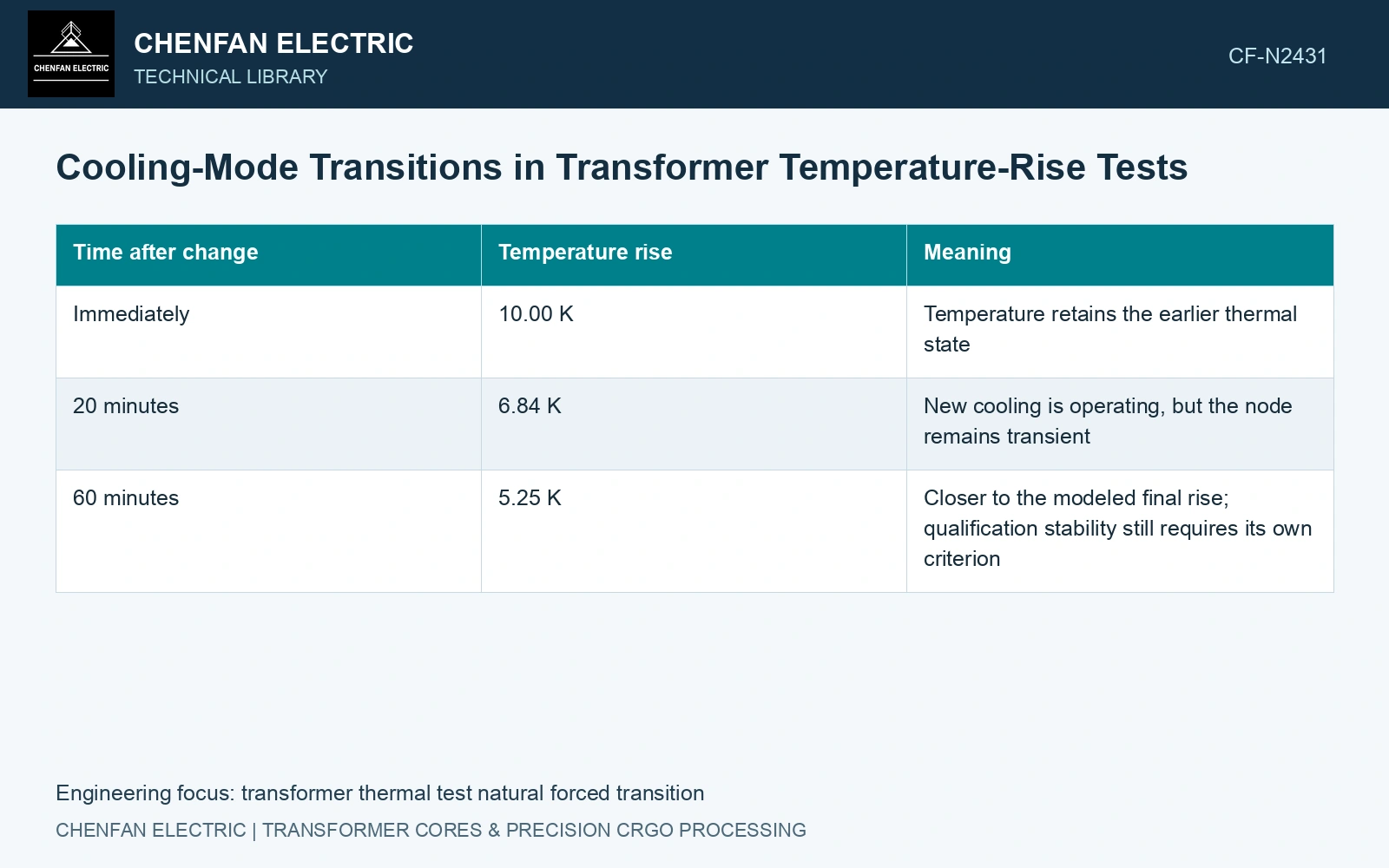
For an illustrative single-node model at constant ambient, let heating power be10kW. The initial conductance is1kW/K, giving a steady rise of10K. When conductance increases to2kW/K, the new modeled steady rise is5K. The component temperature cannot jump from one value to the other.
With a chosen new time constant of20minutes, the response is ΔT(t) = 5 + 5e−t/20 K, with time in minutes measured from the conductance change. The parameters are illustrative effective quantities, not a model of a particular cooling designation or transformer.
| Time after change | Temperature rise | Meaning |
|---|---|---|
| Immediately | 10.00 K | Temperature retains the earlier thermal state |
| 20 minutes | 6.84 K | New cooling is operating, but the node remains transient |
| 60 minutes | 5.25 K | Closer to the modeled final rise; qualification stability still requires its own criterion |
In the assumed node, increased conductance changes heat removal immediately while the stored-energy temperature remains continuous [1]. Assign the eventual accepted rise to the documented cooling mode and the governing temperature-rise method [2], rather than to the command timestamp alone.
Verify the transition before taking a final rise
With the stated assumed new time constant of 20 min, rise after the cooling change is 6.839 K at 20 min and 5.249 K at 60 min, approaching 5 K. Neither reading alone supplies the governing stability criterion. Assign accepted measurements to the verified cooling state and qualifying interval.
Assign each result to one defined test state
For each cooling arrangement, identify the required load, loss distribution, environmental reference and qualifying stability interval. A winding reading from the earlier mode and an oil reading from the recovered forced-cooling mode do not describe one common thermal state.
References
- U.S. Department of Energy, DOE-HDBK-1012/2-92, Thermodynamics, Heat Transfer, and Fluid Flow, Volume 2, 1992.
- IEC, IEC 60076-2:2011, Power transformers — Part 2: Temperature rise for liquid-immersed transformers.