

Close a heat balance across one defined transformer boundary. A gap between losses and cooler transfer may include surface rejection, stored heat or measurement error [1]. Allocate those independently before diagnosing the residual.
A heat balance is a useful consistency check when its inputs are independently measured or estimated. It becomes circular if an unknown storage term is chosen solely to make the totals agree.
Draw one boundary for all the terms
For a selected equipment boundary, write Ptransformer + Pauxiliary, inside = Qcooler + Qother surfaces + dU/dt. Include only auxiliary heat that enters that boundary. Account for separate cooling circuits and identify any heat transfer that the measurements omit.
A pump motor can introduce heat into the oil circuit. A fan motor may release much of its heat outside the chosen oil-system boundary. Their electrical input powers should not both be added automatically to the same balance. The physical arrangement determines the allocation.
Use flow and temperature measurements at the same interface
For a cooler oil stream with appropriate property data, Q ≈ ṁcp(Tin − Tout). With illustrative inputs2kg/s,2kJ/(kg·K) and8K, the calculated transfer is32kW. These are chosen example values, not specified oil properties or cooler ratings.
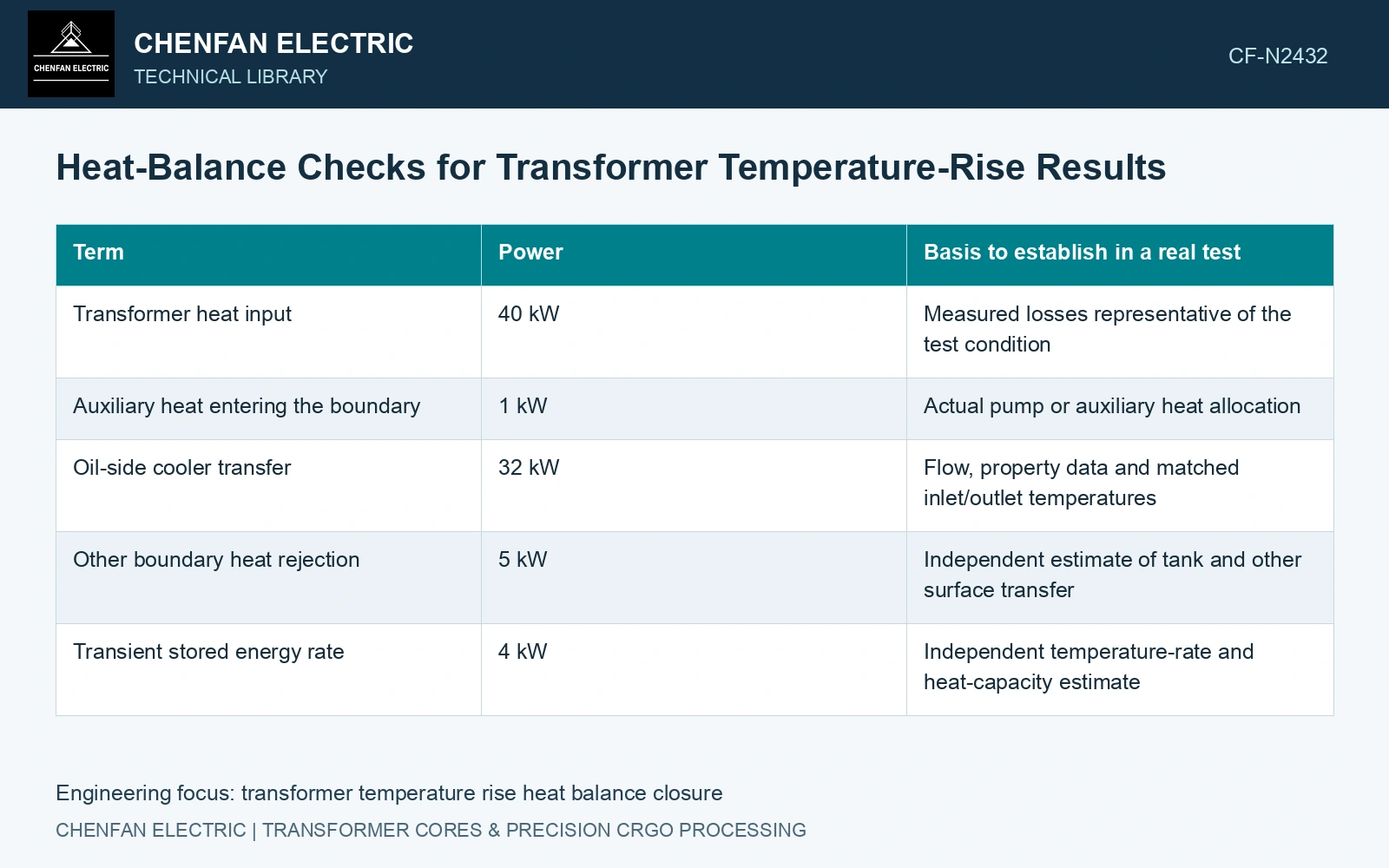
| Term | Power | Basis to establish in a real test |
|---|---|---|
| Transformer heat input | 40 kW | Measured losses representative of the test condition |
| Auxiliary heat entering the boundary | 1 kW | Actual pump or auxiliary heat allocation |
| Oil-side cooler transfer | 32 kW | Flow, property data and matched inlet/outlet temperatures |
| Other boundary heat rejection | 5 kW | Independent estimate of tank and other surface transfer |
| Transient stored energy rate | 4 kW | Independent temperature-rate and heat-capacity estimate |
The input is41kW and the three outgoing or storage terms also total41kW. The example includes continuing thermal storage. It therefore demonstrates energy consistency, not thermal steady state.
For this boundary, the independently assigned 4 kW storage term must come from supported heat capacity and temperature-rate data [1]. A thermal-test method [2] and its qualifying interval still determine whether a steady result has been obtained; zero algebraic residual alone does not.
Separate energy consistency from steady operation
The assumed cooler stream removes 2×2×8 = 32 kW. Inputs total 40+1 = 41 kW and removal/storage terms total 32+5+4 = 41 kW. The zero residual is consistent, while the independently assigned 4 kW storage term means the equipment remains transient. Qualify thermal stability separately.
Investigate a residual before declaring the test wrong
Check flowmeter location, bypass paths, fluid properties and temperature-channel alignment. A small inlet/outlet difference can make the calculated transfer sensitive to differential probe errors. Shared calibration effects may correlate, so the uncertainty of a difference is not always the sum of two independent temperature uncertainties.
References
- U.S. Department of Energy, DOE-HDBK-1012/2-92, Thermodynamics, Heat Transfer, and Fluid Flow, Volume 2, 1992.
- IEC, IEC 60076-2:2011, Power transformers — Part 2: Temperature rise for liquid-immersed transformers.