

Compare repeated heat runs through both assembly state and electrical settings. Reassembly may disturb cooling passages, restraints, lead routes or probes. Record the intervention and actual cooling condition using the maintenance evidence [1], then identify which measured temperatures remain comparable.
The comparison must account for the actual assembly and the measurement process. Otherwise assembly sensitivity may be dismissed as scatter, or a sensor relocation may be reported as a design change.
Pair the build records before pairing the temperatures
Document the parts disturbed, cooling passages opened, clamping changes and subsequent drying or filling operations. Check for displaced insulation, altered duct alignment and changes to directed-flow paths. Record the liquid condition and any intervention capable of affecting circulation.
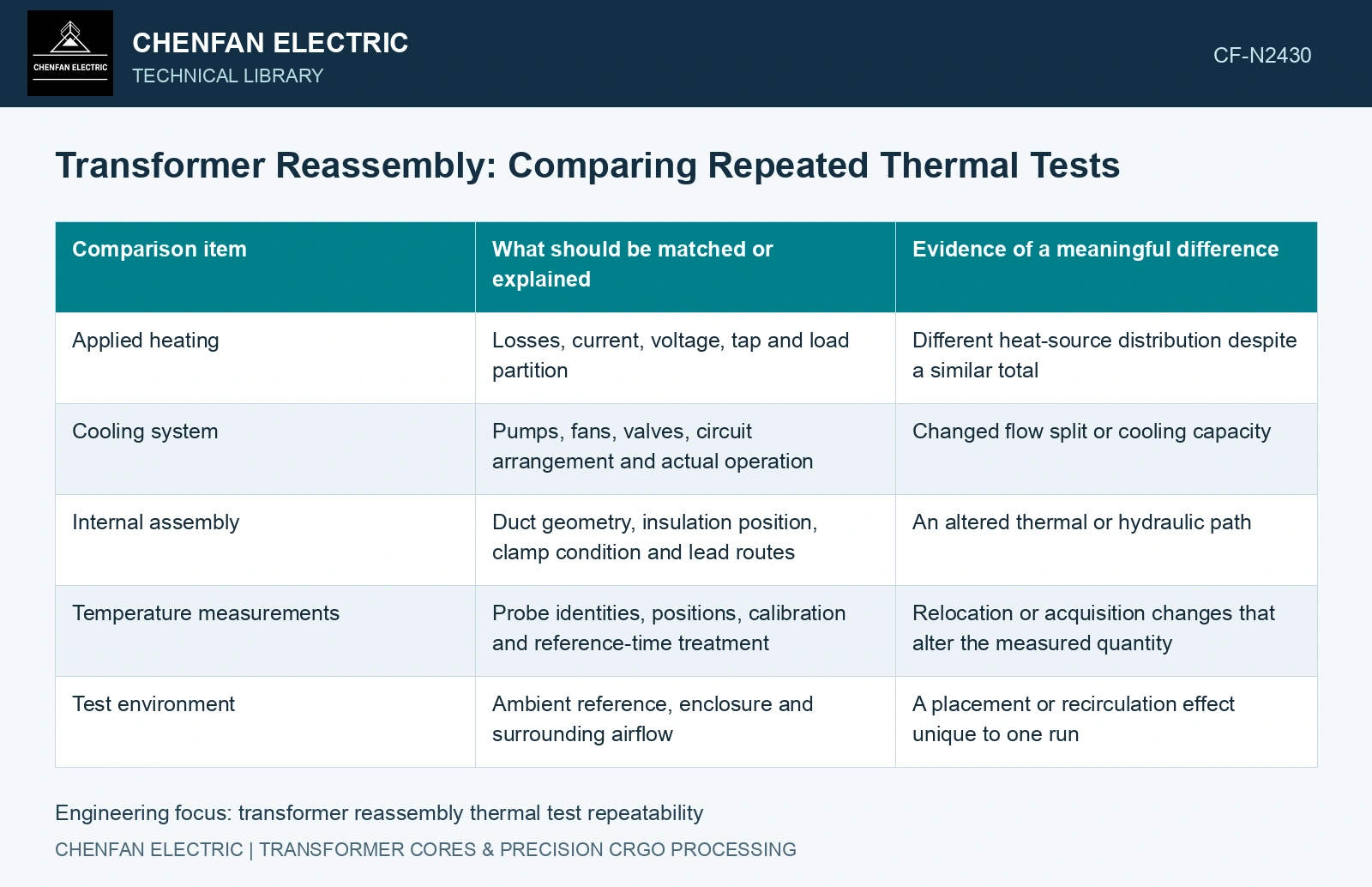
| Comparison item | What should be matched or explained | Evidence of a meaningful difference |
|---|---|---|
| Applied heating | Losses, current, voltage, tap and load partition | Different heat-source distribution despite a similar total |
| Cooling system | Pumps, fans, valves, circuit arrangement and actual operation | Changed flow split or cooling capacity |
| Internal assembly | Duct geometry, insulation position, clamp condition and lead routes | An altered thermal or hydraulic path |
| Temperature measurements | Probe identities, positions, calibration and reference-time treatment | Relocation or acquisition changes that alter the measured quantity |
| Test environment | Ambient reference, enclosure and surrounding airflow | A placement or recirculation effect unique to one run |
Look for a spatial change before averaging it away
Compare the individual temperature traces as well as the final rise values. A change concentrated in one winding region is more suggestive of a local path or placement change than a uniform shift across every channel. The pattern is evidence for an investigation, not proof of its cause.
Check whether oil inlet and outlet behavior changed at the same time. A local hotter region with similar overall cooler performance may indicate redistribution rather than insufficient total cooling capacity. A changed total-loss input requires a different comparison.
Compare the two defined duties under the governing temperature-rise method [2]. Maintenance records [1] establish the actual cooling arrangement and interventions; they do not turn a different assembly or sensor position into a repeated identical test.
Compare a local change with a common shift
Assume matched before/after channels change by 1 K at three locations and by 8 K at one winding region. Relative to that common 1 K shift, the local excess is 7 K. Investigate channel position, duct geometry and flow at that region before averaging it into general test scatter. These are comparison assumptions, not a statistical acceptance rule.
Estimate scatter from observations that actually repeat the process
Instrument repeatability measured on a stable reference does not represent the variability of dismantling and rebuilding a transformer. Repeated unchanged runs characterize one part of the test variation. Controlled reassemblies, where available, provide evidence about a different part.
References
- U.S. Bureau of Reclamation, FIST Volume 3-30, Transformer Maintenance, 2000.
- IEC, IEC 60076-2:2011, Power transformers — Part 2: Temperature rise for liquid-immersed transformers.