

Preserve broken pieces as a paired fracture record during transformer teardown. Keep their original orientation, separation and surface condition connected through photographs, identifiers and packaging before handling changes the evidence. [1]
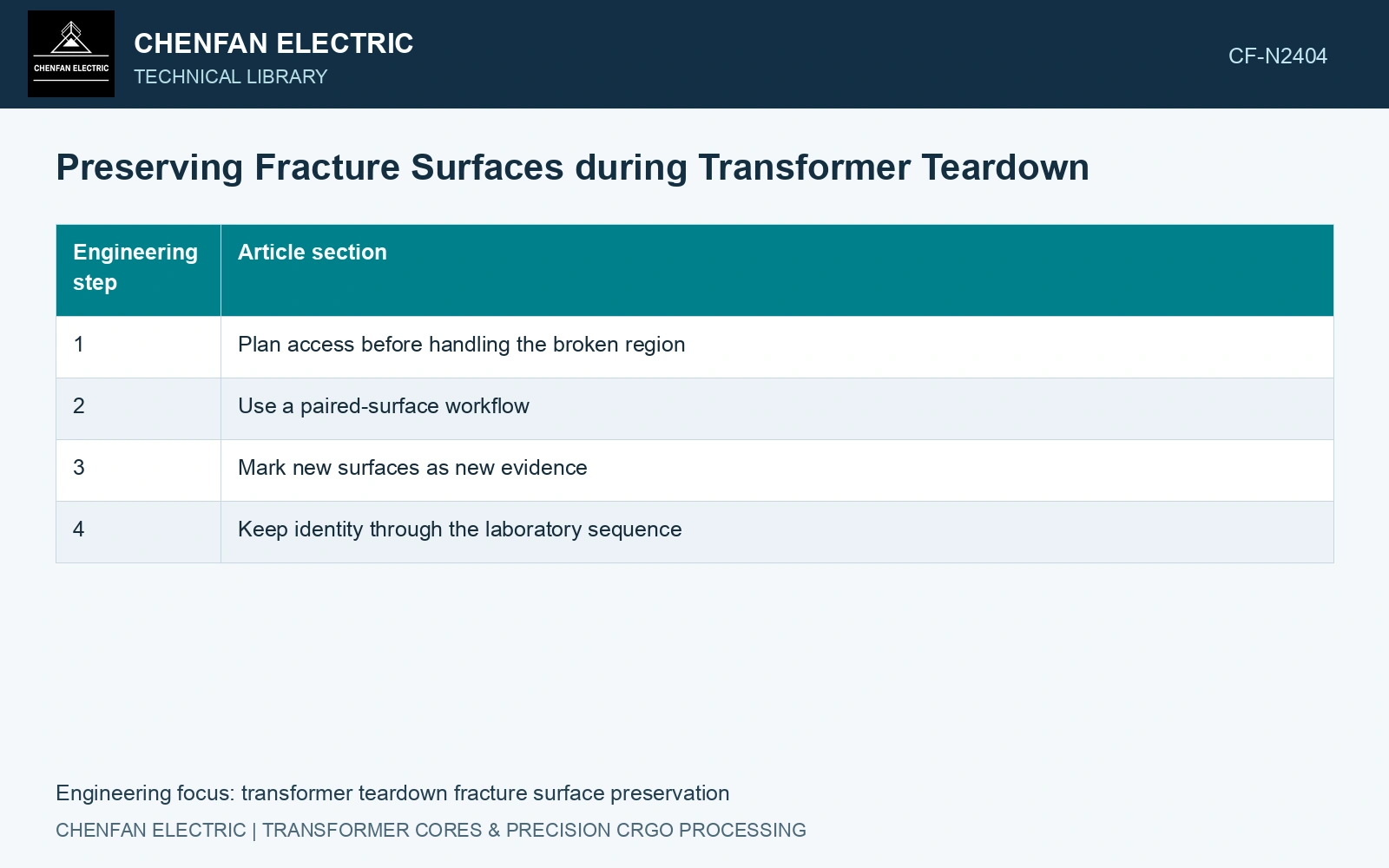
Plan access before handling the broken region
After the equipment has been made safe under the responsible site’s procedures, document the assembly before movement. Locate the suspected fracture in the transformer coordinate system and photograph adjacent supports, insulation and contact marks. An isolated close-up cannot show which constraint was present when the part broke.
Decide with the examining laboratory which regions must remain untouched. Do not make cleaning the default route to a better photograph. Deposits may obscure a feature, but they may also contain evidence of material transfer or event order.
Use a paired-surface workflow
- Assign a pair identifier and separate piece identifiers while the original relationship remains visible.
- Record overview, detail, scale and orientation before separation or repositioning.
- Identify the fracture boundary and any surfaces already altered during emergency response.
- Protect surfaces from rubbing and additional contamination using packaging agreed with the laboratory.
- Log every later intervention, including sectioning, preparation and examination-created breaks.
- Retain unused material where practical so a later question does not depend only on prepared specimens.
Integrate the laboratory’s evidence priorities into the competent dismantling plan before access, lifting or sectioning begins. That plan must coordinate the physical work, stored-energy controls and the surfaces to preserve.
Mark new surfaces as new evidence
Some investigations require sectioning or creating a new fracture to expose a hidden region. Record the intervention time, purpose and resulting boundary. A newly broken ligament must not be interpreted later as part of the original accident surface.
The NASA pylon investigation documented original cracked regions separately from the ligament deliberately fractured during examination. It also preserved the paired larger piece and selected cuts to avoid features of interest. That example supports staged documentation; its loading and chemical preparation are specific to its own specimen.
Link each piece to its parent, orientation and documented intervention in the configuration record [2]. Label examination-created faces explicitly so a later image or laboratory result cannot silently acquire an as-found status.
Distinguish original and examination-created fracture area
Assume a specimen has 60 mm² documented original fracture and a 40 mm² ligament deliberately broken during examination. The final separated face contains 100 mm², but only 60% was original fracture. Map both areas and keep parent/piece identities so later microscopy does not convert the created surface into accident evidence.
References
- J. A. Newman, R. S. Piascik and R. A. Lindenberg, Failure Analysis of a Helicopter External Fuel-Tank Pylon, NASA/TM-2002-211645 and ARL-TR-2711, April 2002.
- NASA, NASA Systems Engineering Handbook, section 6.5, Configuration Management, official online text.