

Map a carbonized insulation path as a damage route, then test when it became conductive. Progressive deterioration and secondary arc attachment can produce similar final paths, so the initiating sequence needs evidence from preserved interfaces and event records. [1]
Map the path without assigning an origin
Record both ends, changes in width, branches, interrupted regions and surrounding surfaces. Tie these features to the original conductor and support geometry. Identify missing material rather than drawing an assumed continuous line through it.
Document unaffected neighboring regions at the same scale. A damaged path next to relatively intact material raises different questions from a broad region exposed to fire or extensive secondary arcing. Neither pattern alone gives an event duration.
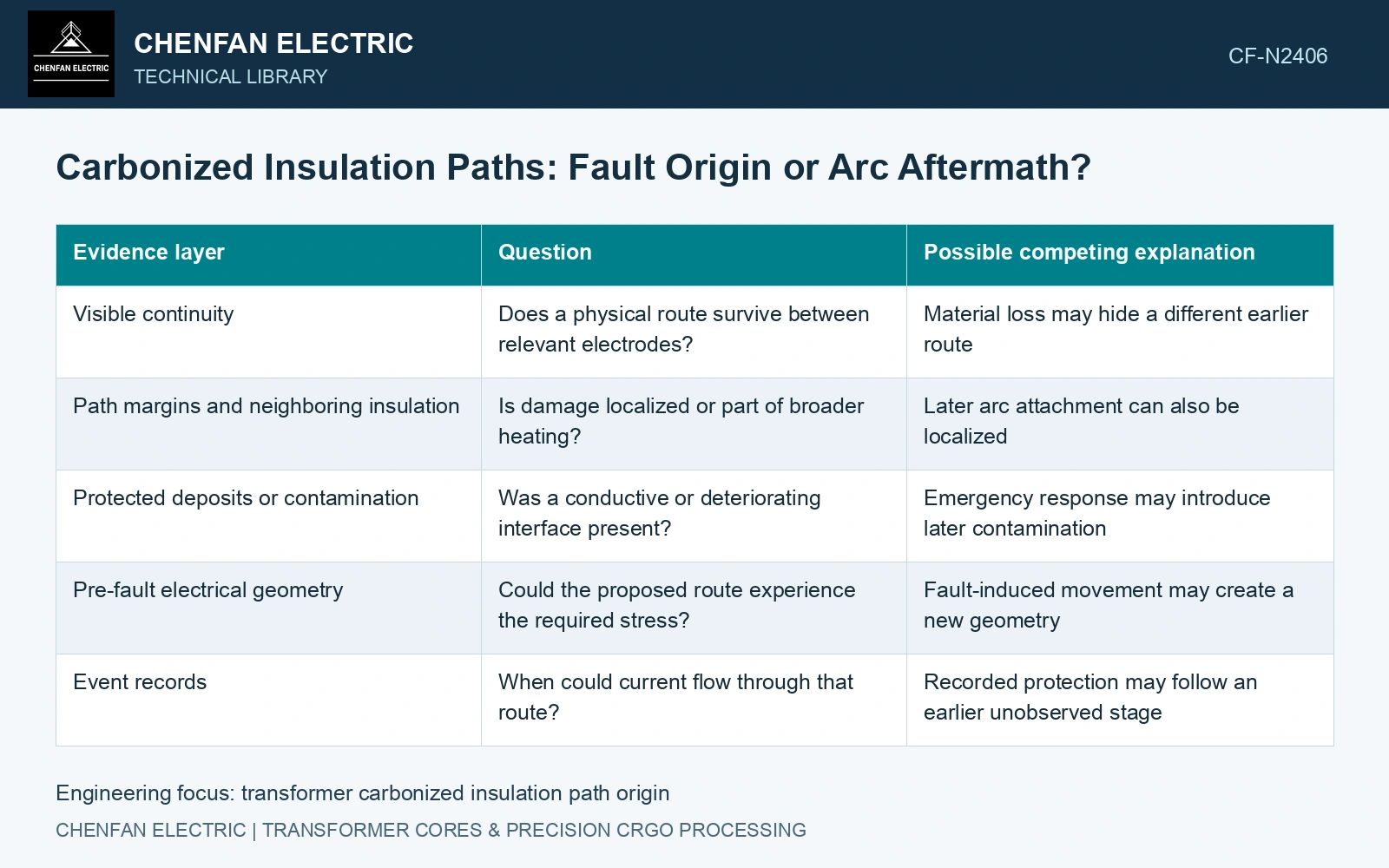
| Evidence layer | Question | Possible competing explanation |
|---|---|---|
| Visible continuity | Does a physical route survive between relevant electrodes? | Material loss may hide a different earlier route |
| Path margins and neighboring insulation | Is damage localized or part of broader heating? | Later arc attachment can also be localized |
| Protected deposits or contamination | Was a conductive or deteriorating interface present? | Emergency response may introduce later contamination |
| Pre-fault electrical geometry | Could the proposed route experience the required stress? | Fault-induced movement may create a new geometry |
| Event records | When could current flow through that route? | Recorded protection may follow an earlier unobserved stage |
Separate surviving conductivity from earlier conductivity
A damaged insulation path may now conduct under a laboratory test. That establishes a present property under stated conditions. It does not demonstrate that the same path was conductive before the accident, because heating and material alteration can change it.
Likewise, an open discontinuity after the event does not rule out an earlier conducting path that was subsequently burned away. Use the original geometry, deposits and chronological evidence to test that possibility.
NASA notes that severe damage can destroy the original failure evidence [2]. Preserve the carbonized path’s margins and comparison material before further preparation; distinguish a present conductive feature from a claim about its pre-event state.
Test present conductivity against the earlier geometry
Assume an approved low-energy laboratory measurement gives 10 mA at 10 V across the recovered path, equivalent to 1 kΩ at that stated test point. It establishes only post-event conduction there; do not extrapolate an ohmic law to fault voltage. Establish earlier geometry and chronology independently before identifying an initiating defect.
Sample the question, not only the darkest region
Select preserved margins, path intersections and comparison material as well as heavily charred areas. Record sample coordinates and preparation. Material analysis can constrain explanations, but one severely altered specimen may contain little information about its earlier state.
References
- U.S. Bureau of Reclamation, FIST Volume 3-31, Transformer Diagnostics, June 2003.
- L. Ochs, NASA Goddard Space Flight Center, Basics of Failure Analysis, NASA Parts 101, December 4, 2024.