

Establish when a transformer joint lost contact pressure. Pre-existing deterioration and fault-induced heating, movement or material loss can leave the same loose connection, so compare both histories against earlier records and paired surfaces. [1]
Measuring its final torque does not reconstruct its original preload. The relationship between torque and bolt tension depends on friction and geometry, both of which may have changed. A post-fault reading belongs in the as-found record, with the limits of that record intact.
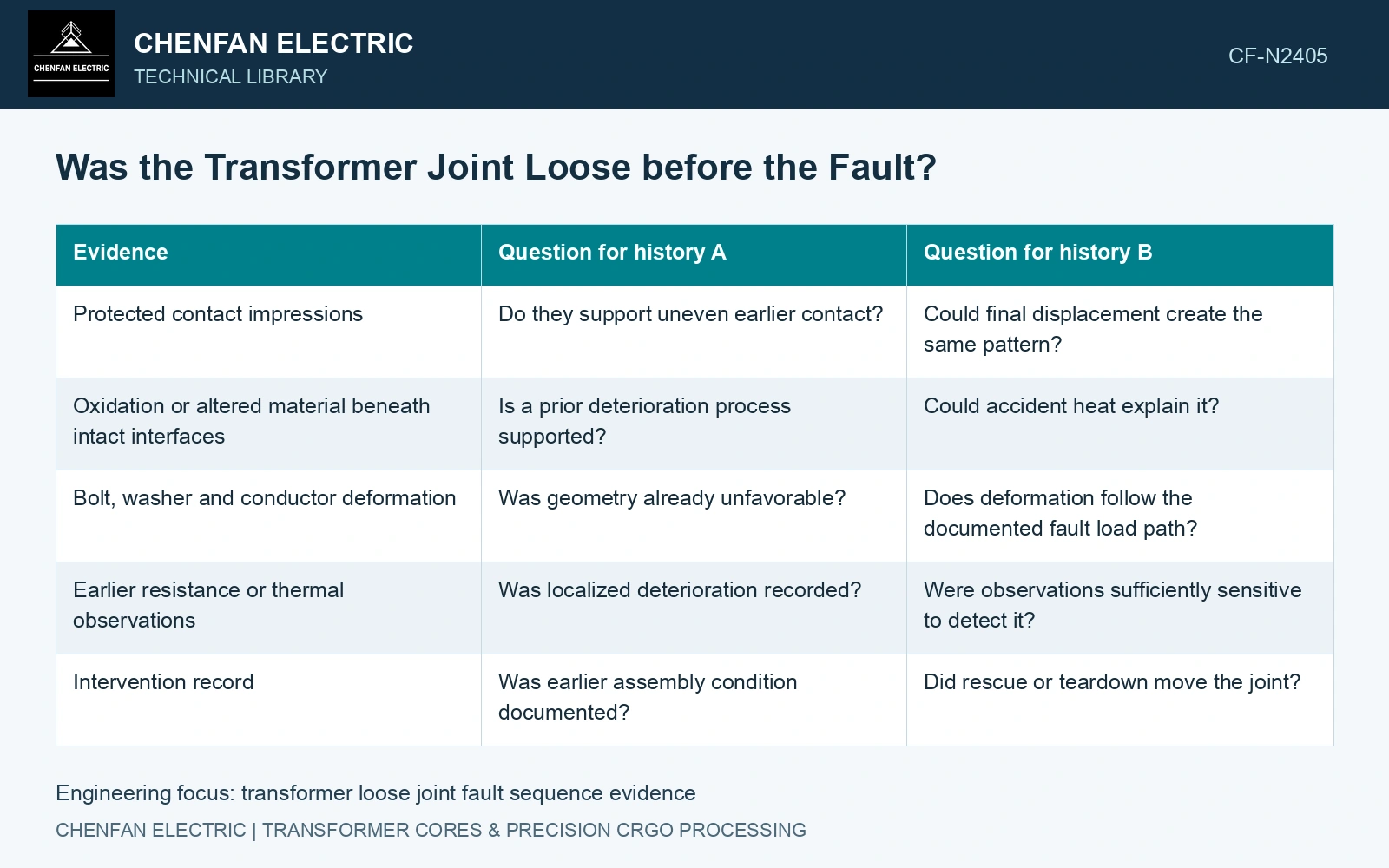
Compare two histories
History A begins with inadequate or deteriorating contact pressure. Increased contact resistance creates localized heating before the electrical fault. History B begins with a separate fault; forces or heating then deform the connection and reduce its surviving pressure. The visible loose joint fits both.
| Evidence | Question for history A | Question for history B |
|---|---|---|
| Protected contact impressions | Do they support uneven earlier contact? | Could final displacement create the same pattern? |
| Oxidation or altered material beneath intact interfaces | Is a prior deterioration process supported? | Could accident heat explain it? |
| Bolt, washer and conductor deformation | Was geometry already unfavorable? | Does deformation follow the documented fault load path? |
| Earlier resistance or thermal observations | Was localized deterioration recorded? | Were observations sufficiently sensitive to detect it? |
| Intervention record | Was earlier assembly condition documented? | Did rescue or teardown move the joint? |
Look beyond one surface
Inspect the mating surfaces as a pair and map which areas remained protected. Exposure after separation can produce new contamination, while severe heating may remove older indicators. Neither a dark surface nor a clean surface has a universal time interpretation.
Compare nearby joints with similar construction and service conditions. Differences can be informative, but a neighboring joint may have experienced a different current or temperature. Define what the comparison controls before calling it a witness.
Use the earlier resistance record only after matching the measured connection and temperature basis [2]. Preserve physical repair and teardown changes alongside the test, because they can alter the contact whose prior condition is being inferred.
Compare torque-based preload assumptions explicitly
Assume a simple assembly screen F=T/(Kd) with torque 100 N·m, nominal diameter 0.020 m and nut factor 0.20 gives 25 kN. An assumed post-fault friction factor 0.30 gives 16.67 kN for the same torque. This difference shows why final torque cannot reconstruct original preload; verify actual material, geometry and prior-condition evidence.
Use electrical history with the correct boundary
Historical winding-resistance comparisons require consistent connections, tap position and temperature treatment. The Bureau of Reclamation diagnostic guide specifically emphasizes as-found tap conditions and accurate connection records. A change of measurement arrangement can imitate a change in the joint.
References
- R. T. Barrett, Fastener Design Manual, NASA Reference Publication 1228, 1990.
- U.S. Bureau of Reclamation, FIST Volume 3-31, Transformer Diagnostics, June 2003.