

A shake-table result is a response of a particular specimen on a particular fixture under measured input. An analytical model of another mass state or installation boundary may disagree for a physical reason. Align those configurations before changing model parameters to improve the numerical match. [1]
Use the measured input and the tested assembly
Record accessories, oil/active-part state and fixture connections against the tested configuration baseline [2]. Correlate with achieved table/interface motion, distinguishing it from the target input. Those inputs cannot be substituted silently by another installation model.
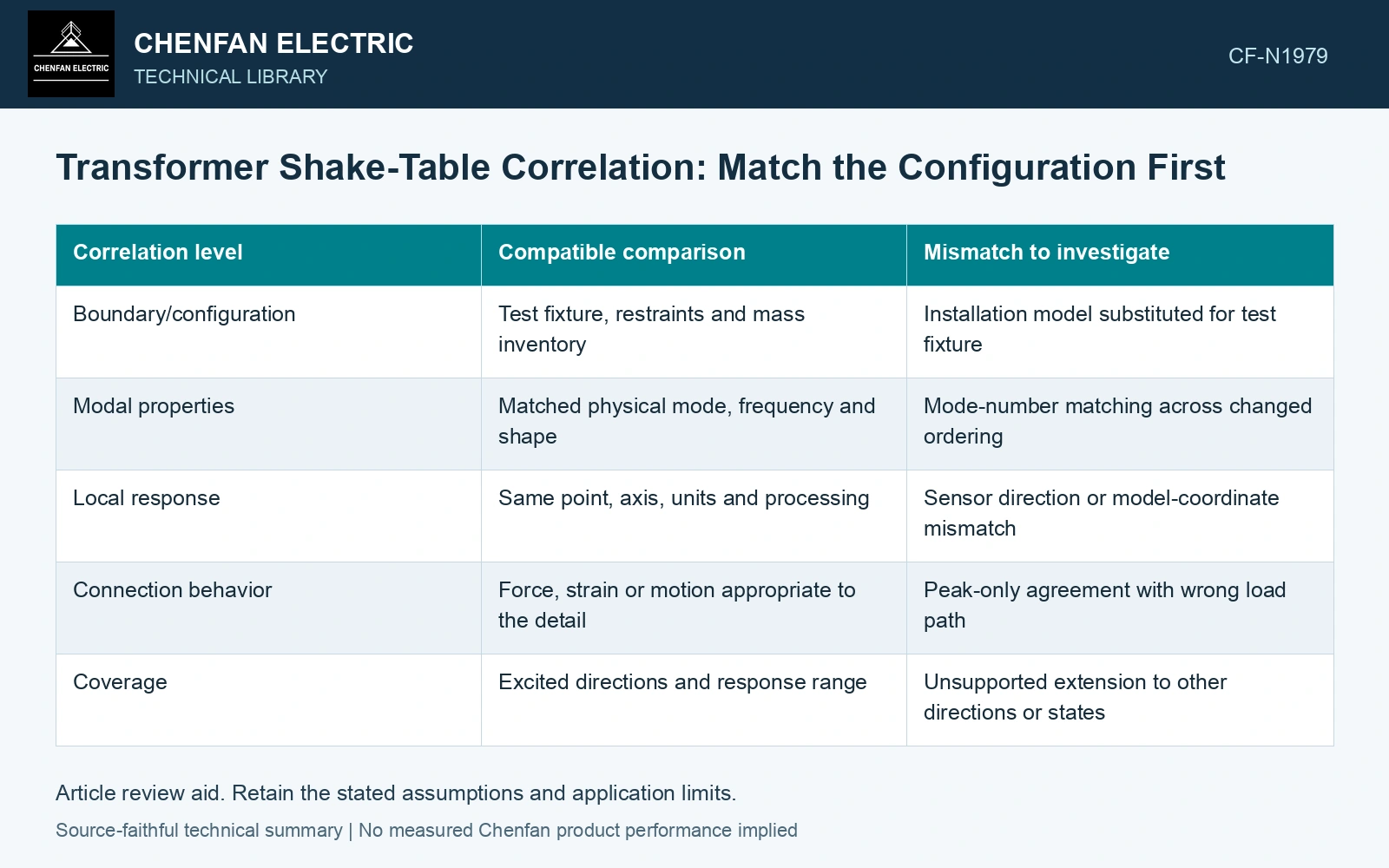
| Correlation level | Compatible comparison | Mismatch to investigate |
|---|---|---|
| Boundary/configuration | Test fixture, restraints and mass inventory | Installation model substituted for test fixture |
| Modal properties | Matched physical mode, frequency and shape | Mode-number matching across changed ordering |
| Local response | Same point, axis, units and processing | Sensor direction or model-coordinate mismatch |
| Connection behavior | Force, strain or motion appropriate to the detail | Peak-only agreement with wrong load path |
| Coverage | Excited directions and response range | Unsupported extension to other directions or states |
Frequency agreement is one part of the correlation
Compare physical mode shapes and participating regions, not mode numbers alone. Equal frequency can result from different mass/stiffness combinations; it need not give the correct connection force. NIST’s validation guidance cautions against relying on one numerical agreement [3].
For time-dependent responses, retain timing and relevant waveform features where they inform the mechanism. Align processing, filtering and coordinate definitions before interpreting amplitude differences. An agreement between two filtered peaks may hide a disagreement in the underlying motion.
Keep calibration and validation distinguishable
Adjust parameters only within a physical and evidential basis. Record which test results were used for calibration, then examine other suitable responses or conditions without continuing to tune them. A parameter that matches one sensor while degrading nearby responses needs investigation.
State the directions, configuration and amplitudes for which comparison evidence exists. A single-direction test cannot establish observed behavior in an unexcited direction. An analysis may contribute to the broader qualification basis, but that contribution should be identified separately from what the test measured.
Assume the tested configuration has first mode 8.0 Hz and a model predicts 10.0 Hz. The frequency ratio is 1.25; if effective modal mass is truly unchanged, the model’s modal stiffness is 1.25² = 1.5625 times the tested value. That 56.25% difference warrants checking supports, oil state and attached masses before tuning damping to fit one response peak. Correlate mode shape and boundary conditions, then retain an independent response history for validation.
Retain the physical explanation for each parameter change and check responses that were not used to select it. If a tuned model still loads the wrong region or misses a relevant mode, matching one peak is insufficient. Its usable scope ends where the configuration and response evidence cease to support it.
References
- IEEE, IEEE 693-2018, IEEE Recommended Practice for Seismic Design of Substations.
- NASA, NASA Systems Engineering Handbook, section 6.5, Configuration Management, official online text.
- NIST/SEMATECH, e-Handbook of Statistical Methods, Model Validation, section 4.4.4, and Estimation, section 4.1.3.1.