

Retain oil level in the controlled test configuration baseline; NASA’s configuration-management method preserves the identity and verified state of the tested item [1]. Changing liquid state can change mass and boundaries, so transport-fill evidence cannot be silently relabelled as operating-fill qualification.
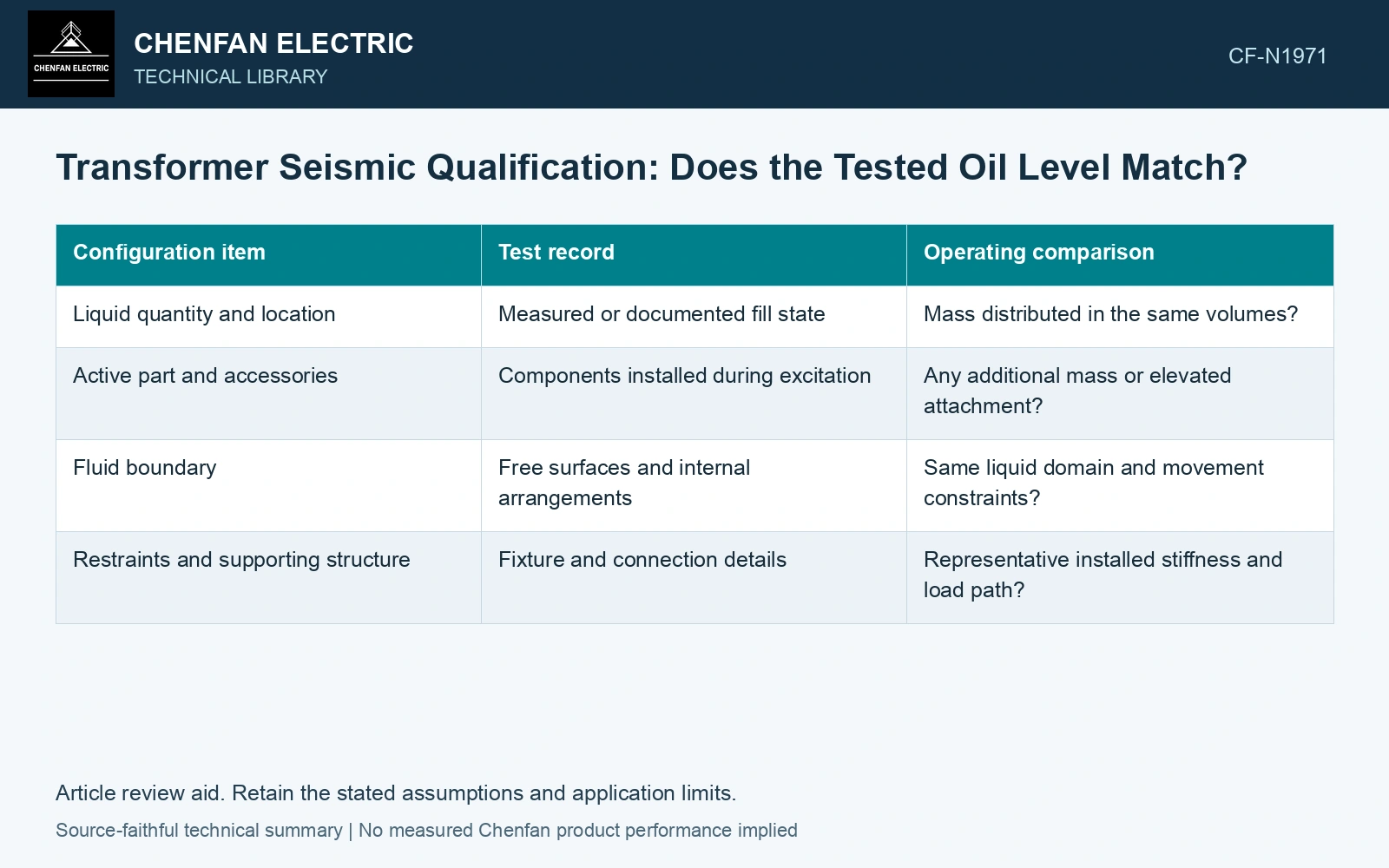
Compare configurations component by component
Use the tested equipment description, measured fill condition and installation drawings. Separate tank oil from conservator oil and identify any filled radiator banks. Retain the active part, accessories and supports actually present during the test; oil level may not be the only difference. [2]
| Configuration item | Test record | Operating comparison |
|---|---|---|
| Liquid quantity and location | Measured or documented fill state | Mass distributed in the same volumes? |
| Active part and accessories | Components installed during excitation | Any additional mass or elevated attachment? |
| Fluid boundary | Free surfaces and internal arrangements | Same liquid domain and movement constraints? |
| Restraints and supporting structure | Fixture and connection details | Representative installed stiffness and load path? |
Added mass does not imply a simple demand multiplier
For a single idealized mode, frequency varies with the square root of effective stiffness divided by effective mass. This explains why a mass change can move a mode; it does not predict the complete transformer response. Distributed fluid mass, multiple modes and changed fluid boundaries require a representation appropriate to the equipment.
A heavier configuration need not increase every response by the same percentage. Its modes may occupy different regions of the input spectrum, and connections may receive different force distributions. Compare modal shapes and participation, attachment motion and local demands rather than scaling the test peak solely by total weight.
State what the comparison demonstrates
A configuration comparison should separate a documented match, a difference supported by additional analysis, and a difference still outside the evidence. Keep assumptions about liquid coupling and damping visible. If the original test did not excite a relevant mode or direction, a fill-level comparison cannot create that missing evidence.
Assume the transformer is qualified with 8,000 kg of oil but the proposed operating configuration contains 10,000 kg at the relevant level. At an assumed 0.5g acceleration, the additional 2,000 kg contributes 9.81 kN of horizontal inertia before accounting for fluid motion or changed modes. If the added fluid’s effective centre is assumed 1.5 m above the base, its simple moment increment is 14.715 kN·m. Reconcile the tested and operating oil states in the mass and fluid model before transferring the qualification.
The report should identify the oil states covered, how intervening states were evaluated and which configuration governs each checked response. Include the uncertainty in fill quantity where it affects the decision. A transport configuration can remain useful evidence, but extending its qualification requires a justified assessment of the operating mass and boundaries.
References
- NASA, NASA Systems Engineering Handbook, section 6.5, Configuration Management, official online text.
- FEMA and Applied Technology Council, FEMA E-74, Reducing the Risks of Nonstructural Earthquake Damage—A Practical Guide, December 2012, section 6.4.7.3, Transformers.