

Damping represents energy dissipation in a dynamic model, but the underlying mechanisms differ. Material behavior, joint contact, friction and fluid motion need not produce the same damping in every transformer mode. A single value copied across the model can conceal that distinction.
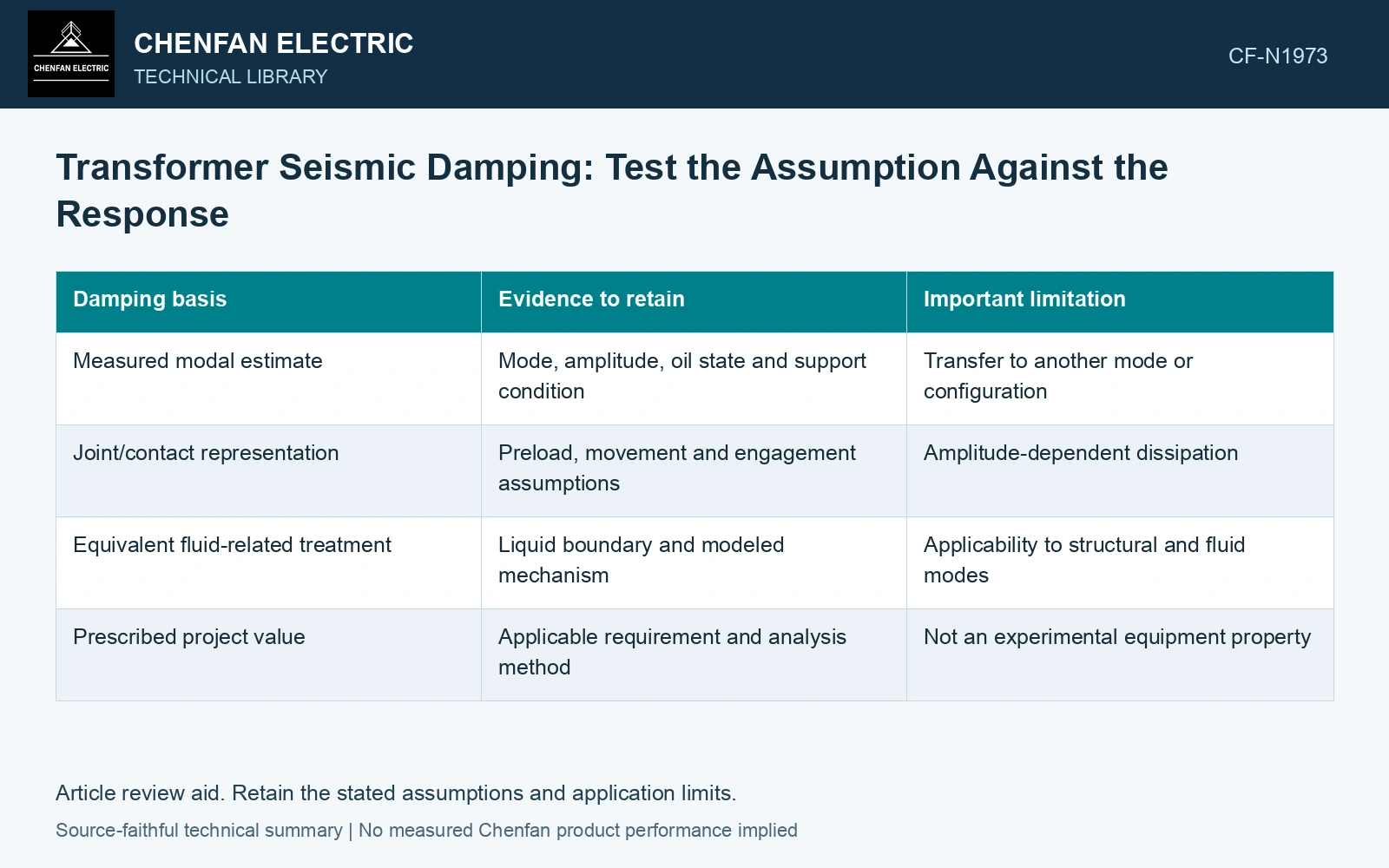
Keep the origin of each damping value visible
For measured damping retain mode, amplitude, oil/support configuration and estimation method. For assumptions state their evidence. NRC’s damping guide describes viscous damping as an elastic-analysis representation of dissipated energy and requires evidence for departures within its nuclear scope [1]; it does not prescribe the values in this teaching case.
| Damping basis | Evidence to retain | Important limitation |
|---|---|---|
| Measured modal estimate | Mode, amplitude, oil state and support condition | Transfer to another mode or configuration |
| Joint/contact representation | Preload, movement and engagement assumptions | Amplitude-dependent dissipation |
| Equivalent fluid-related treatment | Liquid boundary and modeled mechanism | Applicability to structural and fluid modes |
| Prescribed project value | Applicable requirement and analysis method | Not an experimental equipment property |
Make sensitivity a controlled comparison
Vary supported damping cases while keeping mass, stiffness, input and combination conventions consistent. Compare connection force and relative displacement. Qualification remains tied to the actual assembly and analysis/test basis [2].
Changing modal damping can change the applicable spectral ordinate. The spectral demand and response calculation must remain compatible; reducing damping in the structural model while leaving a differently damped input unexplained is not a complete sensitivity study. Record how the chosen assessment method treats that change.
Do not tune damping to hide a structural mismatch
If measured and predicted responses disagree, inspect boundary stiffness, mass configuration, mode shape and instrumentation before adjusting damping. A fitted value can compensate for a wrong support or an omitted mode. Matching one amplitude through damping alone does not demonstrate that the model represents the equipment.
Where sliding or impact is explicitly represented, review how the model dissipates energy. Adding broad equivalent damping on top of an already dissipative contact law can count the same mechanism twice. Numerical damping should also be distinguished from a physical assumption.
Assume a single linear mode under harmonic force at exact resonance. Relative to static displacement F₀/k, amplification is 1/(2ζ): 25 at assumed ζ = 2% and 10 at 5%. With assumed static displacement 1 mm and dynamic screen cap 15 mm, the respective 25/10 mm predictions fail/pass. Acceptance therefore depends on the unverified damping input. Obtain configuration/amplitude-relevant evidence before selecting a value. This steady harmonic result is not a conversion between seismic response spectra.
Report the demands that move materially across the justified damping cases and the evidence needed to reduce uncertainty. If the acceptance decision changes with an unsupported value, that value needs attention. A sensitivity table makes this dependency visible without claiming a universal transformer damping ratio.
References
- U.S. Nuclear Regulatory Commission, Regulatory Guide 1.61, Damping Values for Seismic Design of Nuclear Power Plants, Revision 2, December 2023, sections B and C.1.
- IEEE, IEEE 693-2018, IEEE Recommended Practice for Seismic Design of Substations.