

Response-spectrum analysis produces peak modal responses without the full time relationship between them. The combination method determines how those peaks contribute to an equipment or connection result. Closely spaced modes require attention because their responses may not behave as statistically independent contributions. [1]
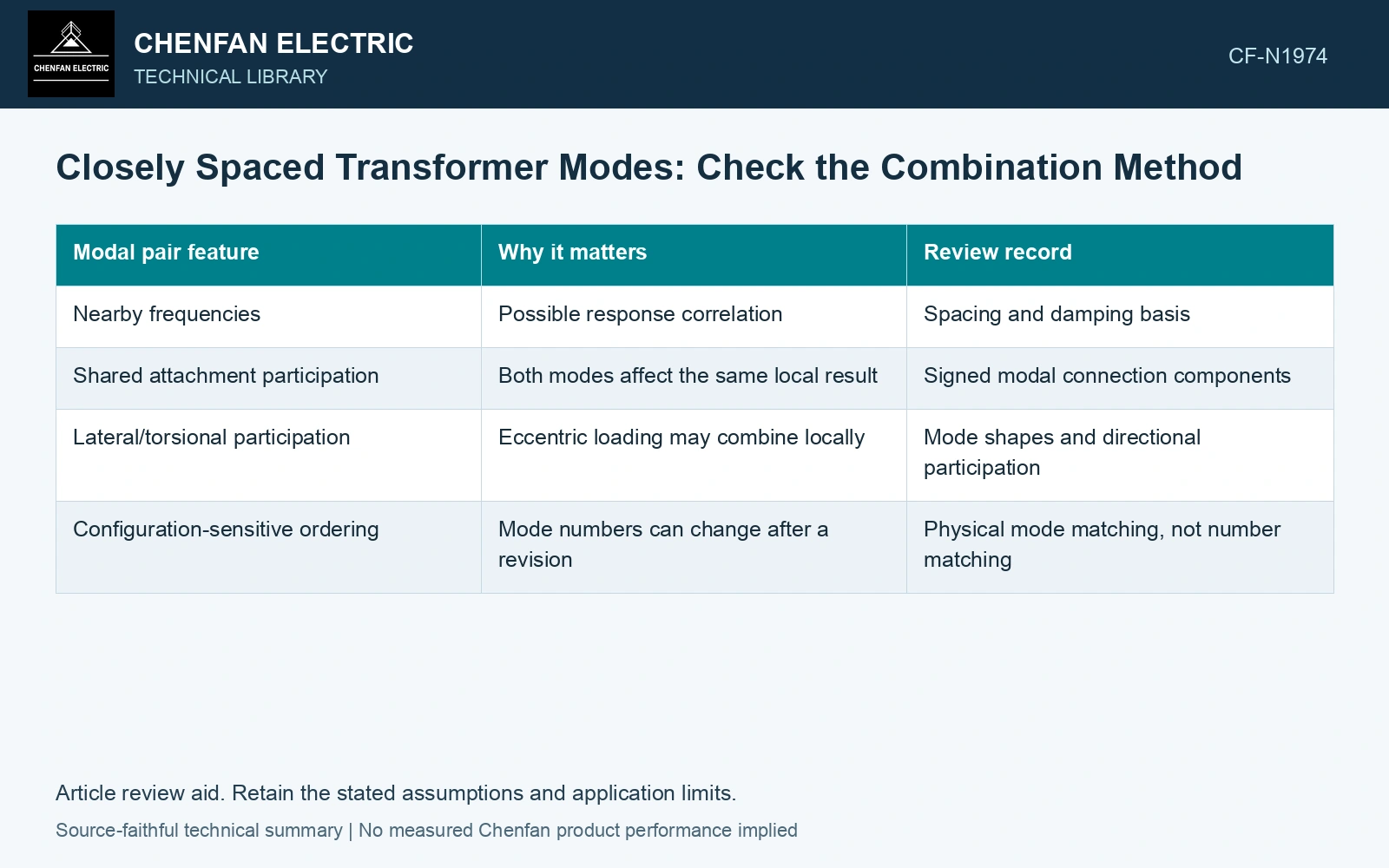
Review mode shapes alongside the frequency list
Review physical mode shapes and their signed contribution to the same attachment. NRC’s guide distinguishes periodic modal correlation, rigid response and spatial-input combination [2]. A frequency list alone does not establish which responses can be combined.
| Modal pair feature | Why it matters | Review record |
|---|---|---|
| Nearby frequencies | Possible response correlation | Spacing and damping basis |
| Shared attachment participation | Both modes affect the same local result | Signed modal connection components |
| Lateral/torsional participation | Eccentric loading may combine locally | Mode shapes and directional participation |
| Configuration-sensitive ordering | Mode numbers can change after a revision | Physical mode matching, not number matching |
SRSS and CQC make different correlation assumptions
Square-root-of-sum-of-squares combination treats modal contributions as uncorrelated in its usual application. Complete quadratic combination includes correlation terms based on modal properties and the selected formulation. The applicable project method and its assumptions should determine their use; no single frequency-gap rule is prescribed here.
Use compatible modal quantities for the response being combined. A support-force component, displacement component and scalar stress measure are not interchangeable inputs to the same expression. Preserve signs and component definitions through the calculation where the combination formulation requires them.
Modal combination does not resolve every other combination
Combining modes within an input direction and combining different earthquake input directions are separate operations. Keep their sequence and conventions explicit. A result labeled “combined maximum” should state which operations it contains so it is not combined again or compared with an incompatible result.
Include the required modal coverage and any accepted treatment of residual or missing-mass response. A sophisticated correlation method cannot recover a relevant response omitted from the modal basis. Check local attachment response as well as global mass participation when an accessory mode is important.
For an independent periodic-response screen, assume modes 8.0/8.2 Hz, equal damping ζ = 0.05 and same-signed connection contributions 100/80 kN. With r = 8.2/8.0, NRC’s Der Kiureghian expression reduces to ρ = 8ζ²(1+r)r³ᐟ²/[(1−r²)²+4ζ²r(1+r)²] = 0.9424 [2]. SRSS gives 128.06 kN; correlated combination √(100²+80²+2ρ100×80) gives 177.42 kN. Against an assumed 150 kN connection cap, SRSS passes but the correlated screen fails. Retain the supported project combination and check missing/rigid response separately; do not choose SRSS merely because it passes.
When a connection demand is sensitive to a nearby modal pair, examine the pair’s signed contributions and physical shapes. Confirm that the correlation treatment matches the chosen analysis basis. Refining the mesh addresses a different numerical question and cannot repair an inappropriate response-combination rule.
References
- IEEE, IEEE 693-2018, IEEE Recommended Practice for Seismic Design of Substations.
- U.S. Nuclear Regulatory Commission, Regulatory Guide 1.92, Combining Modal Responses and Spatial Components in Seismic Response Analysis, Revision 3, October 2012, sections C.1.1 and C.2.