

A winding becomes taller after spacers are removed. The change is often called springback, but that word may hide several mechanisms: elastic recovery, frictional release, displaced discs or irreversible damage. The measured movement needs a condition and a location before it can inform reassembly. [1]
Record the winding while its original restraints are still identifiable. Once clamping parts and spacers have been removed without position records, an accurate relaxed measurement may no longer explain the assembled geometry. The investigation is part of an isolated, professionally controlled repair.
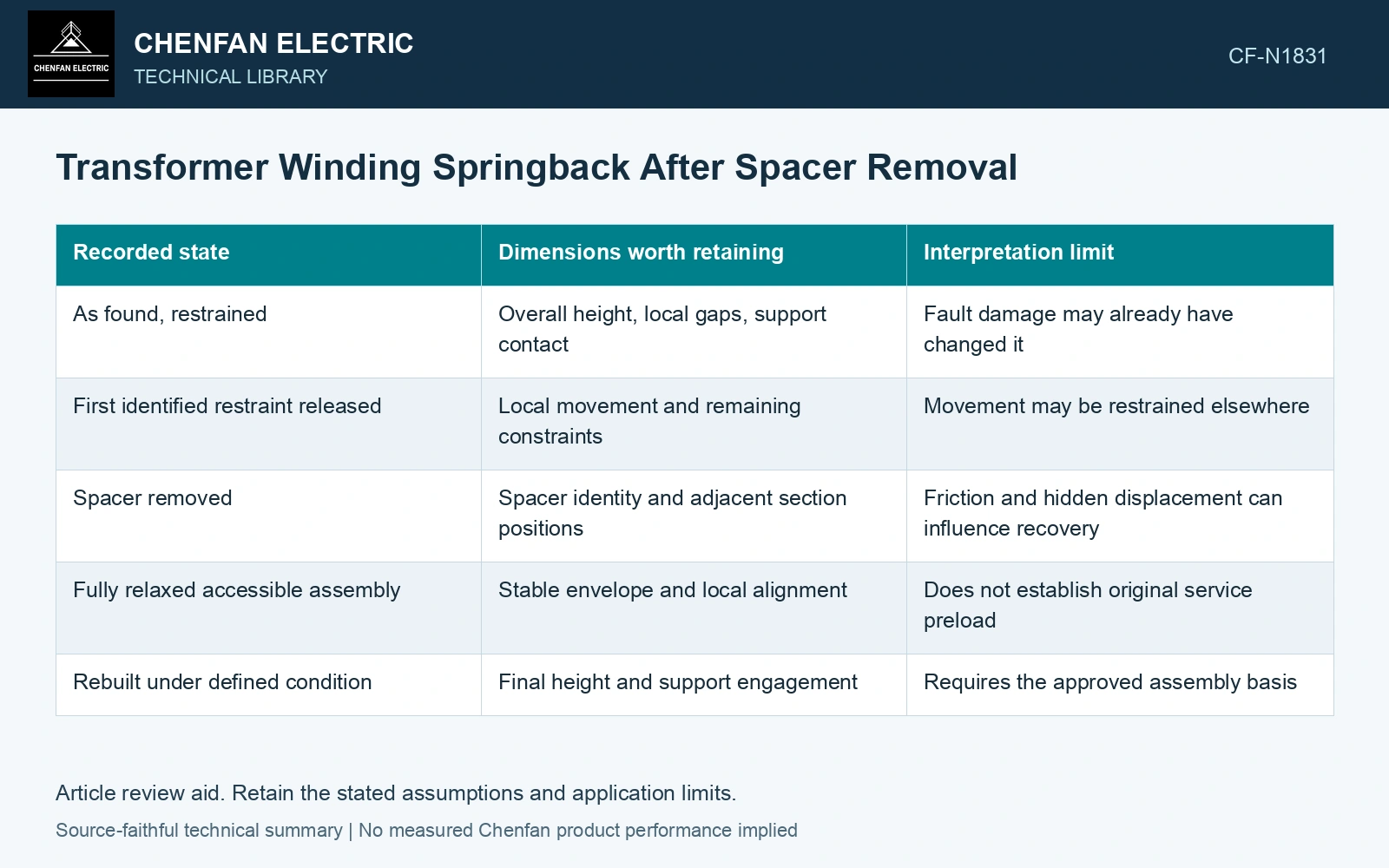
Give every measurement a mechanical state
Choose stable datums that survive dismantling. Record total active height and local section positions, spacer thickness and location, end-support geometry and visible gaps. Distinguish a dimension taken under the retained clamp arrangement from one taken after partial release. If the original clamping load is unknown, state that fact.
| Recorded state | Dimensions worth retaining | Interpretation limit |
|---|---|---|
| As found, restrained | Overall height, local gaps, support contact | Fault damage may already have changed it |
| First identified restraint released | Local movement and remaining constraints | Movement may be restrained elsewhere |
| Spacer removed | Spacer identity and adjacent section positions | Friction and hidden displacement can influence recovery |
| Fully relaxed accessible assembly | Stable envelope and local alignment | Does not establish original service preload |
| Rebuilt under defined condition | Final height and support engagement | Requires the approved assembly basis |
The sequence matters because the same final height can result from different internal distributions. One disc can move while another remains stuck. Total height alone cannot show whether cooling spaces and end alignment have returned to the intended arrangement.
Separate recovery from damage
Elastic springback suggests reversible movement as restraint changes. Permanent distortion, crushed supports, shifted conductors and damaged insulation require a different assessment. A smooth rebound is not proof that no damage exists; a small rebound is not proof that the winding retained its original compression.
Plot each recorded dimension against the documented restraint state, rather than against elapsed time alone. An abrupt local movement at spacer removal identifies an interface worth examining. It does not supply a load-displacement curve unless the loads were also measured and the boundary conditions controlled.
Pressboard compression depends on conditioning, ageing and the loading cycle; Oria and co-authors preserve these variables in their measurements. Keep the support history with any interpretation of a winding’s released and reloaded dimensions. [2]
Keep free and restrained height separate
Assumptions: winding active height is 500.0 mm under a documented 50 kN restraint at 20 °C, and 503.0 mm after complete release at the same temperature. Free recovery is 3.0 mm, or 0.6%; that change alone does not identify damage or the original spring constant. On reapplying the same 50 kN with aligned datums, suppose height is 501.0 mm. The 1.0 mm residual shift exceeds an assumed ±0.5 mm repeatability/geometry acceptance envelope by 0.5 mm. Hold reassembly and investigate disc seating, support compression and permanent deformation before reconstructing the clamp setting. Retain local section positions, since the total height cannot locate the shifted interface. [2]
Rebuild the dimension chain, not the memory
The reassembly chain includes winding height, spacer stack, end blocks, clamp position and the condition under which each dimension was specified. Reused compressible components can have a different history from new ones. Mixing their free dimensions without considering the final restrained condition can shift load sharing and leave one support unloaded.
References
- U.S. Bureau of Reclamation, FIST Volume 3-31, Transformer Diagnostics, June 2003.
- C. Oria et al., Experimental dataset on the compressive mechanical properties of high-density pressboard used in power transformers spacers, Data in Brief 50, 109471, 2023. DOI: 10.1016/j.dib.2023.109471.