

A scorched tap lead may still carry a readable number. That number is useful only if its meaning is known. It could identify a terminal, a winding section endpoint, a drawing reference or the position selected by the mechanism. Treating those labels as interchangeable can preserve the appearance of the old wiring while changing the voltage schedule. [1]
The repair record should trace electrical identity from the regulating winding to the selected circuit. It should not begin with a list of replacement wire lengths. Work is performed on isolated equipment using an approved repair design; tap-changer contact servicing is a separate task.
Keep three identities on the same line
Record the physical lead tag, the winding-section endpoint and the switch terminal it reaches. Preserve the original marking alongside a new temporary tag rather than overwriting it. Where fault damage has erased a junction, mark the destination uncertain until physical tracing and circuit interpretation agree.
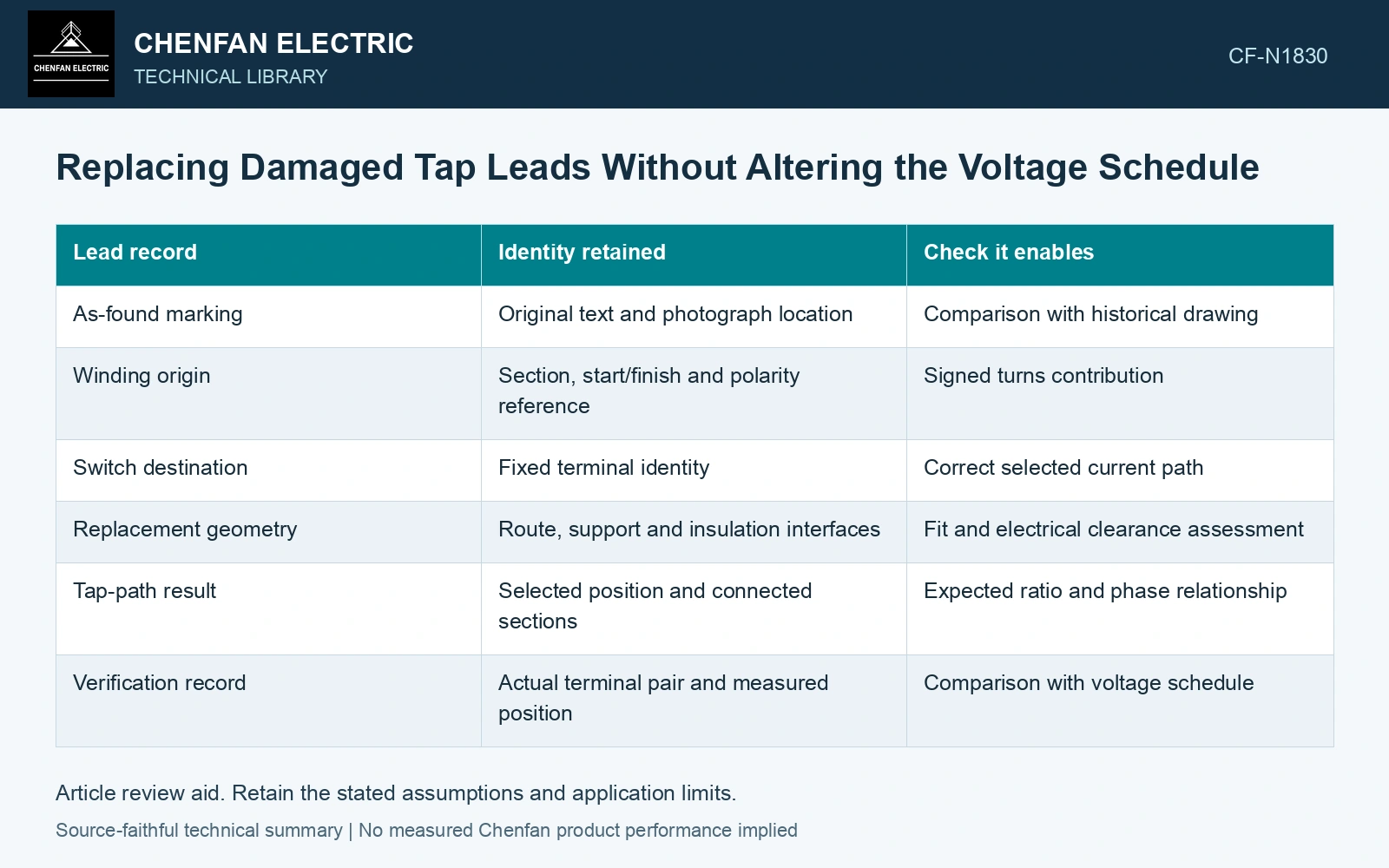
| Lead record | Identity retained | Check it enables |
|---|---|---|
| As-found marking | Original text and photograph location | Comparison with historical drawing |
| Winding origin | Section, start/finish and polarity reference | Signed turns contribution |
| Switch destination | Fixed terminal identity | Correct selected current path |
| Replacement geometry | Route, support and insulation interfaces | Fit and electrical clearance assessment |
| Tap-path result | Selected position and connected sections | Expected ratio and phase relationship |
| Verification record | Actual terminal pair and measured position | Comparison with voltage schedule |
Reconstruct the schedule before reconnecting
Keep the expected schedule and measured schedule separate. A useful expected entry contains the selected position, effective series turns or phasor construction, terminal ratio and relevant phase relationship. It is derived from the reconstructed circuit, not copied backward from the desired nameplate result.
A lead replacement can change more than continuity
New lead routing can alter clearances, mechanical support and local exposure to leakage fields. A replacement that reaches the correct terminal may still have an unsuitable bend or an unsupported section. Check these interfaces against the repair design, particularly where the old support or insulation was damaged.
If two leads appear interchangeable, identify the circuit reason before accepting that equivalence. Similar length and resistance do not establish equal electrical function. Likewise, continuity through a selected path says nothing about the identity of a parallel path that remains hidden.
Use the actual winding connection, turns and common electrical reference when interpreting induced voltage, impedance and copper loss. [2]
Calculate the selected series-turn path
Assumptions: the reconstructed high-voltage winding has 1,000 main turns and a selectable 25-turn series section; the secondary has 100 turns. Additive and reversed connections produce 1,025 and 975 HV turns, with HV/LV ratios 10.25 and 9.75. At a fixed 1,000 V RMS, 50 Hz applied to the HV winding, secondary voltage is 97.561 V for the intended additive path but 102.564 V if reversed. The latter is 5.128% above the intended tap result. Against an assumed ±0.2% repair verification gate, reject the reversed path and correct its signed endpoint identity. Raising HV turns lowers LV voltage at fixed HV input; record the tested winding and direction in the voltage schedule. [2]
References
- U.S. Bureau of Reclamation, FIST Volume 3-31, Transformer Diagnostics, June 2003.
- U.S. Department of Energy, DOE-HDBK-1011/4-92, Electrical Science, Volume 4, 1992.