

A repair shop may find pressboard that looks surprisingly clean beside a damaged winding. Elsewhere, an undamaged spacer can be dark from its service history. Neither observation settles whether the component should be reused. Color does not measure moisture, mechanical strength, dielectric integrity or remaining life. [1]
The first question is what the piece does. A barrier, a load-bearing end block and a duct spacer cannot be assessed with the same evidence merely because all are made from cellulose-based material. Their failure consequences and the stresses they carry differ.
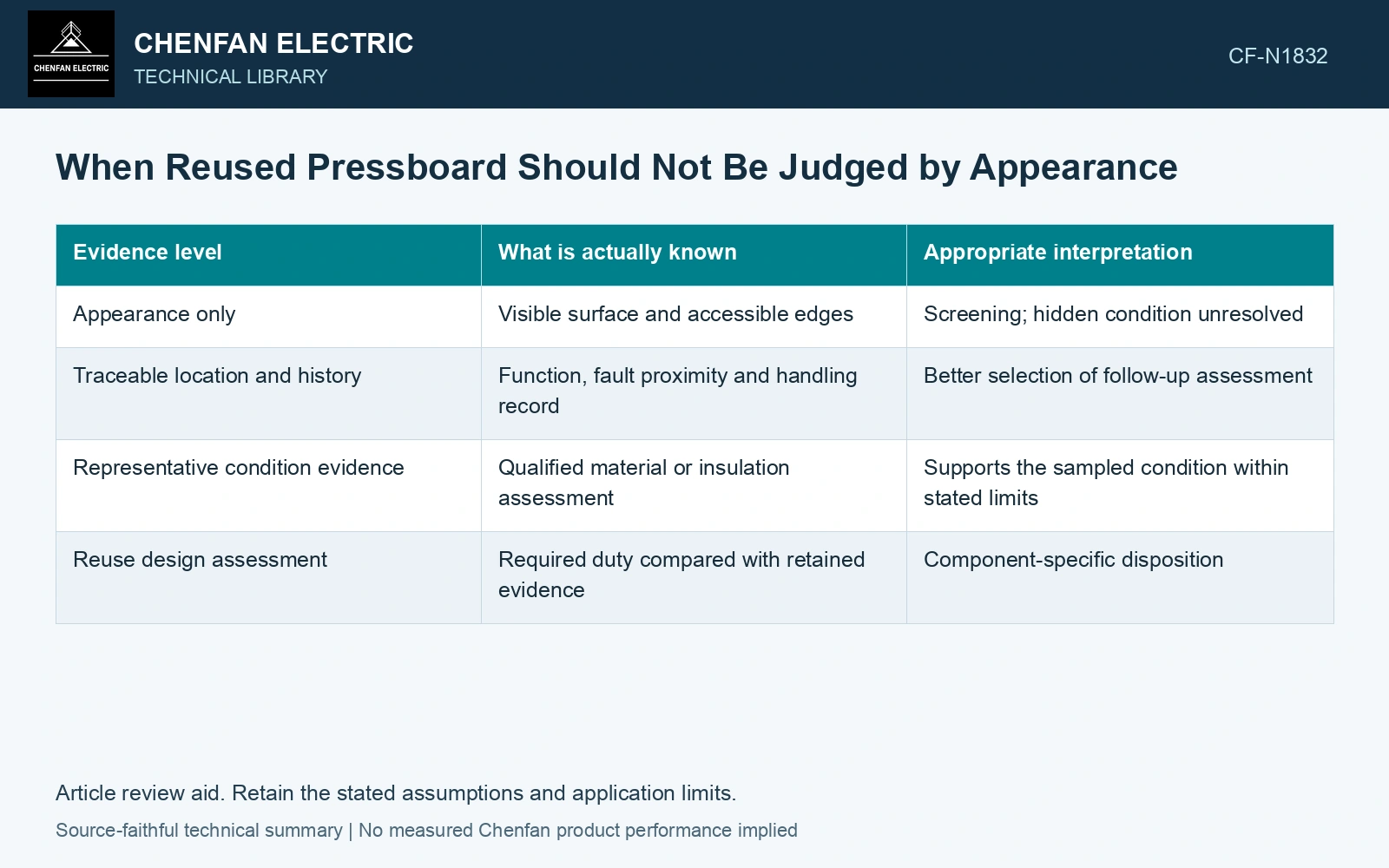
Grade evidence by function
Identify each retained piece by location, material information available and service exposure. Note whether it was near the fault, held a mechanical load, formed a dielectric boundary or controlled a cooling gap. Record cutting, drilling or handling damage introduced during dismantling as well as pre-existing damage.
| Evidence level | What is actually known | Appropriate interpretation |
|---|---|---|
| Appearance only | Visible surface and accessible edges | Screening; hidden condition unresolved |
| Traceable location and history | Function, fault proximity and handling record | Better selection of follow-up assessment |
| Representative condition evidence | Qualified material or insulation assessment | Supports the sampled condition within stated limits |
| Reuse design assessment | Required duty compared with retained evidence | Component-specific disposition |
A specimen from an accessible offcut may not represent the most highly stressed location. Document why a sample represents a retained population, or keep the conclusion confined to the sample. If taking a sample damages a functional part, that tradeoff belongs in the repair plan.
Look for mismatches between duties and evidence
A support that must retain compression needs mechanical evidence. A barrier that establishes a critical insulation interface needs evidence relevant to its dielectric function and surface condition. A duct spacer must retain geometry as well as insulation. A favorable finding in one category cannot silently substitute for another.
Moisture and treatment history also need careful interpretation. A drying process can change moisture condition; it does not reverse every ageing mechanism or restore crushed geometry. An acceptable final bulk insulation measurement may not isolate one mechanically damaged block. Avoid descriptions such as renewed pressboard unless the claimed renewal is defined and demonstrated.
Diagnostic interpretation depends on matched connection and test conditions; preserve the baseline and the physical repair changes beside the result. [2]
Compare moisture on a dry-material basis
Assumptions: representative retained and replacement pressboard specimens each have 100 g dry cellulose mass, containing 2.0 g and 0.5 g water. Dry-basis moisture is therefore 2.0% and 0.5%, a fourfold difference. For a project reuse screen assumed to require at most 1.0% dry-basis moisture, the retained specimen fails by 1.0 percentage point and the replacement passes the moisture screen by 0.5 percentage point. Hold reuse or apply a qualified drying/reassessment process. Passing that moisture gate still does not establish mechanical strength, dielectric geometry or ageing reversal; evaluate each retained piece by its load-bearing/insulating function. [1]
Compare replacement and retention on the same basis
New pressboard has its own required conformity and manufacturing evidence. Retained pressboard has a different uncertainty profile, especially where original material identity is missing. The decision should compare these alternatives against the function needed in the rebuilt transformer, including dimensional compatibility.
References
- S. R. Arsad et al., Water Content in Transformer Insulation System: A Review on the Detection and Quantification Methods, Energies 16, 1920, 2023. DOI: 10.3390/en16041920.
- U.S. Bureau of Reclamation, FIST Volume 3-31, Transformer Diagnostics, June 2003.