


Transformer Core Engineering Notes · CF-N231
An oil sample measures the liquid at a particular place and time. It does not directly measure the water contained throughout the paper and pressboard. Because moisture moves between liquid and solids as conditions change, paper-moisture assessment needs operating history and a justified interpretation method, not a single oil concentration labelled as a complete insulation diagnosis.
Understand what the sample can represent
Record liquid type, temperature, sampling point and recent load changes. A sample after warming may differ from one after a cold shutdown even without new moisture entering the transformer. Sampling contamination can also distort the result. The first review question is whether the measurements are comparable and reliable. Only then should the specialist consider what they suggest about the solid insulation and whether the system was near the conditions assumed by the interpretation model.
Equilibrium is an assumption that needs evidence
Moisture partitioning relationships can be useful, but a transformer in changing service is not automatically at equilibrium. Thick insulation and different local temperatures complicate the picture. Identify the model, liquid and insulation system used for any estimated paper-moisture value. A plotted estimate should carry its assumptions and uncertainty. Do not imply laboratory precision by reporting many decimal places when the operating state and material history are poorly known.
Use complementary evidence for a stronger assessment
Depending on the asset and access, the specialist may combine liquid results with dielectric-response measurements, drying records and service history. Direct solid samples have their own limitations because one accessible location may not represent the most stressed insulation. The evidence should be assessed collectively. This article does not set a universal moisture threshold or prescribe opening an energized transformer. Sampling, testing and any internal work require the applicable safety and maintenance procedures.
Do not confuse oil treatment with complete drying
Reducing water in the circulating liquid does not by itself prove that all solid insulation has reached the desired condition. Moisture can continue to redistribute afterwards. An approved treatment plan should define its objective, monitoring and completion evidence for the actual transformer. Establish a post-treatment baseline and compare it with later results under recorded conditions. The useful conclusion is a bounded assessment of the insulation system, not simply “the oil is dry, therefore the paper is dry.”
| Review item | Evidence to request | Boundary to preserve |
|---|---|---|
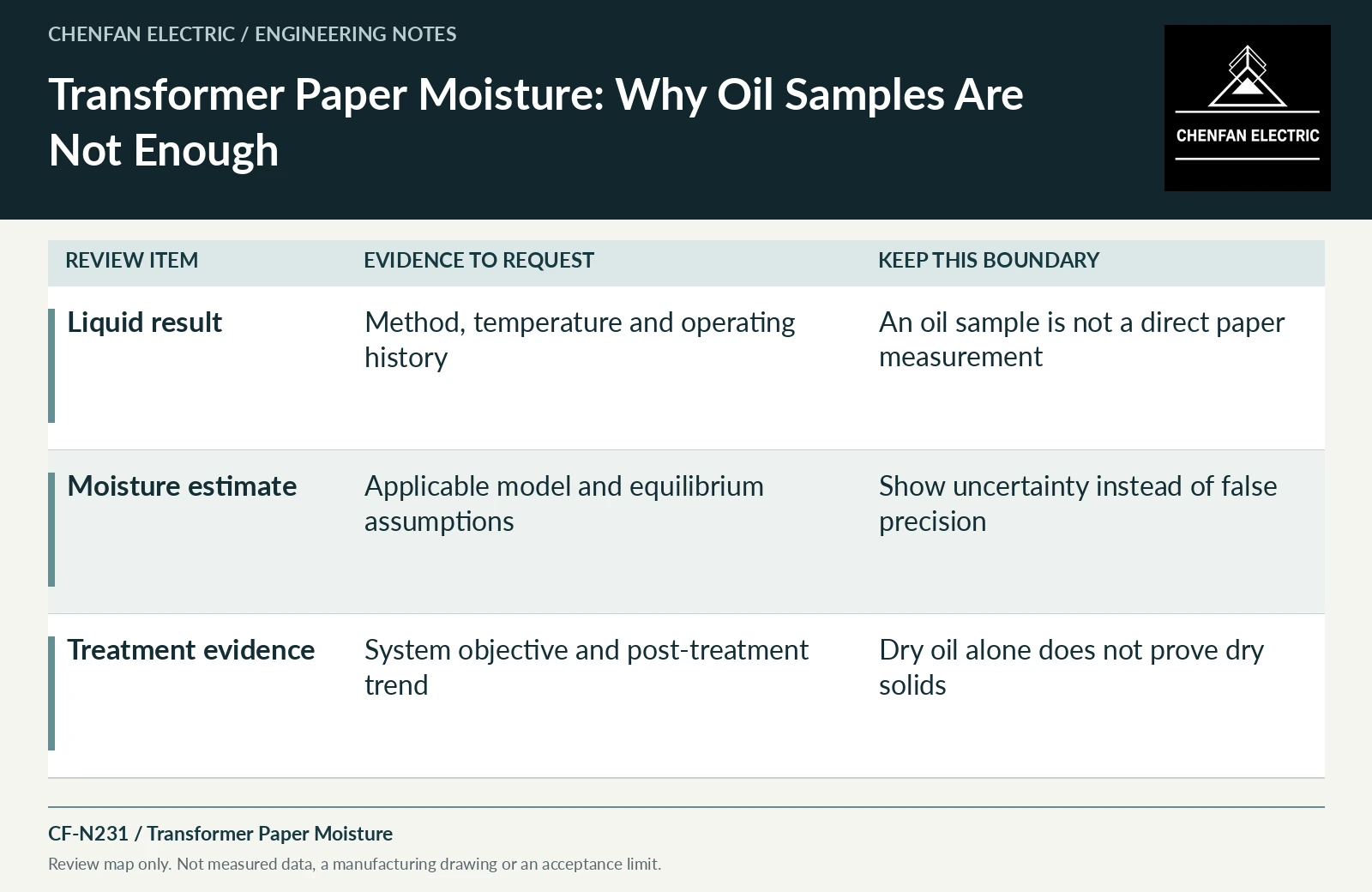
| Liquid result | Method, temperature and operating history | An oil sample is not a direct paper measurement |
| Moisture estimate | Applicable model and equilibrium assumptions | Show uncertainty instead of false precision |
| Treatment evidence | System objective and post-treatment trend | Dry oil alone does not prove dry solids |
References and scope
- IEEE C57.162-2025 — Interpretation of Moisture Related Parameters in Liquid Immersed Transformers and ReactorsPublic standard abstract · Moisture-related interpretation for liquid-immersed transformers; this is not a DGA guide.
- IEEE C57.166-2026 — Acceptance and Maintenance of Insulating Liquids in Transformers and Related EquipmentPublic standard abstract · Acceptance and maintenance of insulating liquids; equipment type, liquid family and compartment must be identified.