


Transformer Core Engineering Notes · CF-N232
When measured by IEC 60450, the reported quantity is the average viscometric degree of polymerization, DPv, of the sampled cellulosic material. It is method-dependent, not a universal chain-length average interchangeable with every other technique. It supports an assessment of paper degradation, but the sample location, material and history must be known. A single DPv result does not directly yield the transformer’s remaining service life.
Location determines the meaning of the result
Paper near a readily accessible lead may have experienced a different temperature from paper at a winding hot spot. Replacement or repair material may also be younger than the original insulation. Record the sample location on the equipment drawing and explain why it was selected. Do not report an accessible sample as the transformer’s worst-case DP unless evidence supports that interpretation. Multiple locations can add context, but sampling must follow an approved maintenance plan.
Separate material condition from a lifetime forecast
A DP result is one indicator of cellulose condition. Translating it into remaining years requires assumptions about future temperature, moisture, oxygen exposure and mechanical duty. Those assumptions are seldom captured by the laboratory result alone. Avoid declaring a fixed remaining life from a single number or applying an end-of-life threshold without the relevant method and engineering context. Transformer serviceability also depends on components and failure mechanisms unrelated to the sampled paper.
Interpret indirect indicators carefully
Oil-based ageing indicators can support condition assessment, but they are not direct measurements of every paper location. Fluid replacement, treatment, insulation type and operating history can affect their interpretation. Where a correlation to DP is used, identify its basis and applicability instead of presenting it as an exact universal conversion. Agreement between several relevant indicators is more useful than a highly precise estimate built from poorly matched assumptions.
Use the result in a documented asset decision
The specialist should combine the sample result with loading history, moisture evidence, fault events and the condition of the rest of the transformer. Record what the sample supports and what remains unknown. This can inform monitoring, refurbishment or replacement planning without promising an exact failure date. Any intrusive investigation must also consider the risk of damaging otherwise serviceable insulation and follow the OEM’s and asset owner’s approved procedures.
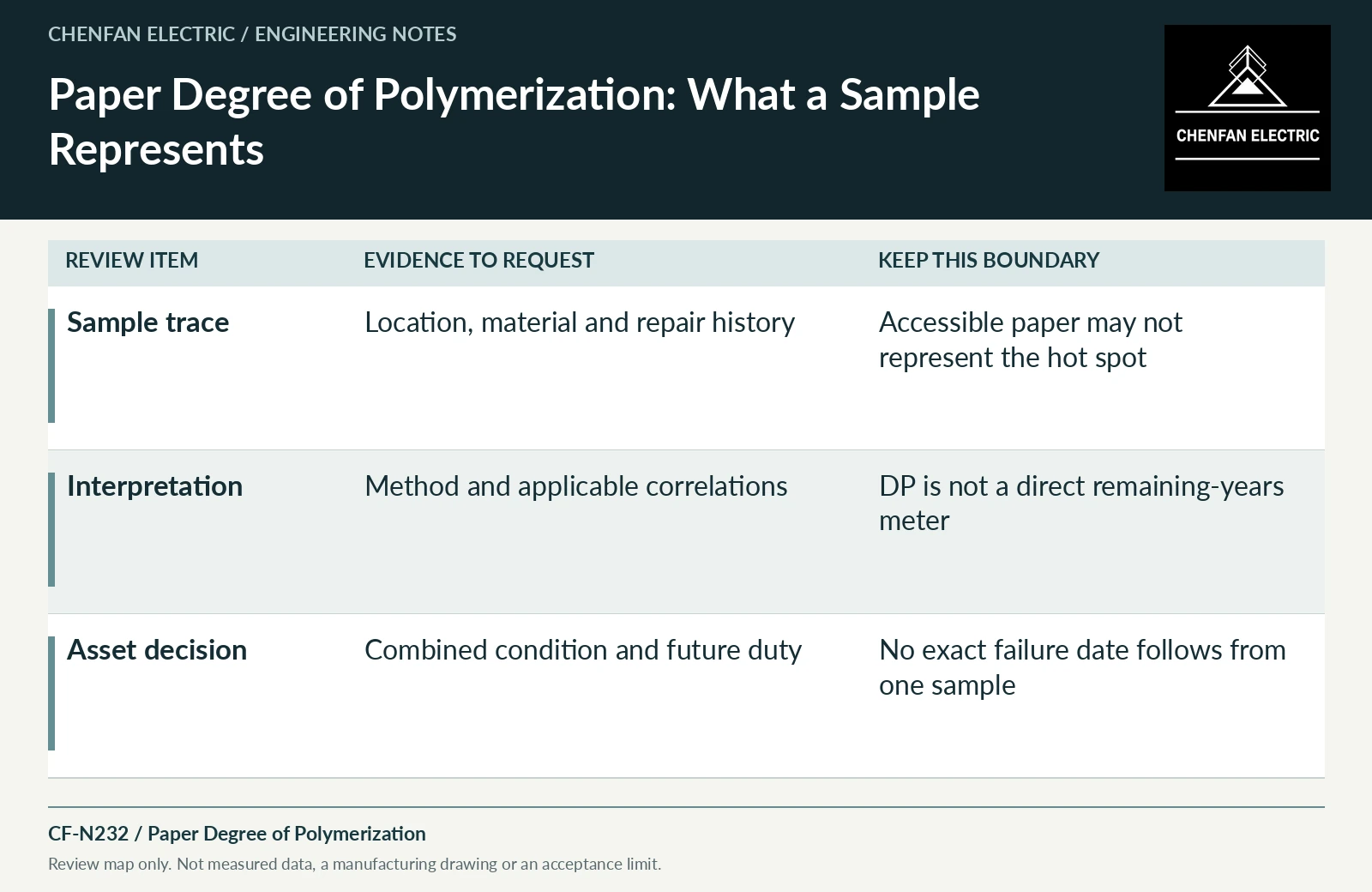
| Review item | Evidence to request | Boundary to preserve |
|---|---|---|
| Sample trace | Location, material and repair history | Accessible paper may not represent the hot spot |
| Interpretation | Method and applicable correlations | DP is not a direct remaining-years meter |
| Asset decision | Combined condition and future duty | No exact failure date follows from one sample |
References and scope
- IEC 60450:2004+AMD1:2007 CSV — Average viscometric DPPublic standard abstract · Measurement of average viscometric degree of polymerization in cellulosic insulation; method-specific sample result, not direct remaining life.
- IEEE C57.100-2022 — Thermal Evaluation of Insulation Systems for Liquid-Immersed TransformersPublic standard abstract · Thermal evaluation of insulation systems for liquid-immersed transformers; not a dry-type qualification reference.
- IEEE C57.91-2025 — Loading Mineral-Oil-Immersed Transformers and Step-Voltage RegulatorsPublic standard abstract · Mineral-oil loading, thermal duty and loading beyond nameplate; do not transfer the scope automatically to ester or dry-type equipment.