

Transformer Core Engineering Notes · CF-N229
Terms such as biodegradable, biobased, non-hazardous and low-carbon describe different claims. None should be treated as a synonym for harmless disposal. A useful environmental comparison identifies the test method, product formulation and system boundary, then considers the actual transformer installation and the response required if liquid is released.
Read biodegradability with its test conditions
A biodegradation result is tied to a method, test medium, time and endpoint. It does not mean that a spill disappears instantly in every soil or water environment. Ask for the report or recognized classification supporting the specific claim, and whether it applies to the supplied formulation. Avoid replacing the test wording with broader advertising language. A product’s biodegradability can be a genuine advantage while spill prevention and recovery remain necessary.
Keep toxicity and hazard classification separate
An aquatic toxicity result, a safety-data-sheet classification and a statement about renewable feedstock answer different questions. Read the applicable exposure conditions and the complete product information. Used transformer liquid may also contain contaminants not represented by a new-fluid test. Consequently, a new product’s environmental statement is not a blanket classification for every drained sample. The asset owner must follow the applicable local handling and disposal requirements for the actual material.
Check the boundary of a carbon comparison
A carbon claim needs a defined functional unit and lifecycle boundary. Comparing the production of one kilogram of fluid is different from comparing a transformer over its operating life. Losses, service duration, replacements and end-of-life assumptions can change the result. Request transparent assumptions rather than a universal percentage saving. Do not attribute an entire transformer-level benefit to its fluid or core when the underlying study assessed a different system.
Turn claims into usable procurement evidence
The tender can request the relevant product reports, safety documentation and any project-specific environmental assessment. Record which claims are verified and which are supplier estimates. The civil and environmental design still needs liquid inventory and release scenarios. Keep the comparison factual: a fluid can offer benefits under defined tests without being described as environmentally risk-free. Any installation or disposal decision must use current local requirements, not a general technical article.
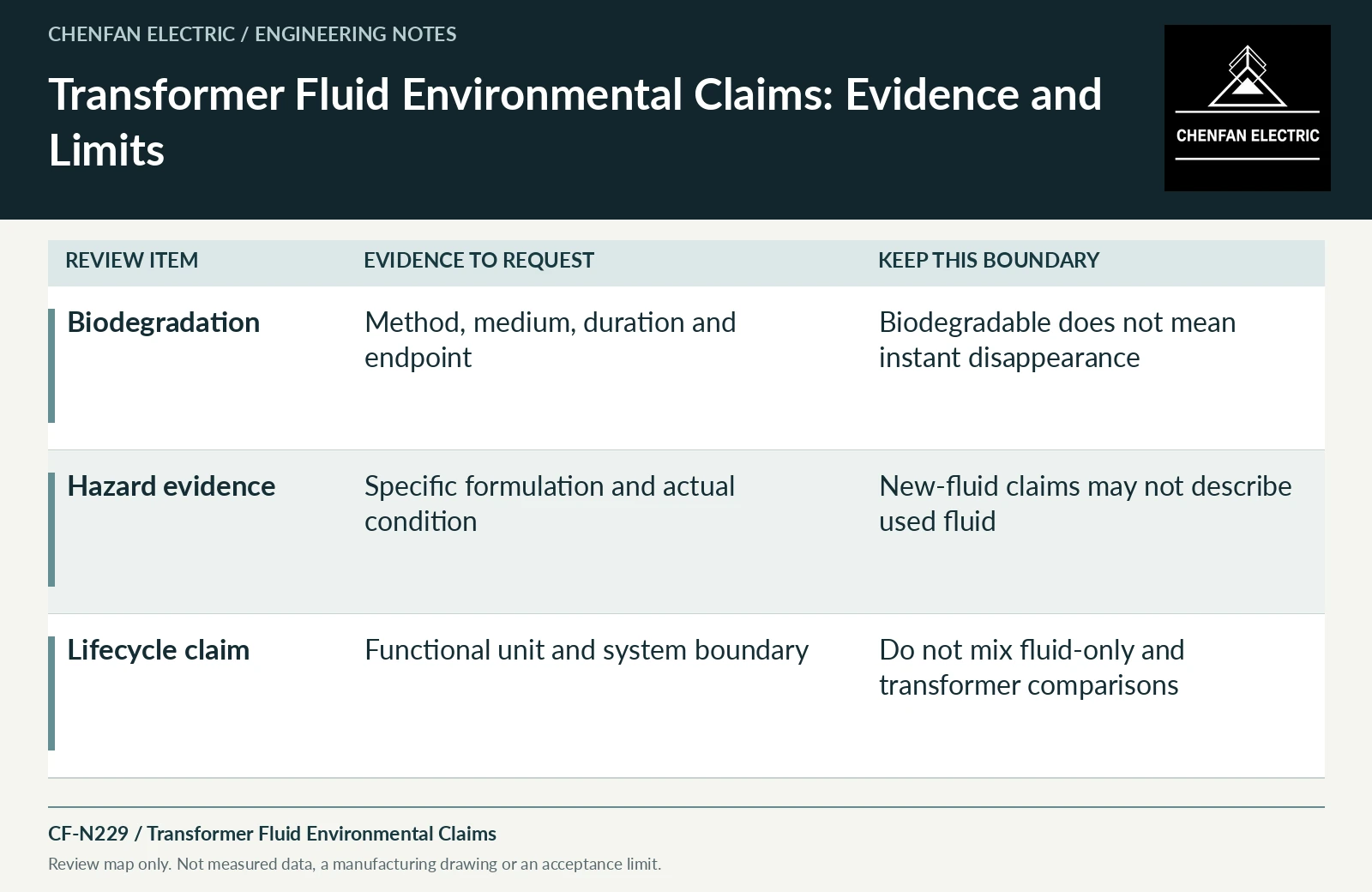
| Review item | Evidence to request | Boundary to preserve |
|---|---|---|
| Biodegradation | Method, medium, duration and endpoint | Biodegradable does not mean instant disappearance |
| Hazard evidence | Specific formulation and actual condition | New-fluid claims may not describe used fluid |
| Lifecycle claim | Functional unit and system boundary | Do not mix fluid-only and transformer comparisons |
References and scope
- FR3 fluid technical detailsManufacturer technical page · Product-specific natural-ester properties and distinction between typical values and acceptance criteria.
- FR3 fluid resource centreManufacturer resource index · Route to the applicable product document for liquid-specific sampling, DGA or environmental substantiation.
- Transformer Fire Protection (FIST 3-32), redacted releaseHistorical technical manual · Fire protection and installation interfaces; local authority and project requirements remain separate.