


Transformer Core Engineering Notes · CF-N233
Thermally upgraded paper is a specified insulation material, not a universal permission to operate a transformer at a higher temperature. Its useful rating depends on the liquid-solid system, qualification evidence and the rest of the equipment. Compare the actual insulation combination and loading requirements before turning a material description into a transformer nameplate claim.
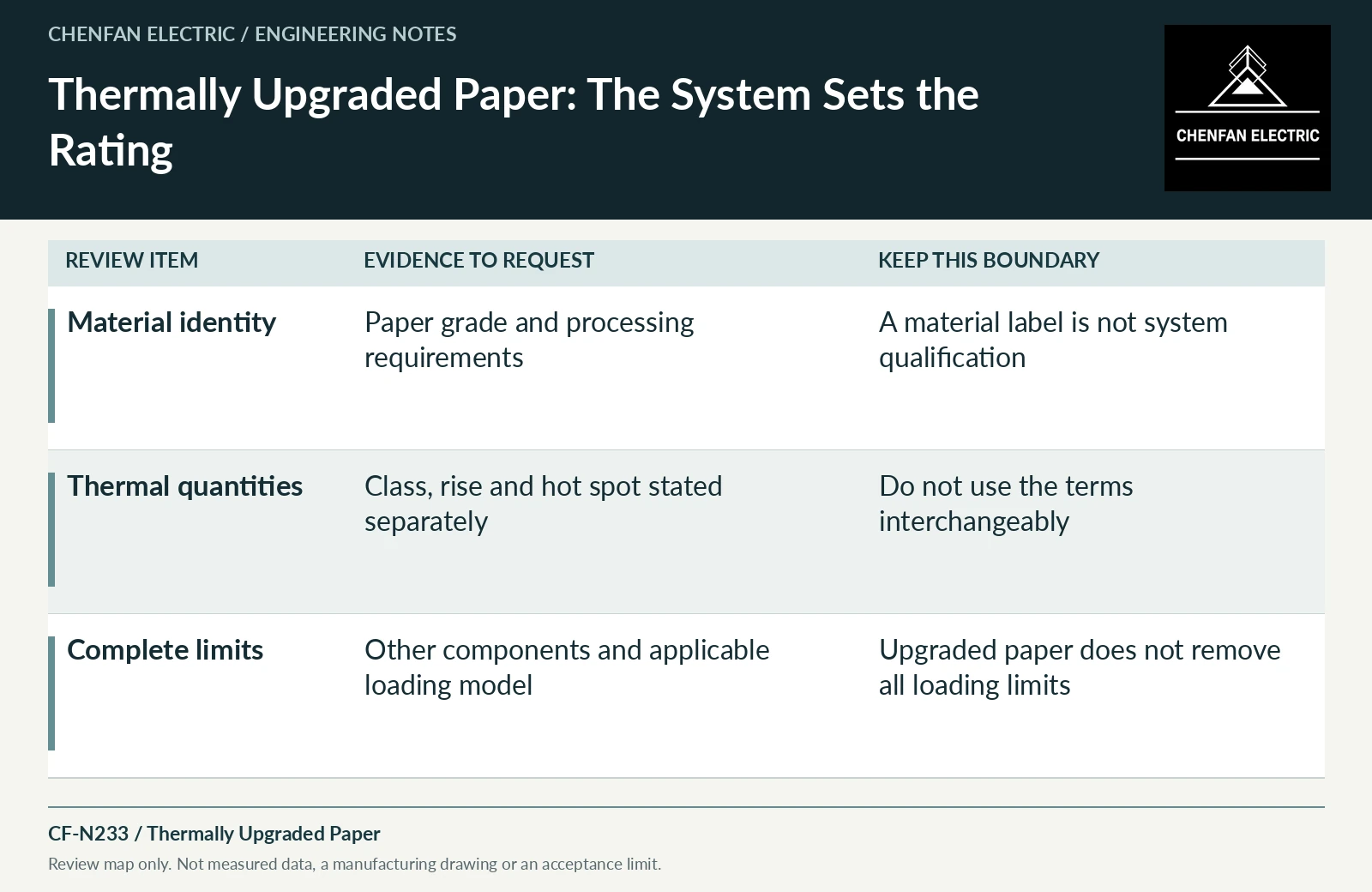
Specify the material and its qualification role
Identify the paper grade, supplier and the manufacturing requirements that preserve its intended properties. Then identify the insulation system in which it has been evaluated. IEEE C57.100 concerns thermal evaluation of liquid-immersed transformer insulation systems; that system emphasis matters. A paper datasheet and a system test report answer different questions. The design documentation should explain how the selected paper, liquid and associated solids are represented by the qualification evidence.
Do not confuse material class with temperature rise
An insulation thermal classification, an average winding temperature rise and a winding hot-spot limit are different quantities. The ambient and cooling conditions also affect the absolute temperatures reached in service. State which quantity appears in each specification and how the OEM applies it. A higher material classification cannot be inserted directly into a temperature-rise guarantee without checking the applicable transformer requirements and the entire insulation arrangement.
Remember components outside the paper system
Bushings, leads, tap-changing equipment, seals and cooling auxiliaries can impose their own limits. Mechanical properties and clamping assumptions also deserve attention when operating temperatures change. Ask which component governs each loading state instead of assuming the paper always governs. A transformer designed around upgraded paper may achieve a different thermal design, but retrofitting that paper into one location does not automatically qualify an otherwise unchanged unit.
Control material and liquid substitutions together
If the liquid or paper grade changes after approval, review whether the existing system evidence still applies. Record the processing requirements and any needed additional qualification. Loading calculations should use the model appropriate to the approved system, with assumptions visible. Avoid a fixed claim such as “upgraded paper adds a stated number of years” unless it is supported by a defined study and clearly limited to that study’s conditions.
| Review item | Evidence to request | Boundary to preserve |
|---|---|---|
| Material identity | Paper grade and processing requirements | A material label is not system qualification |
| Thermal quantities | Class, rise and hot spot stated separately | Do not use the terms interchangeably |
| Complete limits | Other components and applicable loading model | Upgraded paper does not remove all loading limits |
References and scope
- IEEE C57.100-2022 — Thermal Evaluation of Insulation Systems for Liquid-Immersed TransformersPublic standard abstract · Thermal evaluation of insulation systems for liquid-immersed transformers; not a dry-type qualification reference.
- IEC 60076-14:2013 — Liquid-immersed power transformers using high-temperature insulation materialsPublic standard abstract · High-temperature insulation materials in liquid-immersed transformer systems; no automatic dry-type or retrofit rating transfer.
- IEEE C57.91-2025 — Loading Mineral-Oil-Immersed Transformers and Step-Voltage RegulatorsPublic standard abstract · Mineral-oil loading, thermal duty and loading beyond nameplate; do not transfer the scope automatically to ester or dry-type equipment.