

A louder transformer does not tell you which component became a stronger noise source.
The source may have changed. The structure transmitting its vibration may have changed. Both can produce a higher measured sound level.
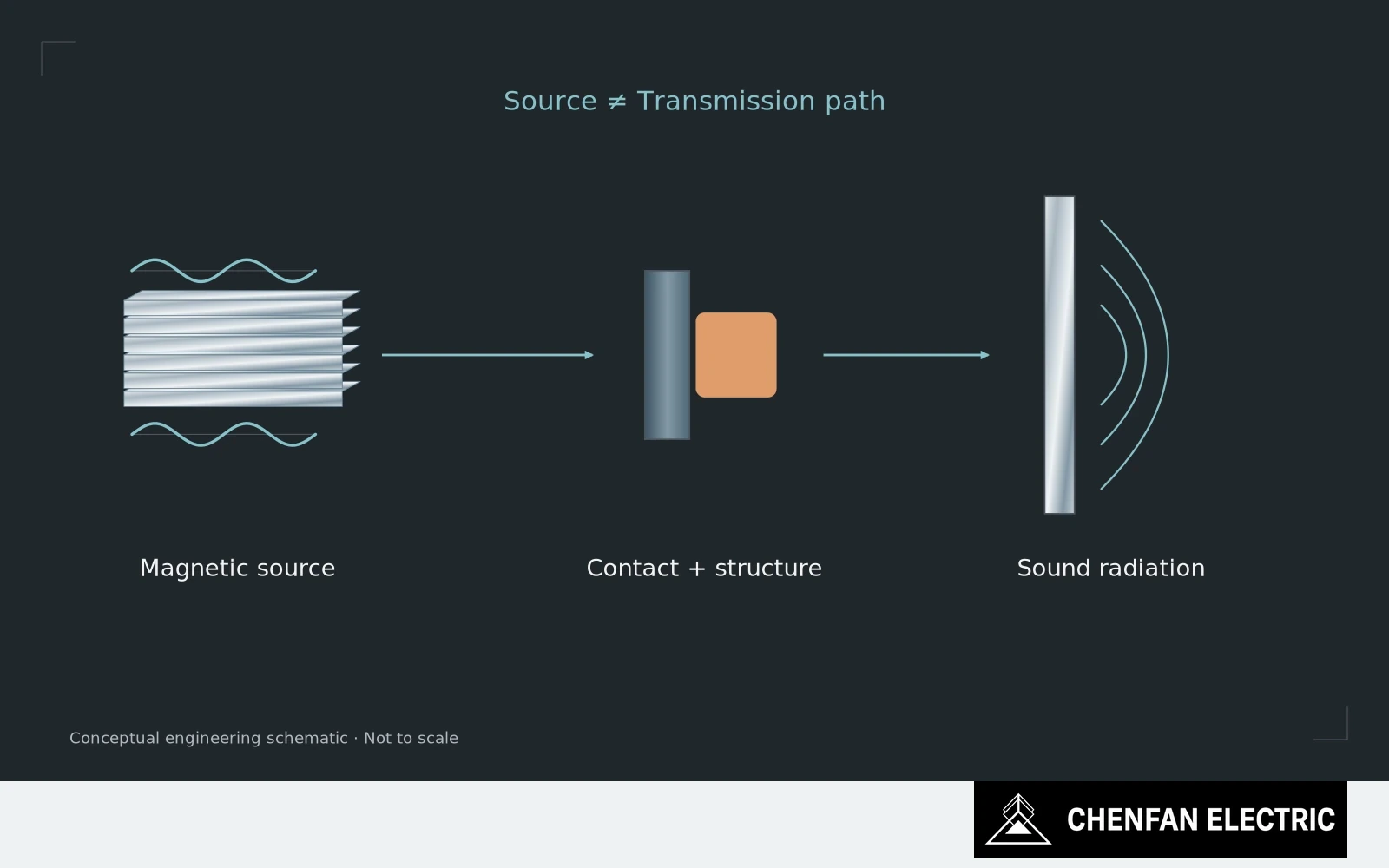
Distinguish magnetostriction from structural response
Magnetostriction gives the core a field-dependent dimensional response. Joint behavior and magnetic forces also contribute to vibration. The assembled structure then determines how that vibration is transmitted and radiated.
This is why a steel’s magnetostriction information is relevant but not sufficient for predicting the sound of a complete transformer. Core geometry, restraint, contact conditions and structural resonances enter the response. The tank and other connected parts can change the radiating system.
A clamping adjustment illustrates the ambiguity. It may alter mechanical movement, contact stiffness and magnetic stress at the same time. A lower sound level after the adjustment does not establish that the material’s intrinsic magnetostriction decreased.
Establish comparable acoustic conditions
Nor is all transformer noise a core-manufacturing issue. Winding forces under load, cooling equipment and other operating sources must be distinguished from the energized no-load condition. Comparing measurements taken in different operating states can send the investigation toward the wrong component.
Begin with a repeatable acoustic comparison: electrical excitation, load state, cooling operation, measurement arrangement and background conditions. Preserve frequency information where it helps distinguish changes, rather than reducing everything immediately to one overall number.
Then connect the acoustic result to structural evidence. Which surfaces or interfaces show changed vibration? Does the change follow excitation, loading or a mechanical configuration? A proposed cause should explain that pattern, not merely be compatible with one sound reading.
Connect the noise pattern to a verified mechanism
Material substitution becomes meaningful after the mechanism is bounded. If the dominant issue is a structural transmission path, buying a different GOES grade may not address it. If a material characteristic is contributing significantly, the comparison should use relevant induction and stress conditions.
Core suppliers can support this work through repeatable assembly and documented restraint states. They should not claim that a low core-loss result guarantees a quiet transformer, or that every noise complaint proves defective laminations.
An acoustic investigation becomes productive when it asks two separate questions: what is exciting the structure, and how is the structure turning that excitation into sound?
Practical takeaway
A sound increase can arise from the source or the structural transmission path.
Chenfan Electric manufactures custom transformer cores according to customer drawings. Where applicable to the specified material and core design, agreed process controls include burr height below 0.02 mm and stacking factor above 97%. Measurement methods and acceptance conditions are defined for each order.