

Neutral surge protection depends first on how the neutral can move during faults and switching. A solidly grounded neutral, resistor-grounded neutral and isolated neutral have very different possible voltages. Before specifying a neutral arrester, define grounding impedance, neutral insulation level, transferred surge paths and whether the neutral can ever be disconnected from ground.
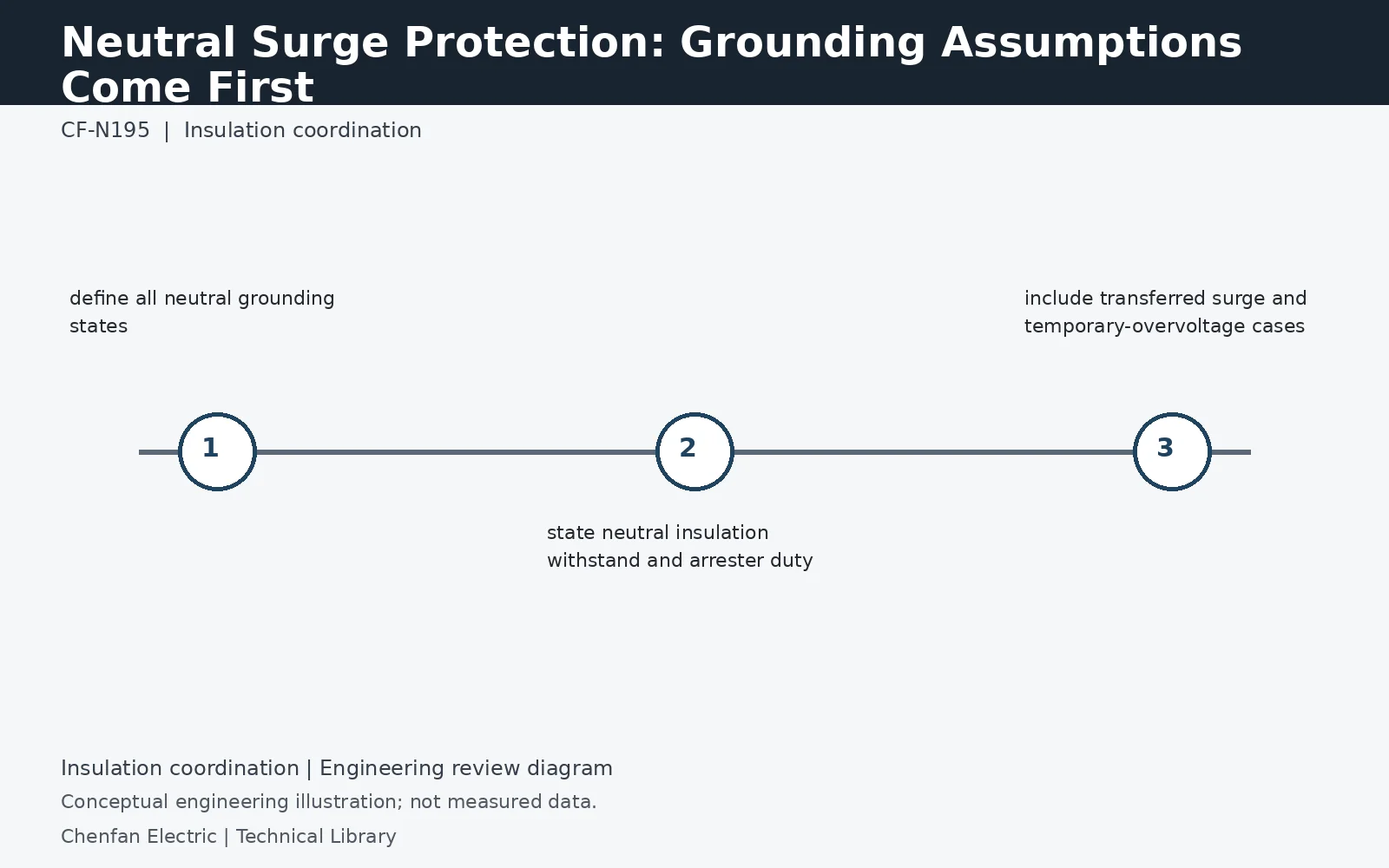
Neutral voltage is determined by the available grounding path
A directly grounded neutral, an impedance-grounded neutral and an isolated neutral do not have the same voltage behavior during faults or switching. Include the condition in which a grounding connection is unavailable if that state is credible. The transformer neutral insulation must be compatible with the resulting voltage-duration envelope. An arrester should not be used to conceal an unapproved assumption that the neutral remains effectively grounded in every operating mode.
Temporary voltage can govern arrester selection
An arrester with an attractive impulse protective level may still be unsuitable if it cannot withstand the neutral's sustained or temporary operating voltage. Evaluate the manufacturer's continuous-voltage, TOV and energy or charge capabilities against the actual system cases. The protection level and survival duty must be satisfied together. There is no universally correct neutral-arrester rating obtained by taking a fixed fraction of the line-terminal arrester voltage.
Include transferred and locally generated surges
Capacitive and inductive coupling between windings, local grounding impedance and connection geometry can influence neutral stress. Request the relevant transformer model or manufacturer assessment where those mechanisms affect the selection. Record the arrester connection point and earth reference, not only its catalogue type. If the station grounding philosophy later changes, reassess both the neutral insulation duty and the protection arrangement rather than assuming the existing device remains adequate.
Technical reference framework
[1] IEC 60071-1:2019 — Insulation co-ordination, Definitions, principles and rules.
[2] IEC 60071-2:2023 — Insulation co-ordination, Application guidelines.
[3] IEC 60076-3:2013 + AMD1:2018 — Insulation levels, dielectric tests and external clearances.