

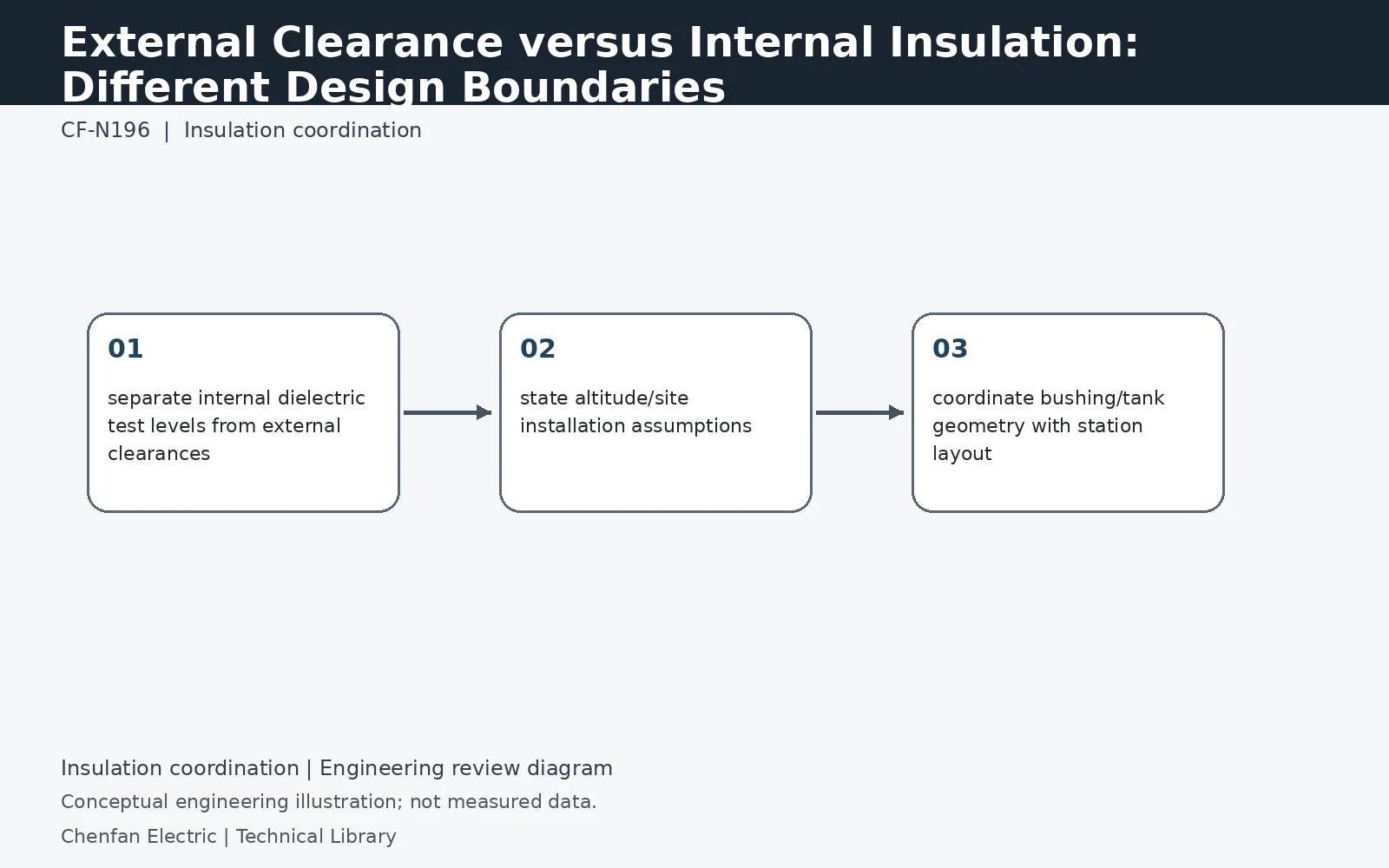
Transformer internal insulation, external air clearance and surface creepage are separate design requirements. Altitude, pollution and installed geometry affect them in different ways. Procurement should keep winding dielectric levels, bushing surface performance and station clearances as distinct acceptance items; satisfying one does not establish the others.
Air clearance and creepage are different dimensions
Air clearance is the shortest relevant distance through air; creepage follows an insulating surface. Altitude affects external air-insulation performance, while pollution and wetting are particularly important to surface insulation and creepage selection. Both also depend on the equipment and test basis. A larger surface creepage distance does not automatically provide the required phase-to-earth air clearance, and one generic “insulation distance” entry cannot replace separate requirements for the two.
Factory geometry is not the complete installed geometry
A transformer supplied with adequate bushing-to-tank spacing can be installed beside buswork, a wall or a cable support that changes the external clearance. Allow for terminal connectors, conductor movement and the actual station arrangement. Allocate responsibility for transformer-mounted and site-provided components and review the assembled layout. The factory dielectric test does not certify clearances to objects that were not present in the tested or approved configuration.
Retain independent internal and external acceptance evidence
Internal winding insulation is addressed through the transformer design and the agreed dielectric tests. External insulation requires the applicable terminal geometry, environmental assumptions and installation checks. Keep these as separate acceptance items, with the governing standards and manufacturer requirements identified. No universal clearance value should be copied into a purchase order without the voltage class, withstand duty, altitude and relevant installation conditions that determine its applicability.
Technical reference framework
[1] IEC 60071-1:2019 — Insulation co-ordination, Definitions, principles and rules.
[2] IEC 60071-2:2023 — Insulation co-ordination, Application guidelines.
[3] IEC 60076-3:2013 + AMD1:2018 — Insulation levels, dielectric tests and external clearances.