


Transformer Core Engineering Notes · CF-N228
Dissolved-gas analysis must be interpreted for the actual insulating liquid and transformer arrangement. An ester-filled unit should not automatically inherit every mineral-oil alarm threshold or gas-ratio interpretation. The gas pattern, its rate of change, the operating history and the sampling boundary need to be considered together before assigning a diagnosis.
Identify the liquid and sampling compartment
Record the exact fluid, whether the unit was retrofilled and any residual or added liquid. Distinguish the main tank from separate tap-changer compartments. Normal switching activity in one compartment can make its gas results inappropriate as a direct comparison with the main insulation system. The laboratory request should identify the compartment and equipment history, not simply state “transformer oil.” This helps prevent a sound measurement from being interpreted using the wrong reference population.
Separate a laboratory result from a fault conclusion
The reported gas concentrations are observations. A fault category is an interpretation that depends on the chosen method and its applicability. Ask the laboratory or diagnostic specialist which ester-specific guidance and product experience support the interpretation. This article does not provide replacement gas thresholds or a universal ratio chart. Where a result is unusual, confirm sample quality and compare it with other electrical, thermal and maintenance evidence rather than naming a fault from one gas alone.
Use trends with a documented baseline
The rate of gas development can be important, but comparisons require consistent sampling and knowledge of fluid processing or replacement. Degassing or retrofilling can reset measured concentrations without proving that an underlying source has disappeared. Record operating load, temperature and recent interventions with the samples. A stable low concentration and a rapidly changing concentration are different situations; neither should be assessed without the asset’s relevant history and monitoring plan.
Define who makes the operational decision
IEEE C57.155-2014 is an ester-specific diagnostic reference, but IEEE lists it as Inactive-Reserved since 27 March 2025. Treat it as historical context, not a current mandatory alarm table. The owner, qualified transformer specialist and fluid supplier should establish the applicable interpretation, follow-up tests and operational decision. Record uncertainty in the mixture and baseline; neither a generic mineral-oil template nor a reassuring gas result alone releases equipment to service.
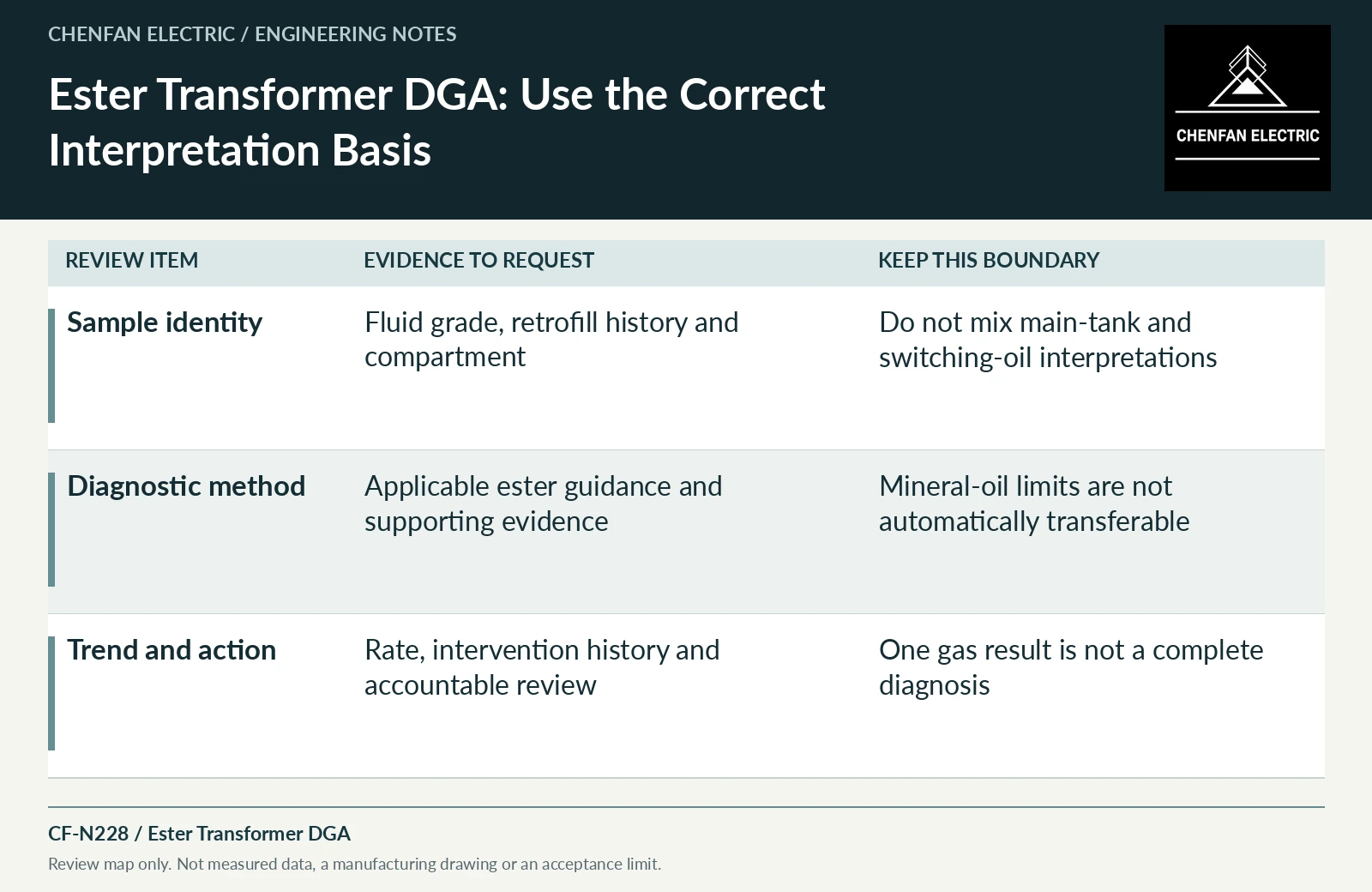
| Review item | Evidence to request | Boundary to preserve |
|---|---|---|
| Sample identity | Fluid grade, retrofill history and compartment | Do not mix main-tank and switching-oil interpretations |
| Diagnostic method | Applicable ester guidance and supporting evidence | Mineral-oil limits are not automatically transferable |
| Trend and action | Rate, intervention history and accountable review | One gas result is not a complete diagnosis |
References and scope
- IEEE C57.166-2026 — Acceptance and Maintenance of Insulating Liquids in Transformers and Related EquipmentPublic standard abstract · Acceptance and maintenance of insulating liquids; equipment type, liquid family and compartment must be identified.
- IEEE C57.155-2014 — Ester DGA guide [Inactive-Reserved]Historical standard catalogue · Historical ester-specific gas-interpretation context. Official status: Inactive-Reserved since 27 March 2025; not a current mandatory alarm table.