

An average stress of zero can describe a lamination whose two faces are under opposite stresses. In simple bending, one face is stretched and the other compressed. If magnetic response depends nonlinearly on stress and material direction, replacing that distribution with its average can remove the very effect being investigated.
The useful comparison is between a known uniform stress state and a known gradient state. Identify what is held constant: average stress, surface strain, curvature or total mechanical energy. Matching one of those quantities does not make the states mechanically equivalent.
A small-bending illustration
For a thin sheet in an idealized, linear elastic beam condition, use sigma(z) = E_r kappa z. Here sigma is longitudinal stress in pascals, E_r is the relevant directional elastic modulus in pascals, kappa is curvature in inverse metres, and z is distance in metres from the neutral surface.
For a symmetric sheet of thickness t with the neutral surface at its midplane, the mean of this stress distribution is zero and the face stresses are ±E_r kappa t/2. This illustration assumes small deformation, a suitable beam geometry and no additional membrane stress. It is not a universal model of a clamped or jointed lamination.
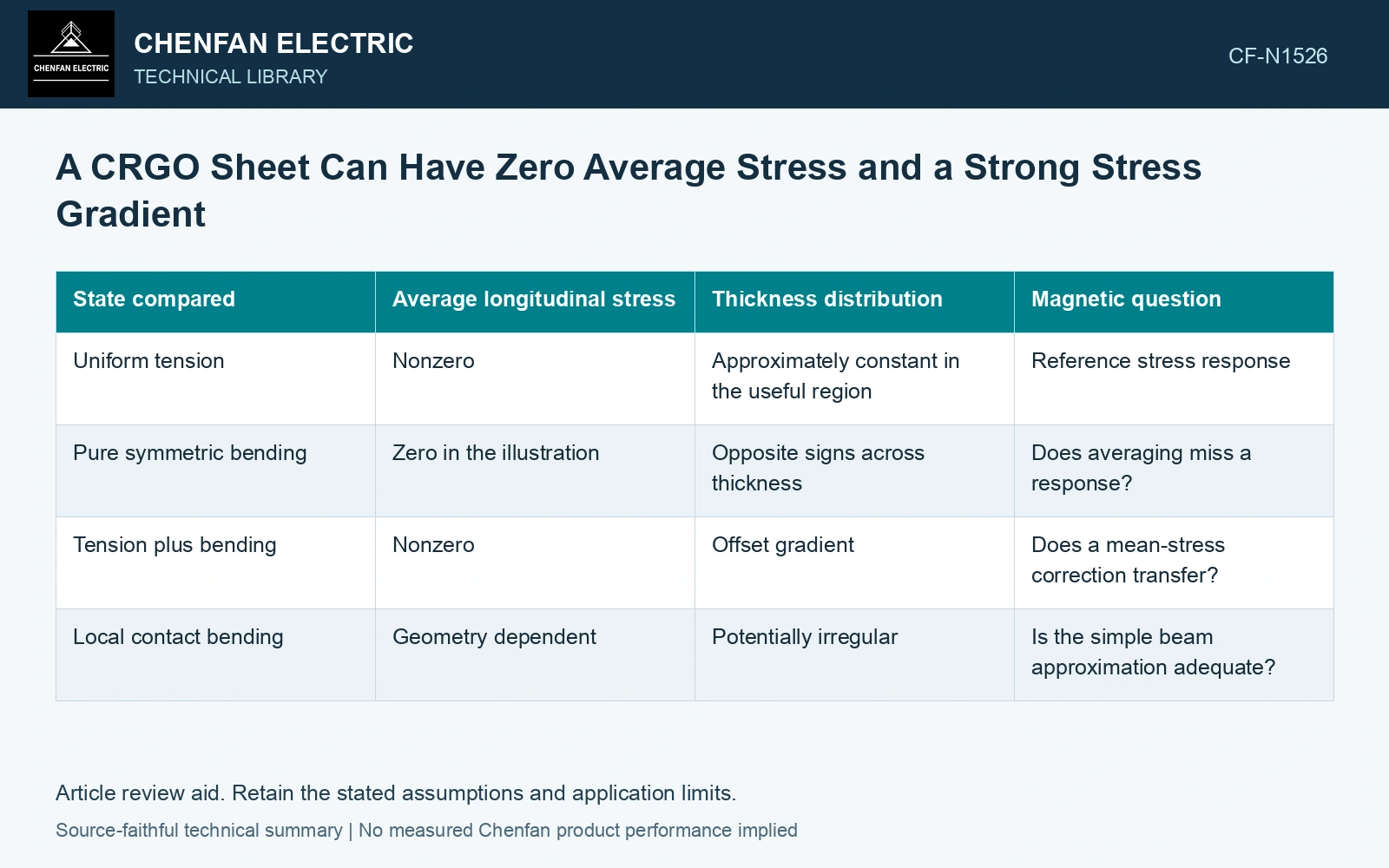
| State compared | Average longitudinal stress | Thickness distribution | Magnetic question |
|---|---|---|---|
| Uniform tension | Nonzero | Approximately constant in the useful region | Reference stress response |
| Pure symmetric bending | Zero in the illustration | Opposite signs across thickness | Does averaging miss a response? |
| Tension plus bending | Nonzero | Offset gradient | Does a mean-stress correction transfer? |
| Local contact bending | Geometry dependent | Potentially irregular | Is the simple beam approximation adequate? |
The table makes the model boundary explicit. A local contact can create a distribution very different from the ideal linear gradient.
Verify the two-face strain condition
Measure opposite-face strains where practical and determine whether the intended curvature and membrane contribution are present. A single surface strain does not identify both. Temperature-induced curvature and fixture eccentricity should also be considered.
Map the region sampled magnetically relative to the mechanical measurement. A tester that includes unstressed ends may dilute the response of the bent central section. The magnetic field itself may also be nonuniform after geometry changes.
Test the averaging assumption
Compare measured magnetic behavior with a model that uses only mean stress and with a justified distribution-aware representation. Keep excitation, magnetic preparation and temperature consistent. If material response is nonlinear, evaluating it at average stress generally need not equal averaging its local responses.
A gradient-aware model still requires validation because layers, field distribution and local coupling may prevent simple independent-slice averaging. The first result should establish whether the uniform-stress approximation is sufficient for the chosen geometry and operating condition. If it is not, the measured two-face strain record identifies the missing mechanical information that the magnetic model must retain.
Technical references
- Materials / MDPI. Magnetostrictive Properties of the Grain-Oriented Silicon Steel Sheet under DC-Biased and Multisinusoidal Magnetizations.
- NIST. NCAL: Diffraction Stress Measurement Under Applied Load.