

A measured magnetic loop describes the specimen’s bulk response to a defined excitation. It does not show every domain wall or reveal uniquely whether a change arose from wall displacement, wall bowing, rotation, or a combination. A plausible microscopic explanation becomes stronger when another observation discriminates it from competing explanations.
For highly oriented steel, direction matters. Record the applied field or magnetization relative to rolling direction, the material condition, mechanical restraint and magnetic history. A mechanism inferred from one directional trial should not be transferred to a joint region where the local magnetic direction changes.
Use excitation intervals as test regions
Divide the measured range into intervals selected from the actual response and research question. Do not impose a universal field value at which every GOES specimen switches from one mechanism to another. Several processes can coexist, and specimen condition can influence their relative contributions.
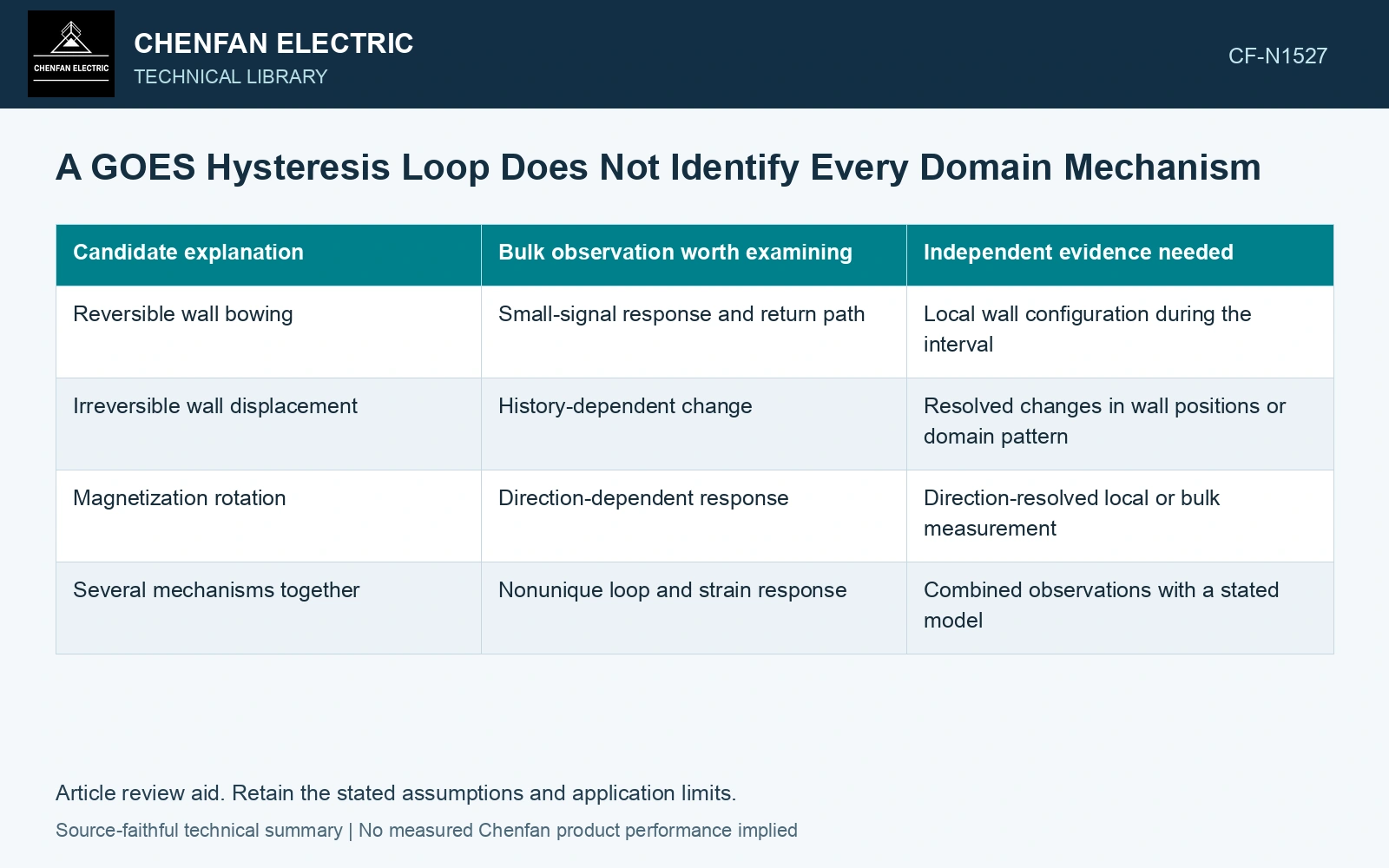
At each interval, identify what the proposed explanation predicts. For example, a wall-motion hypothesis should connect to observable changes in wall configuration where a suitable imaging method is available. A rotation hypothesis requires directional information; a scalar bulk trace alone is weak evidence.
| Candidate explanation | Bulk observation worth examining | Independent evidence needed |
|---|---|---|
| Reversible wall bowing | Small-signal response and return path | Local wall configuration during the interval |
| Irreversible wall displacement | History-dependent change | Resolved changes in wall positions or domain pattern |
| Magnetization rotation | Direction-dependent response | Direction-resolved local or bulk measurement |
| Several mechanisms together | Nonunique loop and strain response | Combined observations with a stated model |
The observations are investigative clues, not one-to-one diagnostic rules. Apparatus response and local sampling can also affect what is seen.
Make local and bulk measurements comparable
An imaged surface region may not represent the entire magnetically measured volume. State its location, orientation and field history. If surface preparation is required for imaging, consider whether that preparation changes coating tension, roughness or the domain state being studied.
Use matched specimens or a demonstrated same-specimen sequence when combining magnetic loops, magnetostriction and imaging. Each method should share the relevant excitation conditions. Otherwise apparently inconsistent results may reflect different histories rather than competing physical mechanisms.
Reject explanations that predict nothing distinct
A model can fit a curve with parameters labeled wall motion and rotation while those contributions remain unidentifiable from the chosen data. Test it against an independent orientation or excitation history that changes their predicted contributions differently.
Report a mechanism as supported, unresolved or inconsistent with the observations. The unresolved category is useful: it identifies which measurement would narrow the explanation. For transformer-core applications, this prevents a local material hypothesis from becoming an unsupported claim about the entire core’s loss or noise.
The practical outcome is an excitation-and-evidence matrix that tells the researcher where a microscopic interpretation is discriminated and where it remains a model choice. That is more informative than naming one process for every bend in a hysteresis loop.
Technical references
- Materials / MDPI. Magnetostrictive Properties of the Grain-Oriented Silicon Steel Sheet under DC-Biased and Multisinusoidal Magnetizations.
- NIST. NCAL: Diffraction Stress Measurement Under Applied Load.