

Transformer kVA should be calculated from the loads that can operate together, with power factor applied once to each relevant electrical input. For sinusoidal loads with different power factors, combine real and reactive power before finding total apparent power. Keep connected capacity, simultaneous demand and the final rating allowance as separate figures.
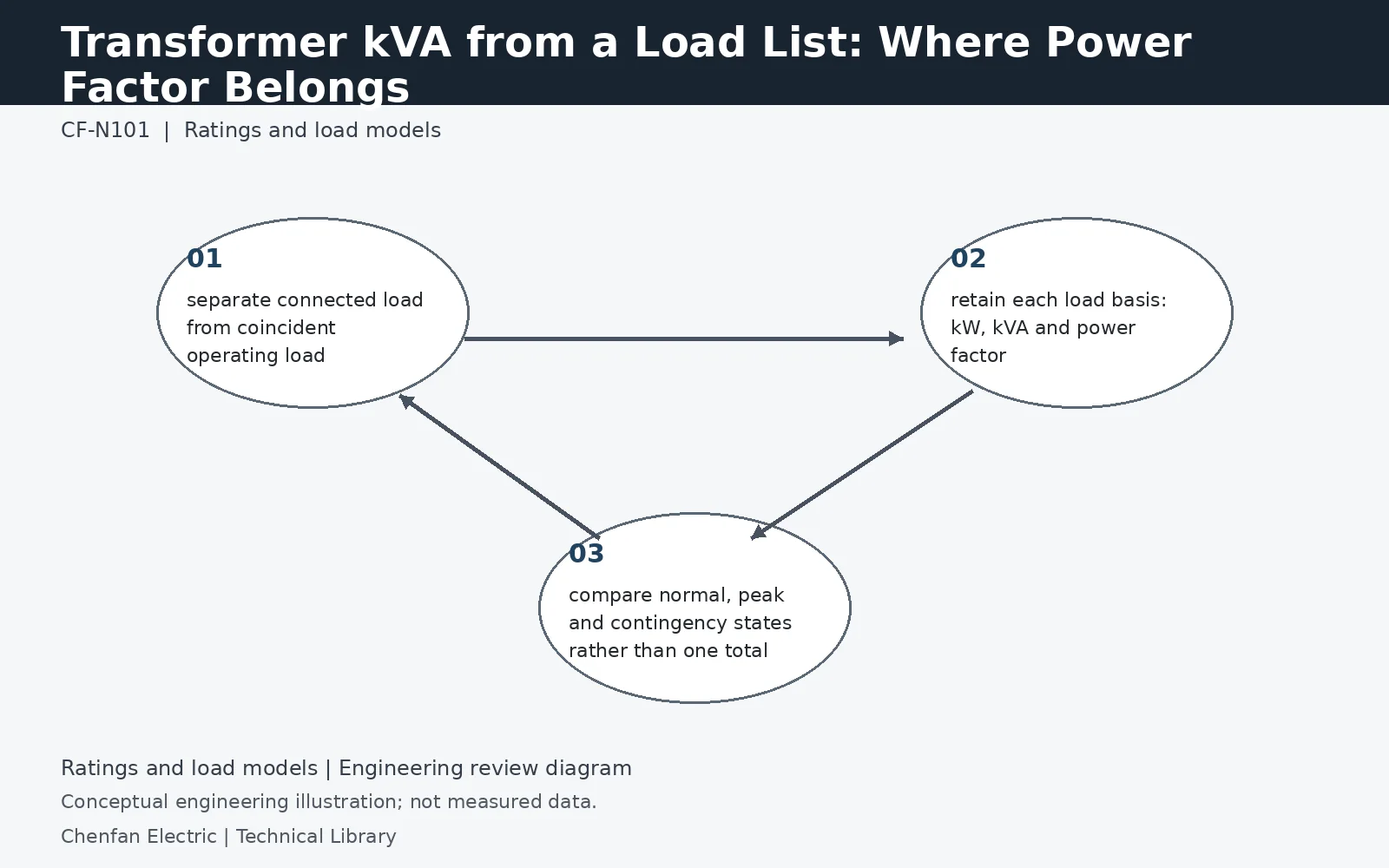
Keep electrical input separate from shaft output
Record whether each kW entry is electrical input or motor shaft output. A motor's shaft rating must first be divided by the applicable efficiency to estimate input kW; power factor then converts that electrical input to kVA. Use operating-point data rather than assuming rated efficiency and power factor remain unchanged at light load. Loads already specified in input kVA do not need another power-factor conversion. Keep the supply voltage, phase allocation and operating duration alongside the power entries so the load list can also support current and thermal checks.
A worked load combination, not a blanket multiplier
Assume two simultaneous, balanced sinusoidal loads: 120 kW at 0.80 lagging power factor and 80 kW at unity power factor. The first draws 150 kVA and 90 kvar; the second draws 80 kVA and zero kvar. Their combined demand is sqrt(200² + 90²) = 219.3 kVA, not 230 kVA. Adding individual kVA magnitudes gives a conservative arithmetic sum here; adding real and reactive power gives the aggregate. Dividing either result by 0.80 again would be incorrect. These are illustrative inputs, not a transformer selection.
Convert the demand into a purchase requirement
Calculate normal production, peak coincidence and the required contingency case separately. Add committed future loads as identifiable entries, not as an unexplained percentage that may duplicate another allowance. Then check the limiting phase current, harmonic heating, ambient conditions, cooling availability and motor-start voltage dip. The selected nameplate rating should refer to the governing case and its duration. A load-list total alone cannot establish emergency overload capability, and a larger transformer may change fault duty as well as available capacity.
Technical reference framework
[1] IEC 60076-1:2011 — Power transformers, General.
[2] IEC 60076-8:1997 — Application guide.
[3] Schneider Electric — Estimation of actual maximum kVA demand.