

Load reductions are valid only when their definitions and aggregation levels are visible. Demand factor, diversity factor and coincidence factor are not interchangeable. A feeder-level adjustment and a group-level adjustment can both be justified, but the same reduction in simultaneous demand must not be counted twice.
Three factors with different denominators
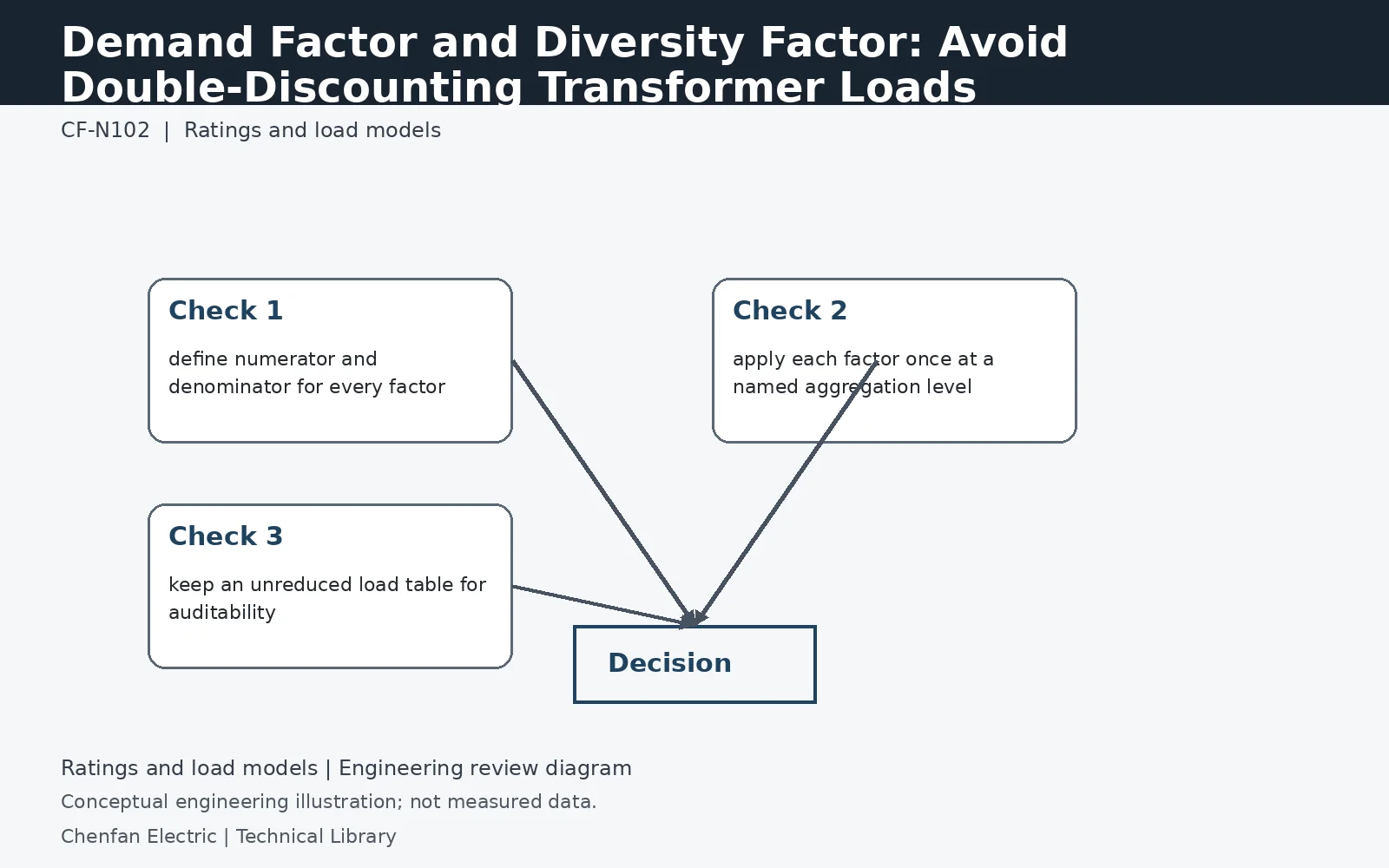
Demand factor is maximum demand divided by connected load on the stated basis. Diversity factor is the sum of individual maximum demands divided by the group's coincident maximum demand; under that definition it is at least one. Coincidence factor is its reciprocal and is at most one. Some project documents use “diversity” to mean coincidence. A factor labelled 0.7 is therefore not self-explanatory. Write the numerator, denominator, measurement interval and applicable load group next to the factor before using it.
Trace a 500 kW example through each level
Suppose connected load is 500 kW and separately established feeder maxima sum to 400 kW. If the measured simultaneous group maximum is 300 kW, group coincidence is 300/400 = 0.75 and diversity is 400/300 = 1.333. The overall demand factor is already 300/500 = 0.60. Applying 0.75 again to that 300 kW would produce 225 kW and count the same coincidence twice. The example assumes consistent real-power records over comparable periods; it does not establish a general factor for an industrial plant.
Do not discount a mandatory operating state
A production interlock can justify excluding mutually exclusive machines; an expectation that operators “usually” avoid coincidence is weaker evidence. Emergency ventilation, restoration loads and committed expansion may have different coincidence from routine production. Preserve the unreduced equipment list and show every adjustment in a separate column, with measured data or operating logic as support. Recalculate the group when operating schedules change. Power factor conversion should remain a distinct operation rather than being hidden inside a demand or diversity percentage.
Technical reference framework
[1] IEC 60076-1:2011 — Power transformers, General.
[2] IEC 60076-8:1997 — Application guide.
[3] Schneider Electric — Estimation of actual maximum kVA demand.